
Key Takeaways
- German student mobility abroad is heavily concentrated in Europe and neighbouring countries.
- Austria is the leading study destination. It hosted 38,178 German tertiary students in 2023.
- German tertiary students abroad show a preference for proximity and low-friction study conditions.
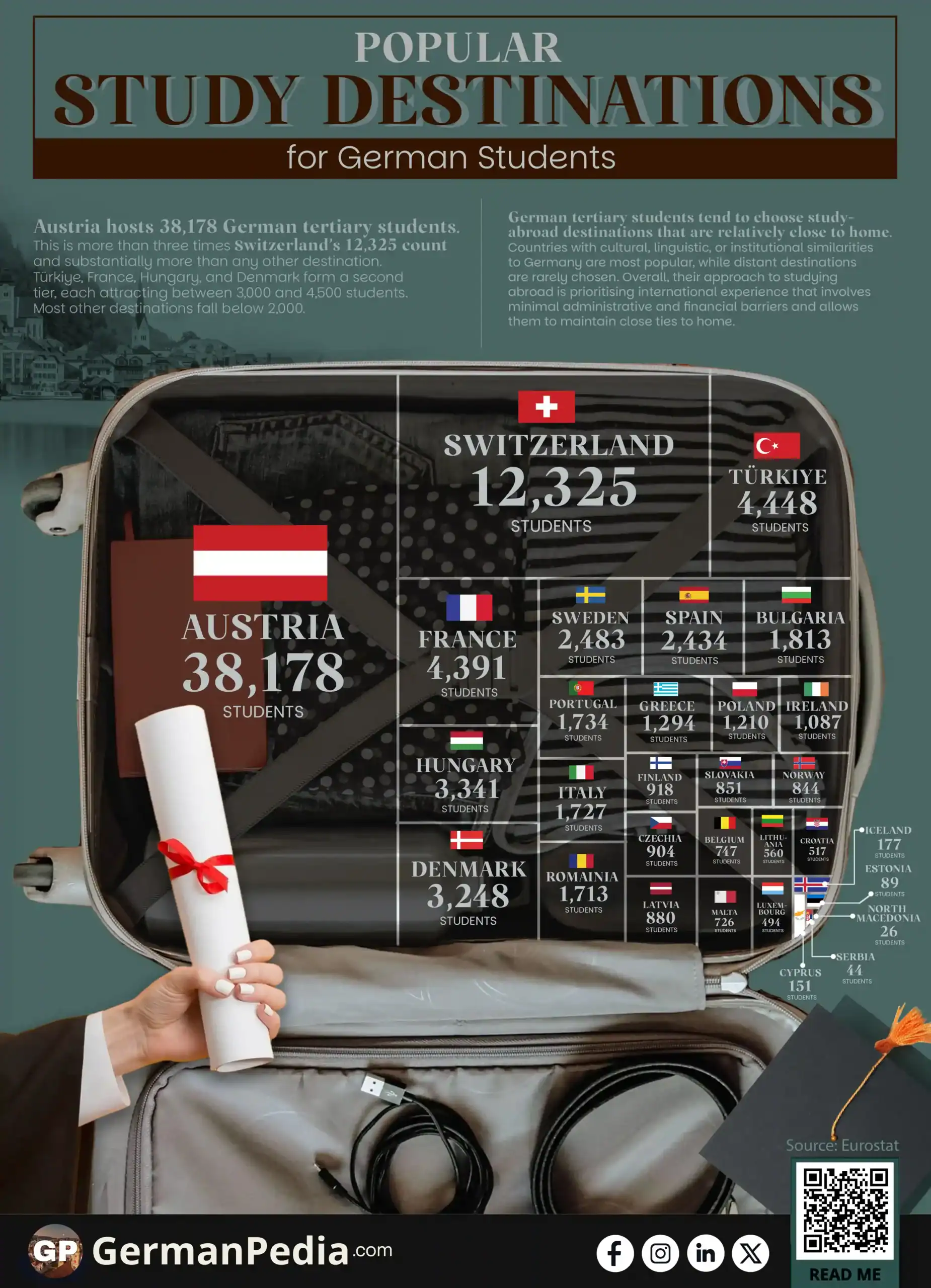
Use this Visualization: You may use this image for free with proper attribution to GermanPedia (i.e., by linking back to GermanPedia).
Top Destinations for German Students Studying Abroad
| Destination country | Number of students |
|---|---|
| Austria | 38,178 |
| Switzerland* | 12,325 |
| Türkiye | 4,448 |
| France** | 4,391 |
| Hungary | 3,341 |
| Denmark | 3,248 |
| Sweden | 2,483 |
| Spain | 2,434 |
| Bulgaria* | 1,813 |
| Portugal | 1,734 |
| Italy | 1,727 |
| Romania | 1,713 |
| Greece | 1,294 |
| Poland | 1,210 |
| Ireland | 1,087 |
| Finland | 918 |
| Czechia | 904 |
| Latvia | 880 |
| Slovakia | 851 |
| Norway | 844 |
| Belgium | 747 |
| Malta | 726 |
| Lithuania | 560 |
| Croatia | 517 |
| Luxembourg | 494 |
| Iceland | 177 |
| Cyprus | 151 |
| Estonia | 89 |
| Serbia | 44 |
| North Macedonia | 26 |
Source: Eurostat
*Value based on a national definition that differs from the standard Eurostat definition
**Break in time series and a definition that differs from the standard Eurostat definition

German tertiary students studying abroad aren’t casting a wide net. They’re sticking close to home.
Austria hosted 38,178 German tertiary students in 2023. This is more than three times Switzerland’s 12,325 count and substantially more than any other destination. Türkiye, France, Hungary, and Denmark form a second tier. Each of them attracted between 3,000 and 4,500 students. Most other destinations fall below 2,000.
There are also destinations which show no figures or missing data for 2023, which reflects reporting gaps rather than zero enrolment. Netherlands, the United Kingdom, and the United States, for example, are part of Destatis’ leading destination countries for German students studying abroad. However, they do not have available data in Eurostat’s table.
Overall, the distribution remains highly uneven. A small number of countries host most German mobile students, while the others trail further behind.
Why is Austria the Leading Destination for German Students?
Austria didn’t become German students’ top destination by accident. It combines nearly every advantage German students seek:
Language and Communication
German is the primary language of instruction and administration at Austrian universities. Students can study, handle bureaucracy, and navigate daily life without language barriers.
Academic Compatibility
Austria’s higher education system uses the same Bologna degree structure and ECTS credit system as Germany. This makes qualification recognition and credit transfer straightforward with minimal bureaucracy.
Logistics and Access
EU freedom of movement eliminates visa requirements and simplifies residency procedures, while Austria’s direct border with Germany enables fast and affordable travel, as well as regular visits home.
Financial Reality
Public universities in Austria charge no tuition or only modest fees for EU/EEA students, keeping overall costs well below long-distance destinations like the UK or the US.
The bigger picture?
The pattern is clear: proximity plays a major role. German tertiary students overwhelmingly select destinations that are easy to reach and allow them to stay relatively close to home, indicating a strong preference for accessible European study options.
Countries with cultural, linguistic, or institutional similarities to Germany also dominate the rankings, while more distant or complex destinations remain less visible or absent in this dataset.
Overall, German students approach studying abroad pragmatically. They are seeking international experience within frameworks that minimise administrative and financial friction while maintaining close connections to home.
More topics
- Highest Paying Jobs in Germany
- Popular Study Destinations for German Students
- Educational Attainment in European Countries
- Grocery Prices in Germany Have Increased Since 2000
- Germany’s Smoking Rate Has Declined Over Two Decades
- Germany’s Electricity Mix: From Coal to Renewables
- Changes in Harvest of Germany’s Five Key Crops
- Top German Companies by Revenue
- Germany’s Top Car Brands by New Registrations
- Unemployment Across Germany: A Federal State Breakdown
- Where Germany’s Tourists Come From
- Germany’s Largest National Parks, Ranked by Size
- Which Federal States Drive Germany’s Economy?
- How Marriage Rates Have Fallen in Germany: 1990–2023
- Leading Causes of Death in Germany