
Key Takeaways
- Automotive companies dominate Germany’s revenue rankings, with Volkswagen, BMW, and Mercedes-Benz leading the list.
- Retail giant Schwarz Group is the second-largest Germany-based company by revenue, at approximately $208.6 billion.
- There is a variety of sectors on the list, but on a smaller scale. The list includes companies from the energy, telecommunications, insurance, logistics, and retail sectors.
- Concentration brings both stability and risk. When the automotive industry faces disruption, a large share of Germany’s economic power is affected at once.
Use this Visualization: You may use this image for free with proper attribution to GermanPedia (i.e., by linking back to GermanPedia).
Despite years of discussion about digitalization and economic diversification, Germany’s largest companies tell a familiar story. Cars still sit at the core of the economy.
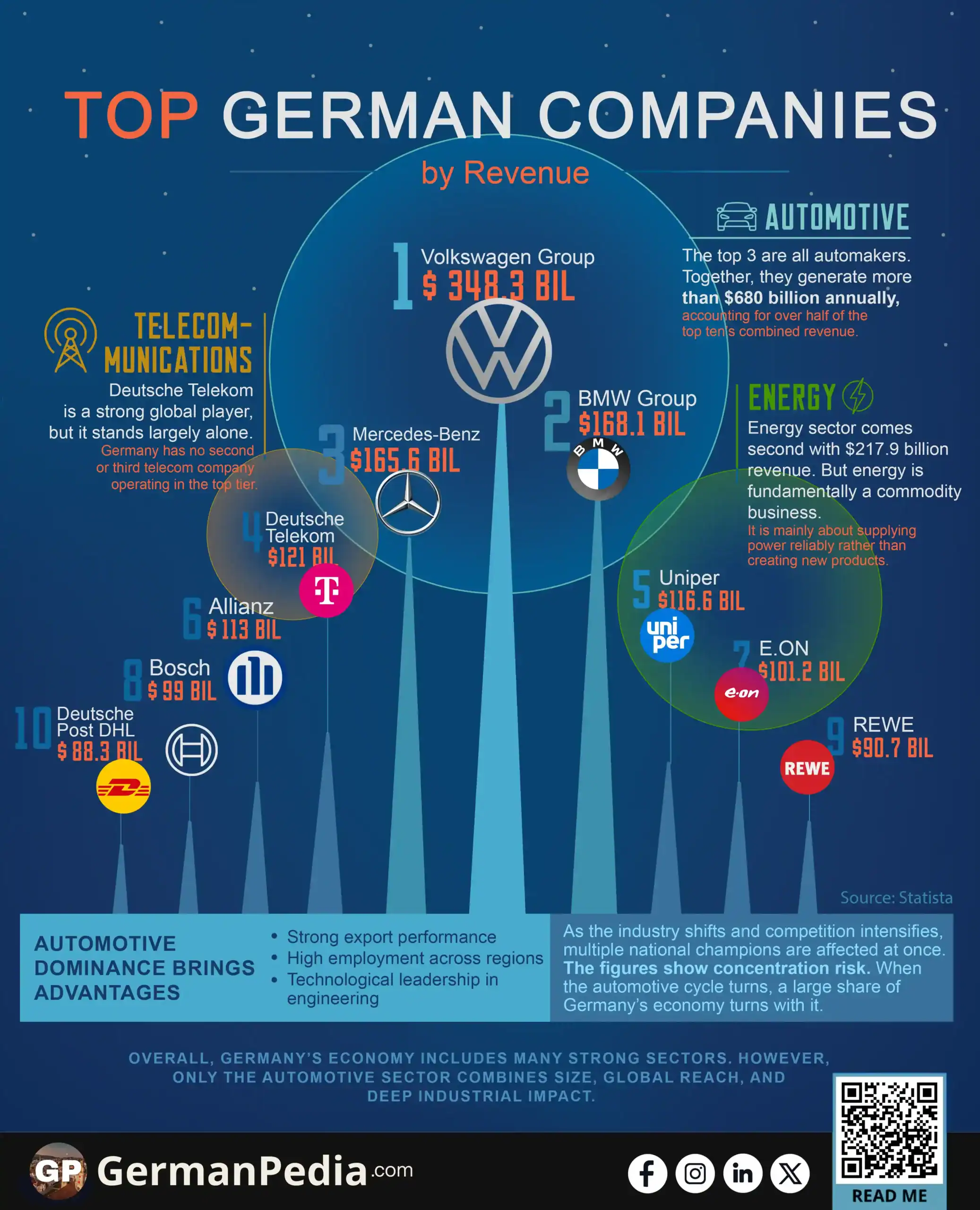
Among Germany’s top 10 companies by revenue, the top three are all automakers. Together, they generate more than $680 billion annually. That accounts for over half of the top ten’s combined revenue.
Germany’s Top Companies by Revenue
| Rank | Company | Industry | Revenue (in billion USD) |
|---|---|---|---|
| 1 | Volkswagen Group | Automotive | 348.31 |
| 2 | Schwarz Group | Food Retail | Approx. 207 (€175.4 billion) |
| 3 | BMW Group | Automotive | 168.10 |
| 4 | Mercedes-Benz Group | Automotive | 165.64 |
| 5 | Deutsche Telekom | Telecommunications | 121.05 |
| 6 | Uniper | Energy | 116.66 |
| 7 | Allianz | Insurance | 113.52 |
| 8 | E.ON | Energy | 101.28 |
| 9 | Bosch | Industrial Engineering | 99.02 |
| 10 | REWE Group | Retail & Wholesale | 90.79 |
| 11 | Deutsche Post DHL Group | Logistics | 88.39 |
Source: Statista, Schwarz Group

A Revenue Concentration That Cuts Both Ways
Automotive dominance brings clear advantages:
- strong export performance
- high employment across regions
- technological leadership in engineering
What are the top car brands in Germany? ->
However, it also creates exposure.
As the industry undergoes major shifts, from the move toward electric vehicles to intensifying global competition and recurring supply-chain disruptions, multiple national champions are affected at the same time.
The revenue figures signal not only strength but also concentration risk: when the automotive cycle turns, a large share of Germany’s economic weight moves with it.
How Other Sectors’ Revenues Compare
Other industries appear in the list of Germany’s largest companies, but none approach automotive scale or concentration:
Retail
Schwarz Group (approximately $207 billion in revenue) is also part of Germany’s largest companies by turnover. They are the owners of retail giants Lidl and Kaufland. Their revenues form a major non-automotive pillar of the economy.
However, retail leadership is concentrated in a single group rather than spread across multiple top-tier firms.
Telecommunications
Deutsche Telekom ($121.05bn) is a strong global player, but it stands largely alone. Germany has no second or third telecom company operating in the top tier.
How to find the best internet provider in Germany? ->
How to fix slow internet in Germany? ->
Is fiber optic internet available in Germany ->
Energy
Uniper ($116.66bn) and E.ON ($101.28bn) rank second with combined revenue of $217.9bn. But energy is fundamentally a commodity business. It is mainly about supplying power reliably rather than creating new products.
Insurance
Allianz ($113.52bn) is globally competitive, but insurance is about risk management rather than building physical goods. Its economic impact is significant, yet less visible in production and supply chains.
Best Private Health Insurance In Germany ->
Best Dental Insurance In Germany ->
Best Legal Insurance In Germany ->
Industrial engineering
Bosch ($99.02bn) is the closest parallel to automotive. It develops complex technologies, supports many suppliers, and sells globally. Even so, it remains smaller in revenue than the three major carmakers.
Logistics and retail
Deutsche Post DHL Group ($88.39bn) and REWE Group ($90.79bn) are essential to daily life, moving goods and supplying food. However, they operate in service-driven businesses where scale does not translate into the same level of industrial output.
Overall, Germany’s economy includes many strong sectors. However, only the automotive sector combines size, global reach, and deep industrial impact at this level.
More topics
- Highest Paying Jobs in Germany
- Popular Study Destinations for German Students
- Educational Attainment in European Countries
- Grocery Prices in Germany Have Increased Since 2000
- Germany’s Smoking Rate Has Declined Over Two Decades
- Germany’s Electricity Mix: From Coal to Renewables
- Changes in Harvest of Germany’s Five Key Crops
- Top German Companies by Revenue
- Germany’s Top Car Brands by New Registrations
- Unemployment Across Germany: A Federal State Breakdown
- Where Germany’s Tourists Come From
- Germany’s Largest National Parks, Ranked by Size
- Which Federal States Drive Germany’s Economy?
- How Marriage Rates Have Fallen in Germany: 1990–2023
- Leading Causes of Death in Germany