
Key Takeaways
- Germany’s marriage rates have followed a long-term downward trend for more than three decades.
- The COVID-19 pandemic accelerated this trend. Marriages dropped by around 10% in 2020 as lockdowns and restrictions forced many couples to postpone weddings.
- A temporary rebound occurred in 2022, when delayed ceremonies finally took place. However, this increase was short-lived, and marriage numbers fell again in 2023.
- Germans are marrying later than ever. By 2024, the average age at marriage reached 35.3 for men and 32.9 for women, reflecting later family formation.
- Non-marital cohabitation has become increasingly common. Many couples now live together and even raise children without marrying, contributing to lower marriage rates.
- Falling marriage numbers, alongside lower birth rates and longer life expectancy, point to a broader demographic shift reshaping Germany’s population structure.
Use this Visualization: You may use this image for free with proper attribution to GermanPedia (i.e., by linking back to GermanPedia).
Germany’s Marriage Rate Since 1991
| Year | Marriages | ||
|---|---|---|---|
| Total | per 1,000 residents1 | Change (in %) | |
| 20232 | 360,979 | 4.3 | -7.6 |
| 20222 | 390,743 | 4.7 | 9.2 |
| 20212 | 357,785 | 4.3 | -4.2 |
| 20202 | 373,304 | 4.5 | -10.3 |
| 20192 | 416,324 | 5.0 | -7.4 |
| 2018 | 449,4662 | 5.4 | 10.4 |
| 2017 | 407,466 | 4.9 | -0.7 |
| 2016 | 410,426 | 5.0 | 2.6 |
| 2015 | 400,115 | 4.9 | 3.7 |
| 2014 | 385,952 | 4.8 | 3.3 |
| 2013 | 373,655 | 4.6 | -3.6 |
| 2012 | 387,423 | 4.8 | 2.5 |
| 2011 | 377,816 | 4.7 | -1.1 |
| 2010 | 382,047 | 4.7 | 1.0 |
| 2009 | 378,439 | 4.6 | 0.4 |
| 2008 | 377,055 | 4.6 | 2.2 |
| 2007 | 368,922 | 4.5 | -1.3 |
| 2006 | 373,681 | 4.5 | -3.8 |
| 2005 | 388,451 | 4.7 | -1.9 |
| 2004 | 395,992 | 4.8 | 3.4 |
| 2003 | 382,911 | 4.6 | -2.3 |
| 2002 | 391,963 | 4.7 | 0.6 |
| 2001 | 389,591 | 4.7 | -6.9 |
| 2000 | 418,550 | 5.1 | -2.8 |
| 1999 | 430,674 | 5.2 | 3.2 |
| 1998 | 417,420 | 5.1 | -1.3 |
| 1997 | 422,776 | 5.2 | -1.1 |
| 1996 | 427,297 | 5.2 | -0.8 |
| 1995 | 430,534 | 5.3 | -2.2 |
| 1994 | 440,244 | 5.4 | -0.5 |
| 1993 | 442,605 | 5.4 | -2.4 |
| 1992 | 453,428 | 5.6 | -0.2 |
| 1991 | 454,291 | 5.7 | -12.0 |
| 1990 | 516,388 | 6.5 | |
Source: Destatis
1 Results up to 2010 are based on earlier censuses; results from 2011 onward use the 2011 Census as the population base.
2 Figures include both heterosexual and same-sex marriages and divorces.

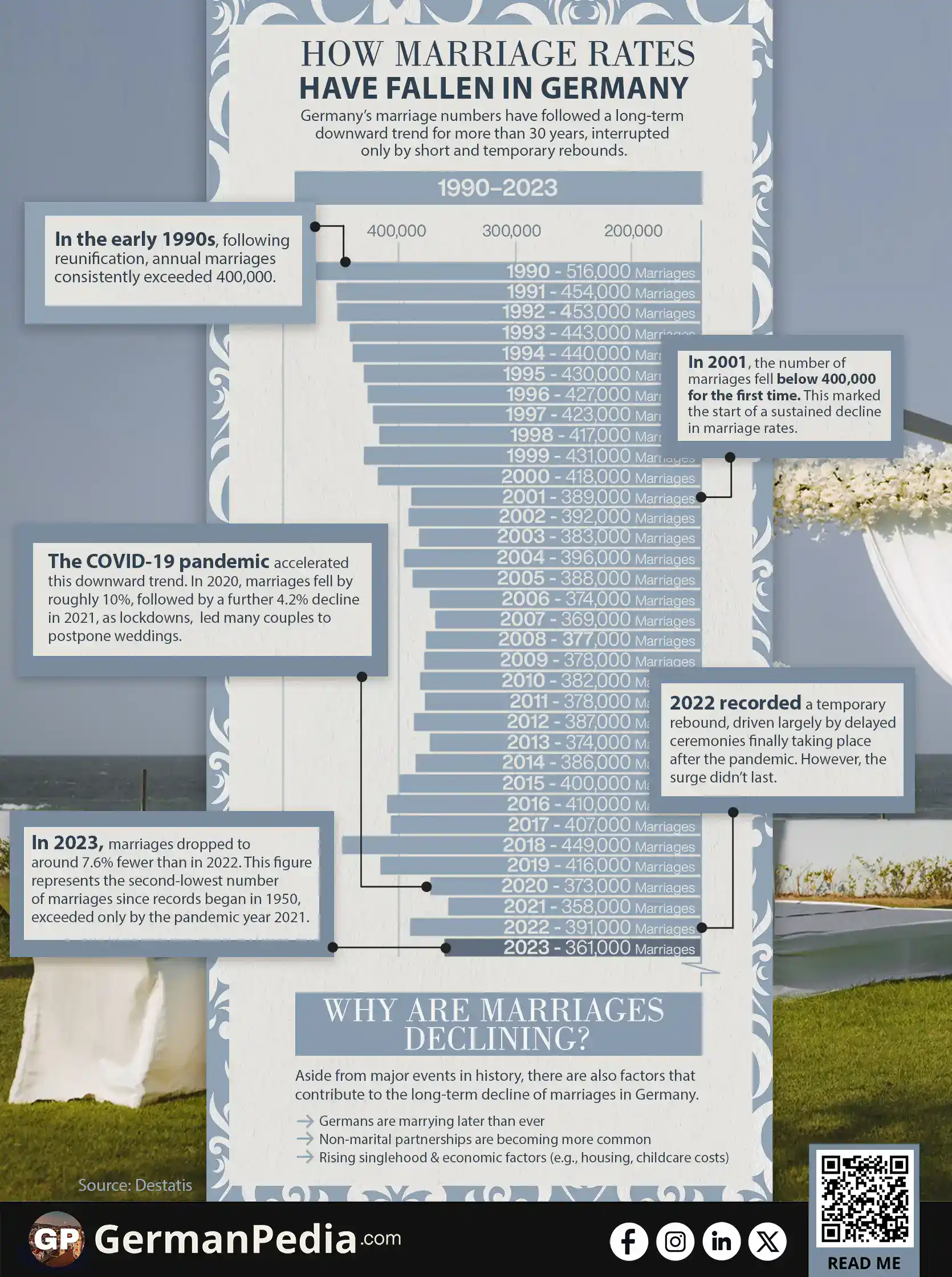
Germany’s marriage numbers have followed a long-term downward trend for more than 30 years, interrupted only by short and temporary rebounds.
In the early 1990s, following reunification, annual marriages consistently exceeded 400,000. This remained the case throughout the decade.
In 2001, the number of marriages fell below 400,000 for the first time. This marked the start of a sustained decline in marriage rates.
The COVID-19 pandemic accelerated this downward trend. In 2020, marriages fell by roughly 10%, followed by a further 4.2% decline in 2021, as lockdowns, gathering restrictions, and temporary registry office closures led many couples to postpone weddings.
When restrictions eased, 2022 recorded a temporary rebound, driven largely by delayed ceremonies finally taking place. However, the surge didn’t last.
In 2023, marriages dropped to 360,979, around 7.6% fewer than in 2022. This figure represents the second-lowest number of marriages since records began in 1950, exceeded only by the pandemic year 2021 [1].
Why are Marriages Declining in Germany?
Aside from major events in history, there are also factors that contribute to the long-term decline of marriages in Germany.
Germans are marrying later than ever
In 2024, men married at an average age of 35.3, while women married at 32.9. This marks a gradual but persistent shift from 2020, when the averages were 34.9 for men and 32.4 for women [3].
Longer periods spent in education, career-building, and achieving financial stability are increasingly delaying formal marriage.
Changes in Germany’s average marriage age ->
Non-marital partnerships are becoming more common
In 2024, around 3.34 million couples (16.2%) were living together without being married. About 1.14 million of these couples shared a household with children [4].
This shows that cohabitation may now also function as a family arrangement rather than just a pre‑marital phase. As more couples live together and raise children without marrying, or marrying much later, overall marriage rates decline.
Aside from these, there are other reasons why marriages are declining in Germany, such as
- rising singlehood
- economic factors (e.g., housing, childcare costs)
What Falling Marriage Numbers Mean for Germany’s Population
The decline in marriages forms part of a broader demographic shift. Fewer and later marriages contribute to fewer and later births, reinforcing Germany’s already low birth rates.
At the same time, life expectancy continues to rise. In recent years, boys born in Germany can expect to live around 78–79 years, while girls have a life expectancy of about 83 years [5].
Together, these developments are reshaping Germany’s demographic structure. As the population is ageing and the younger population is shrinking, the natural population growth remains persistently low.
More topics
- Highest Paying Jobs in Germany
- Popular Study Destinations for German Students
- Educational Attainment in European Countries
- Grocery Prices in Germany Have Increased Since 2000
- Germany’s Smoking Rate Has Declined Over Two Decades
- Germany’s Electricity Mix: From Coal to Renewables
- Changes in Harvest of Germany’s Five Key Crops
- Top German Companies by Revenue
- Germany’s Top Car Brands by New Registrations
- Unemployment Across Germany: A Federal State Breakdown
- Where Germany’s Tourists Come From
- Germany’s Largest National Parks, Ranked by Size
- Which Federal States Drive Germany’s Economy?
- How Marriage Rates Have Fallen in Germany: 1990–2023
- Leading Causes of Death in Germany
References
- https://www.destatis.de/EN/Themes/Society-Environment/Population/Marriages-Divorces-Life-Partnerships/Tables/lrbev06.html#269872
- https://www.destatis.de/EN/Themes/Society-Environment/Population/Marriages-Divorces-Life-Partnerships/Tables/lrbev06.html#fussnote-2-269872
- https://www.destatis.de/EN/Themes/Society-Environment/Population/Marriages-Divorces-Life-Partnerships/Tables/marriages-average-age-marriage.html
- https://www.destatis.de/EN/Themes/Society-Environment/Population/Households-Families/Tables/couples.html
- https://www.destatis.de/DE/Themen/Gesellschaft-Umwelt/Bevoelkerung/Sterbefaelle-Lebenserwartung/_inhalt.html