
Key Takeaways
- Germany’s smoking rate fell from 36.2% in 2000 to 21.3% in 2022, a drop of 14.9 percentage points or about 40%.
- The largest declines happened in the early 2000s, following tobacco tax increases and the start of broader tobacco control policies.
- Progress slowed after 2019, with smoking rates flattening and facing temporary upticks during the COVID-19 period.
- The long-term decline was driven by multiple policies working together, including higher taxes, smoke-free laws, advertising restrictions, and EU-wide product regulation.
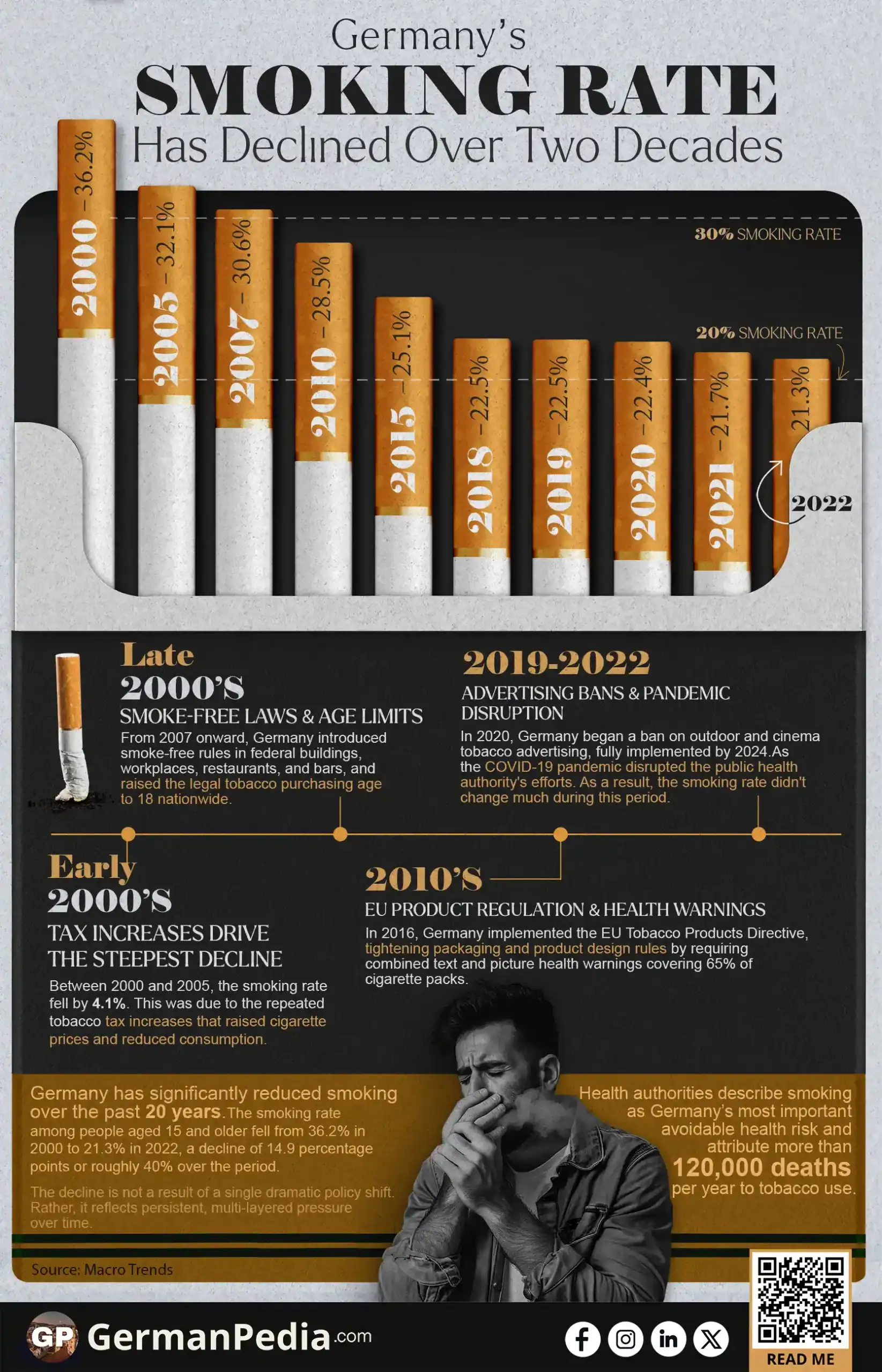
Use this Visualization: You may use this image for free with proper attribution to GermanPedia (i.e., by linking back to GermanPedia).
Smoking Rate in Germany
| Year | Smoking Rate | YoY Change |
|---|---|---|
| 2022 | 21.3% | -0.4% |
| 2021 | 21.7% | -0.7% |
| 2020 | 22.4% | -0.1% |
| 2019 | 22.5% | 0% |
| 2018 | 22.5% | -2.6% |
| 2015 | 25.1% | -3.4% |
| 2010 | 28.5% | -2.1% |
| 2007 | 30.6% | -1.5% |
| 2005 | 32.1% | -4.1% |
| 2000 | 36.2% |
Source: Macro Trends

Germany has significantly reduced smoking over the past twenty years. The smoking rate among people aged 15 and older fell from 36.2% in 2000 to 21.3% in 2022, a decline of 14.9 percentage points or roughly 40% over the period.
The decline is not a result of a single dramatic policy shift. Rather, it reflects persistent, multi-layered pressure over time.
A Long Decline Driven by Layered Policy
Early 2000s: Tax increases drive the steepest decline
Between 2000 and 2005, Germany’s smoking rate fell by 4.1 percentage points, the largest drop in the series.
During this period, Germany implemented repeated tobacco tax increases. This made cigarettes more expensive and reduced consumption, particularly among price-sensitive groups such as adolescents and young adults.
Germany also signed the WHO Framework Convention on Tobacco Control (FCTC) in 2003 and ratified it in 2004, committing to a comprehensive tobacco control strategy.
Late 2000s: Smoke-free laws and age limits
From 2007 onward, Germany introduced smoke‑free regulations in federal buildings, many workplaces, restaurants, and bars, though enforcement varied by state. The legal age for purchasing tobacco was also raised and standardized at 18 nationwide.
Non-smoking became the norm in many public spaces, making smoking less visible and less convenient.
2010s: EU product regulation and health warnings
In 2016, Germany implemented the EU Tobacco Products Directive, which tightened rules on packaging and product design.
Cigarette packs were required to display combined text and picture health warnings covering 65% of the front and back surfaces. These graphic warnings communicate health risks far more effectively than the old text-only labels.
2019–2022: Advertising bans and pandemic disruption
In 2020, Germany adopted legislation to phase in a broad ban on outdoor and cinema tobacco advertising, with full implementation by 2024. Germany had been one of the last EU countries to permit billboard tobacco advertising.
However, progress slowed during this period. The smoking rate barely moved from 2019 to 2020 (-0.1%) and showed only modest declines through 2022.
The COVID-19 pandemic disrupted public health priorities and was associated with upticks in smoking among adolescents and young adults in 2021-2022 [3].
Smoking Rates Are Falling, but Challenges Remain
Health authorities describe smoking as Germany’s most important avoidable health risk and attribute more than 120,000 deaths per year to tobacco use.
What are the leading causes of death in Germany? ->
Why do men face a higher cancer risk? ->
Why is dental insurance important for smokers?
Overall, the data show a clear and sustained decline in smoking over the past two decades, driven by a multi-layered policy approach.
At the same time, the trend also shows that further reductions become slower and more difficult over time, underscoring the need for policies to be maintained, enforced, and adapted to sustain progress.
More topics
- Highest Paying Jobs in Germany
- Popular Study Destinations for German Students
- Educational Attainment in European Countries
- Grocery Prices in Germany Have Increased Since 2000
- Germany’s Smoking Rate Has Declined Over Two Decades
- Germany’s Electricity Mix: From Coal to Renewables
- Changes in Harvest of Germany’s Five Key Crops
- Top German Companies by Revenue
- Germany’s Top Car Brands by New Registrations
- Unemployment Across Germany: A Federal State Breakdown
- Where Germany’s Tourists Come From
- Germany’s Largest National Parks, Ranked by Size
- Which Federal States Drive Germany’s Economy?
- How Marriage Rates Have Fallen in Germany: 1990–2023
- Leading Causes of Death in Germany
References
- https://www.macrotrends.net/datasets/global-metrics/countries/deu/germany/smoking-rate-statistics
- https://www.bundesgesundheitsministerium.de/fileadmin/Dateien/3_Downloads/G/Gesundheitsziele/Broschuere_Nationales_Gesundheitsziel_-_Tabakkonsum_reduzieren.pdf
- https://datenportal.bundesdrogenbeauftragter.de/nikotin