
Key Takeaways
- In the EU, 68.4% of people living in private households owned their homes in 2024. This shows that homeownership is the dominant housing tenure.
- Homeownership rates vary widely across EU countries, from 94.3% in Romania to 47.2% in Germany, reflecting different housing systems rather than a single EU-wide pattern.
- Very high ownership in Central and Eastern Europe reflects the privatization of state-owned housing, where tenants became homeowners at low or no cost.
- Germany has the lowest homeownership rate in the EU, supported by strong tenant protections. Renting is also more affordable compared to homeownership, making it more viable.
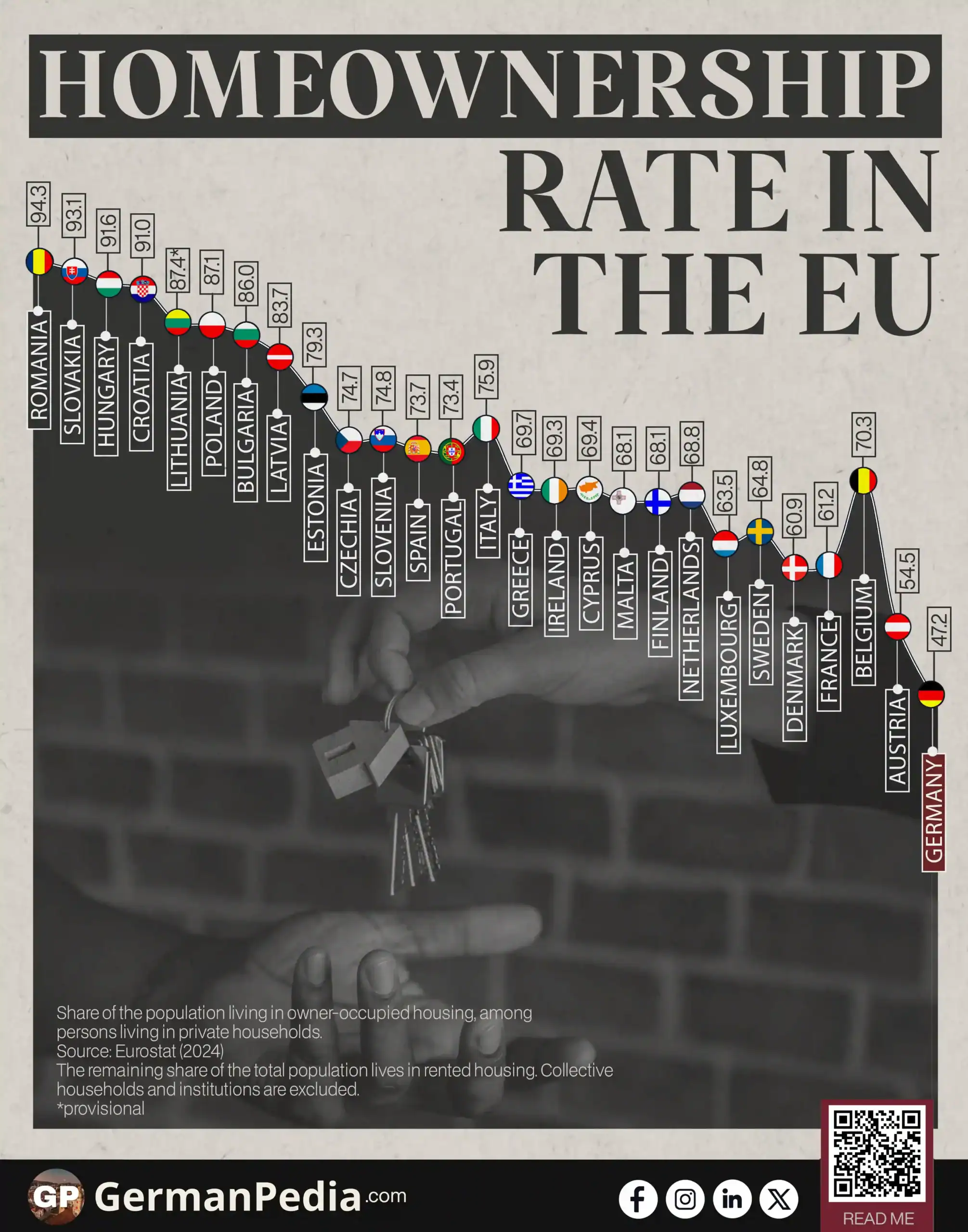
Use this Visualization: You may use this image for free with proper attribution to GermanPedia (i.e., by linking back to GermanPedia).
Need help communicating complex ideas visually? We help you turn data into your most persuasive story. Contact us to learn more.
EU Homeownership Rate By Country
| Country | Homeownership rate |
|---|---|
| Romania | 94.3 |
| Slovakia | 93.1 |
| Hungary | 91.6 |
| Croatia | 91.0 |
| Lithuania | 87.4* |
| Poland | 87.1 |
| Bulgaria | 86.0 |
| Latvia | 83.7 |
| Estonia | 79.3 |
| Czechia | 74.7 |
| Slovenia | 74.8 |
| Spain | 73.7 |
| Portugal | 73.4 |
| Italy | 75.9 |
| Greece | 69.7 |
| Ireland | 69.3 |
| Cyprus | 69.4 |
| Malta | 68.1 |
| Finland | 68.1 |
| Netherlands | 68.8 |
| Luxembourg | 63.5 |
| Sweden | 64.8 |
| Denmark | 60.9 |
| France | 61.2 |
| Belgium | 70.3 |
| Austria | 54.5 |
| Germany | 47.2 |
Source: Eurostat (2024)
The remaining share of the total population lives in rented housing. Collective households and institutions are excluded.
*provisional

Across the European Union, around 68.4% of people living in private households owned their homes in 2024.
This means owner-occupied housing still makes up the majority of the EU housing picture. However, homeownership rates vary widely across EU countries, reflecting different housing systems rather than a single European model.
Some EU countries report high shares of owner-occupied private households, with a few going above 90%. These include:
- Romania (94.3%)
- Slovakia (93.1%)
- Hungary (91.6%)
- Croatia (91.0%)
In much of Central and Eastern Europe, large parts of state-owned housing were privatized during the transition from socialism to support the society’s stability amid economic changes.
Many tenants became homeowners of the residential units they already occupied at lower or even zero costs. This allowed millions to own their homes entirely debt-free, which is a sharp contrast to the mortgage-heavy systems in Western Europe
As a result, homeownership rates rose and became the dominant tenure, while rental markets remained smaller and less developed.
At the other end, countries such as Germany (47.2%) and Austria (54.5%) have lower homeownership rates.
In Germany, for example, renting is more common. The country has strong tenant protections, including rules on eviction, rent regulation, and lease security.
What are the tenants’ rights in Germany ->
At the same time, housing supply is tight in many cities, particularly in high-demand urban areas. Moreover, the price of owning a home has also risen over time. As a result, lower homeownership is not only linked to a developed rental system, but also to affordability constraints in the housing market.
Across Europe, homeownership rates vary not simply because of affordability, but also because housing systems have developed differently over time.
More topics
- Germany’s Home Prices Rise 13.8% as Growth Shifts Regions
- Apartment Rents Are Rising Faster Than House Rents in Germany
- Where People Move Within Germany by Federal State
- Renting in Germany
- Rental Deposit (Kaution) in Germany
- Rent Increase in Germany [Tenant Rights And Regulations]
- Rental Property Scams in Germany
- Rental Contracts in Germany
- 7 Tips on Finding a Rental Property in Germany
- 12 Mistakes Foreigners Make While Living in Germany
- Unemployment Across Germany: A Federal State Breakdown
- Top German Companies by Revenue
- Germany’s Largest National Parks, Ranked by Size
- Which Federal States Drive Germany’s Economy?
- Here’s Why Divorces in Germany Are Falling
- Germans Are Marrying Later Than Ever
- How Marriage Rates Have Fallen in Germany: 1990–2023
References
- https://ec.europa.eu/eurostat/databrowser/view/ILC_LVHO02__custom_21116624/default/table
- https://ec.europa.eu/eurostat/cache/metadata/en/ilc_sieusilc.htm
- https://ec.europa.eu/eurostat/web/products-eurostat-news/w/ddn-20260205-1
- https://oecdecoscope.blog/2022/07/21/addressing-the-housing-challenges-in-central-and-eastern-europe/
- https://pmc.ncbi.nlm.nih.gov/articles/PMC5744614/
- https://ethz.ch/content/dam/ethz/special-interest/arch/ncl/eth-case-dam/documents/netzwerke-wissensaustausch/eth-forum-wohnungsbau/2016/referat/tagungsbericht_lux.pdf
- https://www.brookings.edu/articles/germany-rental-housing-markets/