
Key Takeaways
- Around 1 million people move between German states each year. However, these movements are uneven across regions.
- Large urban areas such as Berlin (-14,755) and Hamburg (-2,419) are losing the most residents. This is mainly due to high rents and limited space.
- Many people are moving to nearby regions. Brandenburg is benefiting the most from people leaving Berlin.
- Economic strength still matters, with states like Bayern (+9,540) attracting residents through jobs and living standards despite high rent costs.
- Not all smaller or rural states benefit equally. Some states gain population, while others lose numbers. This is often driven by local factors such as quality of life and job markets.
- Overall, people in Germany tend to move away from dense cities toward areas with more space, lower costs, and better living conditions.
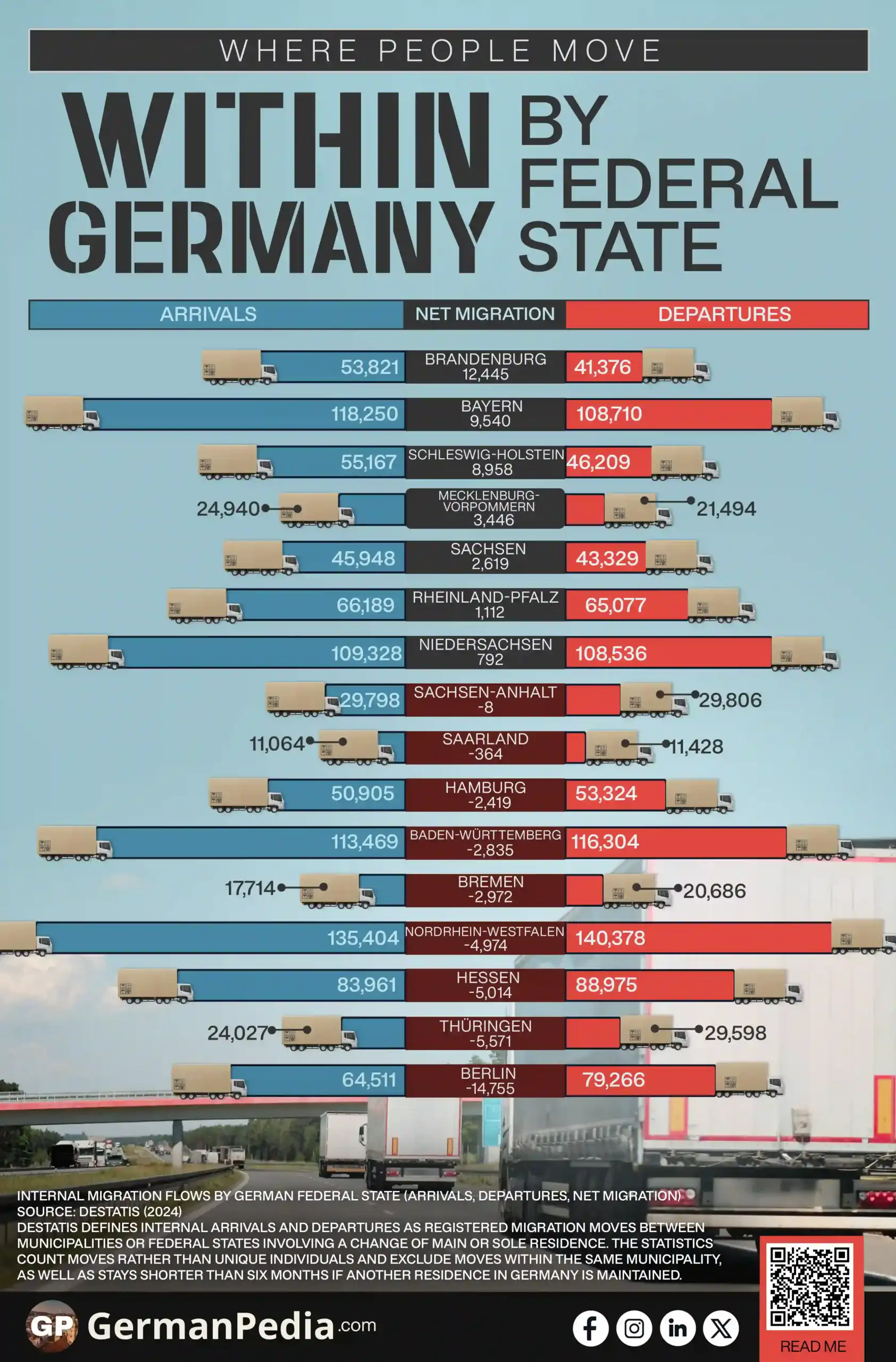
Use this Visualization: You may use this image for free with proper attribution to GermanPedia (i.e., by linking back to GermanPedia).
Need help communicating complex ideas visually? We help you turn data into your most persuasive story. Contact us to learn more.
Internal Migration by German Federal State
| Federal State | Arrivals | Departures | Net Migration |
|---|---|---|---|
| Brandenburg | 53,821 | 41,376 | 12,445 |
| Bayern | 118,250 | 108,710 | 9,540 |
| Schleswig-Holstein | 55,167 | 46,209 | 8,958 |
| Mecklenburg-Vorpommern | 24,940 | 21,494 | 3,446 |
| Sachsen | 45,948 | 43,329 | 2,619 |
| Rheinland-Pfalz | 66,189 | 65,077 | 1,112 |
| Niedersachsen | 109,328 | 108,536 | 792 |
| Sachsen-Anhalt | 29,798 | 29,806 | -8 |
| Saarland | 11,064 | 11,428 | -364 |
| Hamburg | 50,905 | 53,324 | -2,419 |
| Baden-Württemberg | 113,469 | 116,304 | -2,835 |
| Bremen | 17,714 | 20,686 | -2,972 |
| Nordrhein-Westfalen | 135,404 | 140,378 | -4,974 |
| Hessen | 83,961 | 88,975 | -5,014 |
| Thüringen | 24,027 | 29,598 | -5,571 |
| Berlin | 64,511 | 79,266 | -14,755 |
Source: Destatis (2024)
Destatis defines internal arrivals and departures as registered migration moves between municipalities or federal states involving a change of main or sole residence. The statistics count moves rather than unique individuals and exclude moves within the same municipality, as well as stays shorter than six months if another residence in Germany is maintained.

About 1 million people move between states each year, and where people go is not evenly spread.
Some states gain residents, while others lose them.
The biggest losses come from city-states and large urban regions:
- Berlin (-14,755)
- Hessen (-5,014)
- Nordrhein-Westfalen (-4,974)
- Hamburg (-2,419)
Many major urban centers continue to attract many people overall. Berlin, for example, recorded 64,511 internal arrivals in 2024. However, they also record the highest number of departures.
This reflects a common pattern. Large cities draw people in. However, some leave over time. Some reasons include high rents, limited space, and the search for better living conditions.
City states record the highest rental rates in Germany ->
This shift became more visible during the pandemic, when housing pressures increased, and more people looked for space or flexibility.
Many of those leaving cities do not move far. Instead, they settle in nearby regions.
Brandenburg (+12,445) is the clearest example. It surrounds Berlin and gains many residents from the city. This shows how internal migration often stays regional, with people moving outward rather than relocating across the country.
Other states attract residents for different reasons. Bayern (+9,540), for example, continues to gain population despite high housing costs, as its strong economy and job opportunities make it an attractive destination.
Employment by Federal State in Germany ->
Germany’s Median Wage by Federal State ->
Beyond the largest regions, some smaller states also see gains:
- Mecklenburg-Vorpommern (+3,446)
- Sachsen (+2,619)
At the same time, not all rural areas benefit. States like Thüringen (-5,571) and Saarland (-364) lost some residents.
This shows that internal migration is shaped by local conditions. Job markets, housing costs, and overall quality of life all influence where people move.
While international migrants move toward Germany’s biggest economic centers, people already living in Germany often move in the opposite direction in search of more space, lower housing costs, and different living conditions.
Where Do People Arriving from Abroad Settle in Germany? ->
More topics
- Germany’s Median Wage by Federal State
- Employment by Federal State in Germany
- Where Do People Arriving from Abroad Settle in Germany?
- Which Federal States Drive Germany’s Economy?
- Which German States Have the Highest Abortion Ratios?
- Unemployment Across Germany: A Federal State Breakdown
- Hospital Capacity Across Germany: A State-by-State Comparison
- European Union’s Debt Has Grown Sharply Over Two Decades
- Europe’s Population Shifted Over 20 Years
- Germany’s Live Births Per Federal State
- Two Decades of Renewable Energy Growth in Europe
- Germans Earn More Than Foreign Workers Across Germany
- Average Pension in Germany by Federal State
- Top EU Countries Where People Say They Don’t Need AI
- Gender Employment Patterns Across Germany’s Labour Market
References
- https://www.destatis.de/EN/Themes/Society-Environment/Population/Migration/Tables/migration-year-05.html
- https://www.dw.com/en/germany-more-people-moving-from-cities-to-rural-areas/a-66813375
- https://www.thuenen.de/en/newsroom/news/detail/urban-rural-migration-a-decisions-in-favour-of-the-rural-or-against-the-urban
- https://www.bertelsmann-stiftung.de/en/our-projects/data-for-society/project-news/updated-data-in-wegweiser-kommune-1