
Key Takeaways
- Germany’s average home price rose +13.8% between 2021 and 2026.
- Hamburg remains the most expensive at €5,633 per m², despite a -8.3% decline.
- The fastest growth occurred in mid- and lower-priced states. This is led by North Rhine-Westphalia (+16.8%) and Brandenburg (+16.2%).
- Eastern regions remain the most affordable overall. However, they are seeing stronger demand and rising prices.
- Growth is increasingly concentrated outside traditional hotspots, particularly in areas near major cities such as Brandenburg and Mecklenburg-Vorpommern.
- Across regions, higher borrowing costs, limited supply, and weak new construction are continuing to shape German housing markets.
Between Q1 2021 and Q1 2026, the average asking price for a home in Germany rose from €2,642 to €3,007 per square meter. That is an increase of 13.8%.
However, that doesn’t mean prices are rising everywhere in the same way.
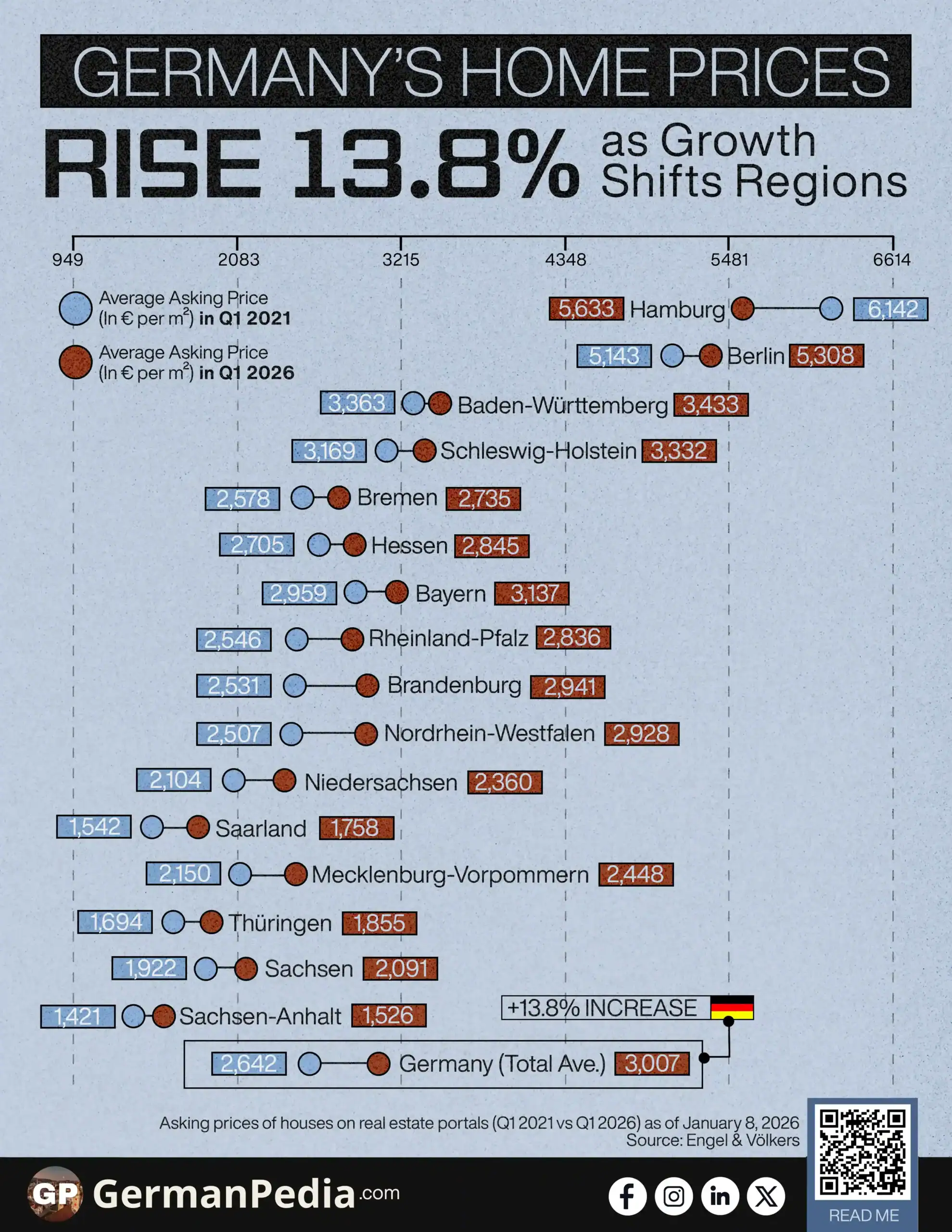
Use this Visualization: You may use this image for free with proper attribution to GermanPedia (i.e., by linking back to GermanPedia).
Need help communicating complex ideas visually? We help you turn data into your most persuasive story. Contact us to learn more.
Average House Prices in Germany By State
| Rank | Federal State | Average Asking Price (In € per m²) | Change (%) | |
|---|---|---|---|---|
| Q1 2021 | Q1 2026 | |||
| 1 | Hamburg | 6,142 | 5,633 | -8.3% |
| 2 | Berlin | 5,143 | 5,308 | +3.2% |
| 3 | Baden-Württemberg | 3,363 | 3,433 | +2.1% |
| 4 | Schleswig-Holstein | 3,169 | 3,332 | +5.1% |
| 5 | Bremen | 2,578 | 2,735 | +6.1% |
| 6 | Hessen | 2,705 | 2,845 | +5.2% |
| 7 | Bayern | 2,959 | 3,137 | +6.0% |
| 8 | Rheinland-Pfalz | 2,546 | 2,836 | +11.4% |
| 9 | Brandenburg | 2,531 | 2,941 | +16.2% |
| 10 | Nordrhein-Westfalen | 2,507 | 2,928 | +16.8% |
| 11 | Niedersachsen | 2,104 | 2,360 | +12.2% |
| 12 | Saarland | 1,542 | 1,758 | +14.0% |
| 13 | Mecklenburg-Vorpommern | 2,150 | 2,448 | +13.9% |
| 14 | Thüringen | 1,694 | 1,855 | +9.5% |
| 15 | Sachsen | 1,922 | 2,091 | +8.8% |
| 16 | Sachsen-Anhalt | 1,421 | 1,526 | +7.4% |
| Germany (Total Ave.) | 2,642 | 3,007 | +13.8% | |
Source: Engel & Völkers

In 2026, Hamburg remains the most expensive market at €5,633 per square meter. Even so, prices there have fallen 8.3% since 2021.
Berlin also stayed very expensive, at €5,308 per square meter. Unlike Hamburg, prices there rose 3.2% over the same period.
In southern states such as Baden-Württemberg and Bavaria, prices also stayed high. Long-run growth there has been moderate.
These regions share a similar structure:
- Strong demand in large cities.
- Limited housing supply, especially in central locations.
- Slow new construction due to land scarcity, planning rules, and high construction costs.
They also tend to be major economic centers with many jobs and strong purchasing power, which helps keep prices elevated even when growth slows.
The strongest price gains are now appearing in markets just below the very top tier, such as:
- North Rhine-Westphalia: +16.8%
- Brandenburg: +16.2%
After financing costs rose, affordability weakened in Germany’s top-tier housing markets. At the same time, housing remained scarce, so demand and price growth continued in more affordable regions,
These areas are still more affordable than major cities, but they are becoming more competitive.
If you’re looking for the cheapest home prices, this can mostly be found in Eastern states:
- Saxony-Anhalt: €1,526
- Saarland: €1,758
- Thuringia: €1,855
These levels reflect lower incomes, weaker demand, and less housing pressure, which keep prices down compared to the major metropolitan markets.
But not all eastern regions are moving at the same pace.
- Brandenburg: +16.2%
- Mecklenburg-Vorpommern: +13.9%
These areas may benefit from demand spillover from nearby cities like Berlin, as some buyers look for more space or lower costs near major urban centers.
Across all regions, the same underlying forces are at work:
- mortgage rates and restrictive lending conditions have weakened affordability
- construction costs remain high
- housing shortages persist
Together, these factors did not eliminate demand. Instead, price growth has become more uneven across regions.
Germany still has large regional price gaps, and some of the stronger gains are now appearing in markets outside the highest-priced centers.
For anyone looking at the market today, the question is becoming less “Where is cheapest?” and more “Where is demand moving next?”
More topics
- Apartment Rents Are Rising Faster Than House Rents in Germany
- Apartment Rents in Germany Rise by 24% in Five Years
- Benefits of Investing in German Real Estate
- Where People Move Within Germany by Federal State
- Top 10 Largest Employers in Germany
- Employment by Federal State in Germany
- Germany’s Top 8 Most Valuable Brands
- Which Federal States Drive Germany’s Economy?
- Which German States Have the Highest Abortion Ratios?
- Where Do People Arriving from Abroad Settle in Germany?
- Germany’s Median Wage by Federal State
- Environmental Impact of AI Websites in Germany
- Hospital Capacity Across Germany: A State-by-State Comparison
- Germany’s Live Births Per Federal State
- Happiness vs Income in the EU
References
- https://www.engelvoelkers.com/de-de/immobilienpreise/
- https://think.ing.com/articles/german-housing-market-likely-to-bend-not-break/
- https://www.cbre.de/en-gb/press-releases/germany-housing-market-remains-under-pressure-signs-of-relief-for-the-new-build-segment
- https://pep.vse.cz/pdfs/pep/2025/01/04.pdf