
Key Takeaways
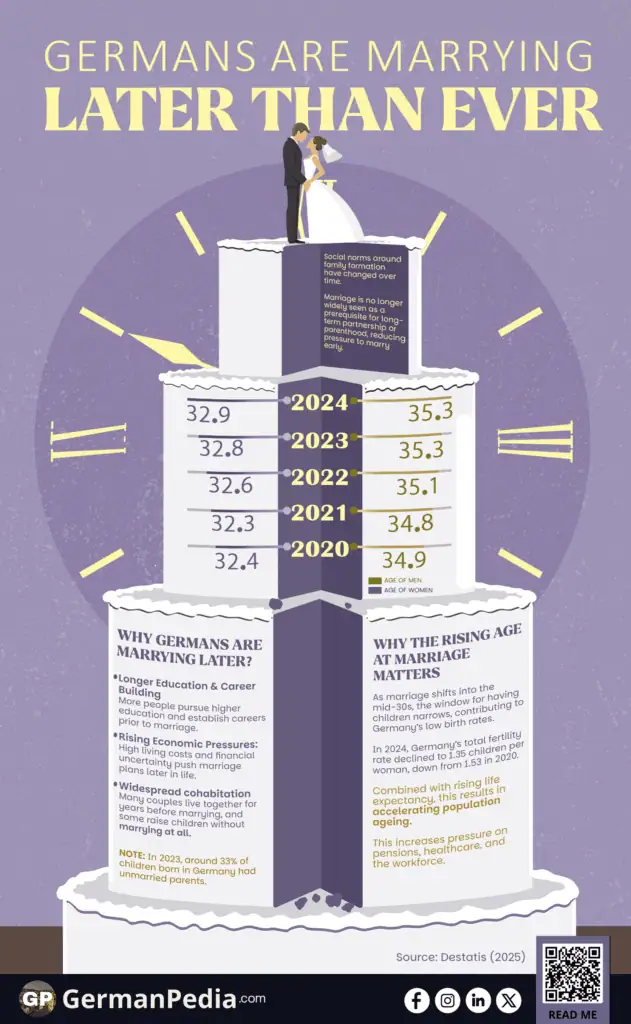
- Between 2020 and 2024, the average age at first marriage in Germany rose from 34.9 to 35.3 for men and from 32.4 to 32.9 for women.
- Longer education paths, career-building, economic uncertainty, and widespread cohabitation have pushed marriage later in life.
- Later marriage contributes to lower birth rates. Together with rising life expectancy, these factors reinforce Germany’s long-term population ageing.
Use this Visualization: You may use this image for free with proper attribution to GermanPedia (i.e., by linking back to GermanPedia).
Germany’s Average Age at First Marriage
| Year | Average Age | |
| Men | Women | |
| 2020 | 34.9 | 32.4 |
| 2021 | 34.8 | 32.3 |
| 2022 | 35.1 | 32.6 |
| 2023 | 35.3 | 32.8 |
| 2024 | 35.3 | 32.9 |
Source: Destatis
The number includes same-sex marriages.

The average age at first marriage among singles in Germany has continued to rise in recent years. In 2020, men married at an average age of 34.9, and women at 32.4. By 2024, these averages had increased to 35.3 for men and 32.9 for women.
While the increases may appear small yearly, they reflect a broader generational shift toward later marriage and delayed family formation.
Why Are Germans Entering Their First Marriage Later?
Social norms around family formation in Germany have changed over time. Marriage is no longer widely seen as a prerequisite for long-term partnership or parenthood, reducing pressure to marry early.
Several factors are reshaping the timing of first marriages in Germany:
- Longer Education and Career Building: More people pursue higher education and establish careers before settling into long-term partnerships.
- Rising Economic Pressures: High living costs, urban housing shortages, and financial uncertainty push marriage plans later in life.
- Widespread cohabitation: Many couples live together for years before marrying, and some raise children without marrying at all. In 2023, around 33% of children born in Germany had unmarried parents [2].
Why the Rising Age at Marriage Matters
As marriage shifts into the mid-30s, the window for having children narrows, contributing to Germany’s low birth rates. In 2024, Germany’s total fertility rate declined to 1.35 children per woman, down from 1.53 in 2020 [3].
Combined with rising life expectancy, this trend accelerates population ageing, which increases pressure on pensions, healthcare, and the workforce.
More topics
- Highest Paying Jobs in Germany
- Popular Study Destinations for German Students
- Educational Attainment in European Countries
- Grocery Prices in Germany Have Increased Since 2000
- Germany’s Smoking Rate Has Declined Over Two Decades
- Germany’s Electricity Mix: From Coal to Renewables
- Changes in Harvest of Germany’s Five Key Crops
- Top German Companies by Revenue
- Germany’s Top Car Brands by New Registrations
- Unemployment Across Germany: A Federal State Breakdown
- Where Germany’s Tourists Come From
- Germany’s Largest National Parks, Ranked by Size
- Which Federal States Drive Germany’s Economy?
- How Marriage Rates Have Fallen in Germany: 1990–2023
- Leading Causes of Death in Germany
References
- https://www.destatis.de/EN/Themes/Society-Environment/Population/Marriages-Divorces-Life-Partnerships/Tables/marriages-average-age-marriage.html
- https://www.statista.com/statistics/1094231/children-born-outside-of-marriage-germany/
- https://www.destatis.de/EN/Press/2025/07/PE25_259_12.html
- https://www.demographic-research.org/volumes/vol33/9/33-9.pdf