
Key Takeaways
- Mixed-breed dogs were registered 92,976 times in 2025. That is more than seven times the Labrador Retriever’s count. They have ranked first in every German state and every year since 2017.
- The Labrador Retriever ranks second nationally with 13,109 new registrations in 2025. It also ranks second in 15 of Germany’s 16 states. Only in Sachsen-Anhalt does the German Shepherd outrank it.
- Dogs weighing more than 26 kilograms fell from 25% of Germany’s dog population five years ago to 19% in 2025.
- The Miniature Poodle entered TASSO’s national top 10 in 2025 with 3,202 new registrations. It is the breed’s first appearance since TASSO began publishing rankings in 2017.
- Housing situations and daily activity levels increasingly shape German owners’ breed choices. Smaller, more adaptable dogs are gaining favor over large working breeds like the Labrador and German Shepherd.
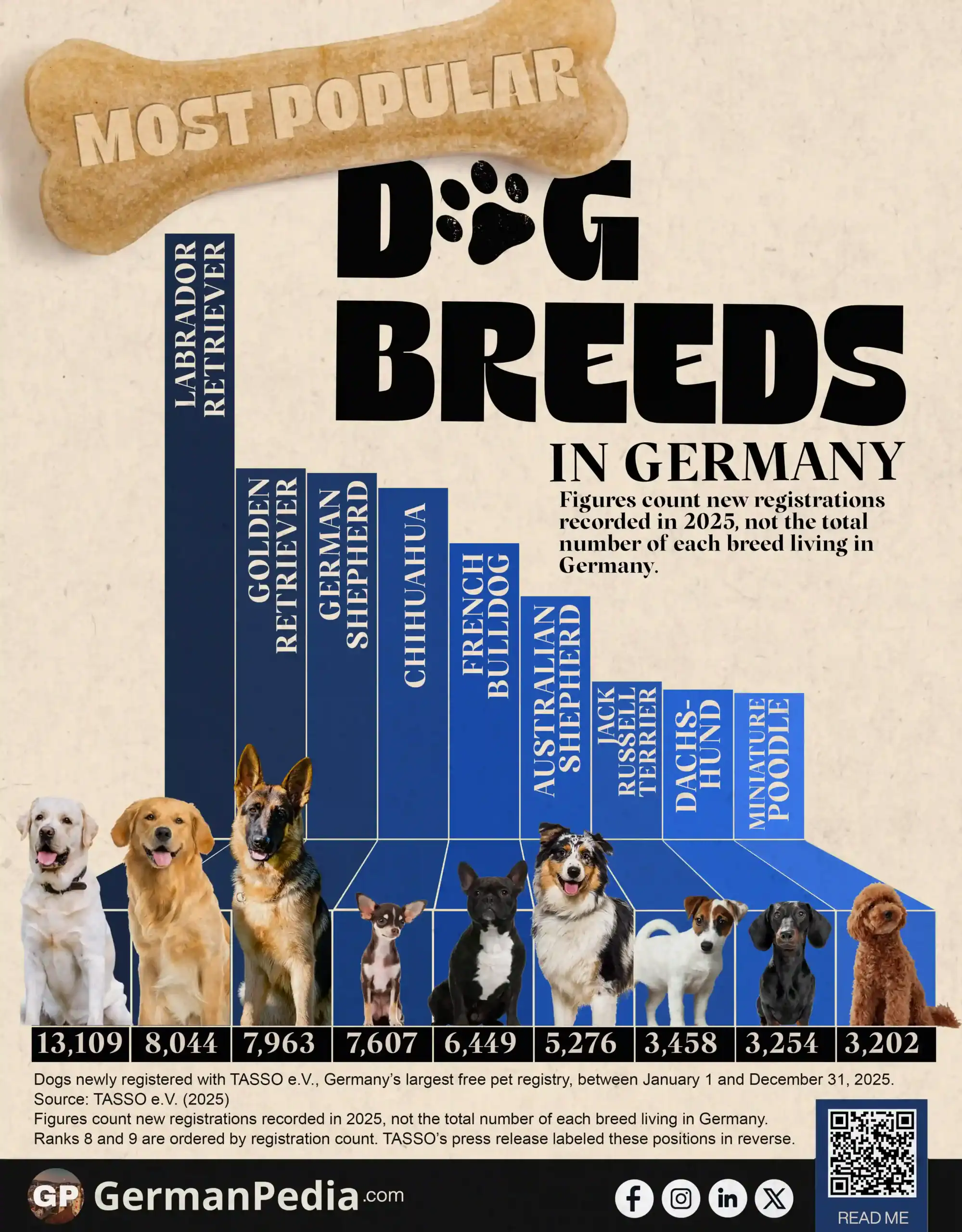
Use this Visualization: You may use this image for free with proper attribution to GermanPedia (i.e., by linking back to GermanPedia).
Need help communicating complex ideas visually? We help you turn data into your most persuasive story. Contact us to learn more.
Most Common Dog Breeds in Germany
| Rank | Breed | New Registrations (2025) |
|---|---|---|
| 1 | Mischling (mixed breed) | 92,976 |
| 2 | Labrador Retriever | 13,109 |
| 3 | Golden Retriever | 8,044 |
| 4 | Deutscher Schäferhund (German Shepherd) | 7,963 |
| 5 | Chihuahua | 7,607 |
| 6 | Französische Bulldogge (French Bulldog) | 6,449 |
| 7 | Australian Shepherd | 5,276 |
| 8 | Jack Russell Terrier | 3,458 |
| 9 | Dackel (Dachshund) | 3,254 |
| 10 | Zwergpudel (Miniature Poodle) | 3,202 |
Source: TASSO e.V. (2025)
Figures count new registrations recorded in 2025, not the total number of each breed living in Germany.
Ranks 8 and 9 are ordered by registration count. TASSO’s press release labeled these positions in reverse.

Mixed-breed dogs are Germany’s most popular dogs by a wide margin. TASSO registered 92,976 new mixed-breed dogs in 2025. That is more than seven times the Labrador Retriever’s count in second place.
These rankings come from TASSO e.V., Germany’s largest free pet registry. Owners register a dog’s microchip with TASSO, so lost pets can be reunited with their families. Registration with TASSO is voluntary. It is separate from Germany’s microchip laws. Those laws vary by state. The figures above count dogs newly registered with TASSO in 2025. They do not represent a census of every dog living in Germany.
Mixed-Breed Dogs Is Germany’s Most Popular Dog Breed Since 2017
In 2025, mixed-breed dogs ranked first in all 16 German states. That includes dense city states like Berlin and Hamburg, and large rural states like Bavaria and Lower Saxony. The pattern holds across every year in TASSO’s records, back to 2017.
The Labrador Retriever ranks second nationally with 13,109 new registrations in 2025. It also ranks second in 15 of Germany’s 16 states. Only in Sachsen-Anhalt does the German Shepherd outrank it. TASSO recorded just a handful more German Shepherd registrations than Labrador registrations there.
No other breed comes close to this consistency. Nationally, the German Shepherd reclaimed fourth place from the Chihuahua in 2025 with 7,963 registrations against the Chihuahua’s 7,607. The Golden Retriever, German Shepherd, and Chihuahua continue to trade positions between third and fifth, depending on the state and year. The top two spots barely move.
Smaller Dog Breeds Are Gaining Ground Across Germany
Germany’s dogs are getting smaller, not in number, but in size. Dogs weighing more than 26 kilograms made up 19% of Germany’s dog population in 2025. Five years earlier, that share stood at 25%.
About a third of German dogs now weigh between 5 and 10 kilograms. That range includes the Jack Russell Terrier. It recorded 3,458 new registrations in 2025. The Miniature Poodle entered TASSO’s national top 10 with 3,202 registrations. That was its first appearance since 2017. It replaced the Havaneser in tenth place.
Housing situations and daily activity levels increasingly shape German owners’ breed choices. Smaller, adaptable dogs fit more easily into apartments and busier schedules than large working breeds like the Labrador and German Shepherd.
Germany’s dog population tells two stories at once. Millions of owners skip pedigree entirely and choose mixed-breed dogs instead. At the same time, the pedigreed dogs that Germans choose are getting smaller and more suited to modern, urban life. Both trends point to the same shift. Convenience and companionship now matter more than breed standards or working pedigree.
More topics
- Most Popular EU Tourist Destinations by Overnight Stays
- Top Relocation Destinations for Germans
- Which EU Countries Attract the Most Foreign Investment?
- Which Are the Busiest Airports in the EU?
- Popular Study Destinations for German Students
- GDP per Capita vs Actual Consumption per Capita in the EU
- EU Household Expenditure on Food and Non-Alcoholic Beverages
- EU Rent Price Index by Country Over Time
- Apartment Rents Are Rising Faster Than House Rents in Germany
- Grocery Prices in Germany [2000 – 2025]
- Which EU Countries Had the Highest Inflation Rates?
- EU Fertility Rate by Country
- Average Working Hours in EU Countries
- Minimum Wages Rose Fastest in Eastern Europe
- The Best EU Countries to Retire In
References
- https://www.tasso.net/Presse/Pressemitteilungen/2026/Die-Deutschen-lieben-Labradore
- https://www.tasso.net/Service/Wissensportal/TASSO-Fakten/Die-beliebtesten-Hunderassen
- https://www.tasso.net/Service/Wissensportal/TASSO-Fakten/Die-beliebtesten-Hunderassen/Nach-Bundeslaender
- https://www.petonline.de/daten/news/2026/06/10/free/labrador-schaeferhund-chihuahua-deutschlands-beliebteste-hunde.html