Key Takeaways
- Germany won 26 medals, including 8 gold, at the 2026 Winter Olympics.
- It fell from second in gold medals in 2022 to fifth in 2026, ranking fourth overall. However, Germany remains one of the leading winter sports nations.
- The medal tally is dominated by sliding sports, accounting for 19 of 26 medals.
- Bobsleigh and luge delivered six of Germany’s eight gold medals.
- Johannes Lochner won most of Germany’s medals at the Games. He secured two golds in the two-man and four-man bobsleigh events.
- Daniela Maier won Germany’s first-ever Olympic freestyle skiing gold.
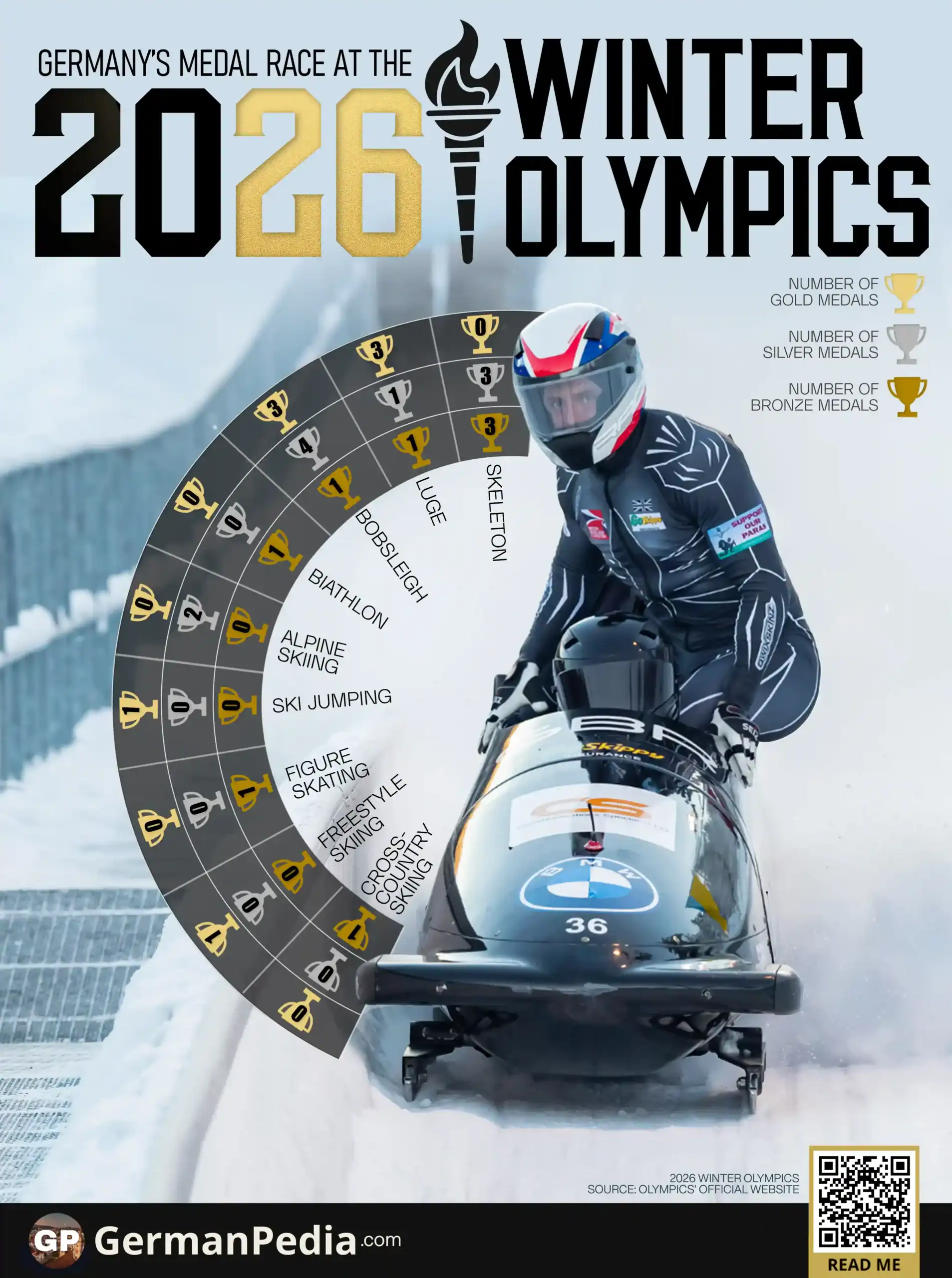
Use this Visualization: You may use this image for free with proper attribution to GermanPedia (i.e., by linking back to GermanPedia).
Need help communicating complex ideas visually? We help you turn data into your most persuasive story. Contact us to learn more.
Germany 2026 Winter Olympics Medal Tally
| Sport | Gold | Silver | Bronze | Total |
|---|---|---|---|---|
| Skeleton | 0 | 3 | 3 | 6 |
| Luge | 3 | 1 | 1 | 5 |
| Bobsleigh | 3 | 4 | 1 | 8 |
| Alpine Skiing | 0 | 2 | 0 | 2 |
| Freestyle Skiing | 1 | 0 | 0 | 1 |
| Ski Jumping | 1 | 0 | 0 | 1 |
| Biathlon | 0 | 0 | 1 | 1 |
| Cross-Country Skiing | 0 | 0 | 1 | 1 |
| Figure Skating | 0 | 0 | 1 | 1 |
| Total | 8 | 10 | 8 | 26 |
Source: Olympics’ Official Website

Germany finished with 26 total medals at the Milano Cortina 2026 Winter Olympics. It comprises 8 gold, 10 silver, and 8 bronze medals.
That keeps the country firmly inside the global winter elite.
Winter Olympics 2022 vs 2026: Medal Table Comparison ->
The overall depth remains nearly identical compared with the Beijing 2022 Winter Olympics, where Germany won 12 gold medals and 27 total medals. The difference lies in gold conversion.
The Ice Tracks Still Belong to Germany
If 2026 confirmed anything, it is that Germany’s strength still runs along frozen tracks.
Skeleton (6 medals), luge (5), and bobsleigh (8) combine for 19 of 26 total medals. That is nearly three-quarters of the entire haul.
Bobsleigh stood out in particular, where German athletes produced eight medals and three gold. Johannes Lochner delivered one of Germany’s defining performances of the Games, capturing gold in both the two-man and four-man events. It was a rare double triumph that anchored the sliding campaign.
Meanwhile, Luge athletes also delivered with three gold medals, and Skeleton athletes demonstrated remarkable depth with six podium finishes, even if a gold remained just out of reach.
This is the familiar German model: technical precision, controlled environments, marginal gains, executed repeatedly at the highest level.
German Athletes with the Most Winter Olympic Medals ->
In sliding sports, Germany remains a benchmark nation.
Germany Stays in the Fight Across Disciplines
Beyond the ice tracks, results were more mixed.
Alpine skiing contributed two silvers.
Ski jumping added one gold.
Biathlon, cross-country skiing, and figure skating each secured bronze medals.
And in freestyle skiing, Germany made history. Daniela Maier claimed gold in women’s ski cross. It was the first Olympic freestyle skiing gold ever won by a German athlete.
These are competitive outcomes across a wide range of disciplines. But in sports where Norway, Italy, and the United States were peaking, the podium battles were exceptionally tight.
At this level, tenths of a second decide outcomes. In 2026, several of those tenths landed just outside gold for Germany.
That is not structural decline. It shows that the elite competition is intensifying.
In Beijing 2022, Germany finished second in gold medals. In Milano Cortina 2026, it slipped to fifth in golds and fourth overall. However, the total medal count remains almost unchanged.
The foundation has not weakened.
The system still delivers depth.
Sliding disciplines remain world-class.
What changed is the margin at the top.
Germany continues to rank among the leading winter sports nations. But converting silver into gold has become more difficult in an increasingly competitive field.
The medals are still there.
The hierarchy remains intact.
The gap between dominance and pursuit is simply narrower.
And in modern Winter Olympics, that gap is often measured in hundredths of a second.
More topics
- Who are Germany’s Most Decorated Winter Olympians?
- Winter Olympics 2022 vs 2026: Medal Table Comparison
- Germany’s Coldest Winters
- Unicorn Startups in Germany
- Germany’s Live Births Per Federal State
- 15 Most Streamed Songs in Germany in 2025
- Highest Paying Jobs in Germany
- Top Companies in Germany by LinkedIn
- Why Germany’s Best-Selling Games Rarely Change
- Germany’s GDP Growth: Three Decades of Economic Evolution
- Germany Drinks 40% Less Beer Than It Did in 1980
- Where Do Immigrants in Germany Come From?
- Commuting in Germany: Cars, Climate Goals, and Daily Reality
- Germany’s Largest Banks by Assets
- Grocery Prices in Germany
References
- https://www.olympics.com/en/milano-cortina-2026/medals
- https://www.olympics.com/en/olympic-games/beijing-2022/medals
- https://www.espn.ph/olympics/story/_/id/48003811/johannes-lochner-caps-career-olympic-4-man-bobsled-gold
- https://www.nbcolympics.com/news/legacy-continues-how-germany-has-added-years-sliding-sport-dominance-milan-cortina
- https://www.nbcolympics.com/news/canada-unseated-german-daniela-maier-flashes-olympic-womens-ski-cross-gold