Key Takeaways
- Germany’s Winter Olympic medals are concentrated in speed skating, biathlon, and luge.
- Claudia Pechstein and Uschi Disl are the Winter Olympians with the most medals, with 9 medals each.
- Several Olympians medaled across four or five consecutive Games.
- Long careers reflect stable funding, training systems, and sports science support.
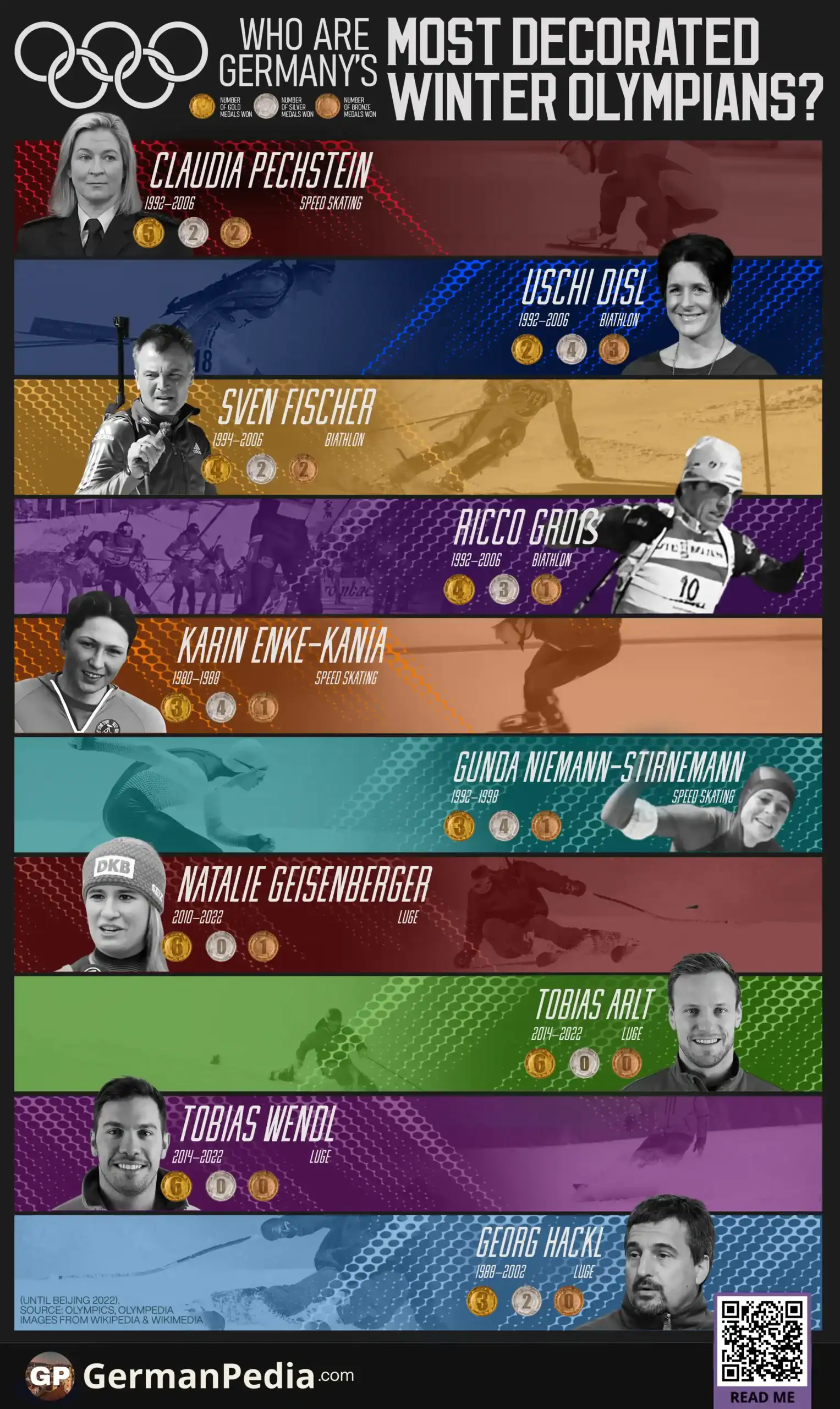
Use this Visualization: You may use this image for free with proper attribution to GermanPedia (i.e., by linking back to GermanPedia).
Need help communicating complex ideas visually? We help you turn data into your most persuasive story. Contact us to learn more.
Germany’s Multi-Medal Winter Olympic Athletes
| Athlete | Sport | Medal Tally | Olympic Years Won | |||
|---|---|---|---|---|---|---|
| Gold | Silver | Bronze | Total | |||
| Claudia Pechstein | Speed skating | 5 | 2 | 2 | 9 | 1992–2006 |
| Uschi Disl | Biathlon | 2 | 4 | 3 | 9 | 1992–2006 |
| Sven Fischer | Biathlon | 4 | 2 | 2 | 8 | 1994–2006 |
| Ricco Groß | Biathlon | 4 | 3 | 1 | 8 | 1992–2006 |
| Karin Enke-Kania | Speed skating | 3 | 4 | 1 | 8 | 1980–1988 |
| Gunda Niemann-Stirnemann | Speed skating | 3 | 4 | 1 | 8 | 1992–1998 |
| Natalie Geisenberger | Luge | 6 | 0 | 1 | 7 | 2010–2022 |
| Tobias Arlt | Luge | 6 | 0 | 0 | 6 | 2014–2022 |
| Tobias Wendl | Luge | 6 | 0 | 0 | 6 | 2014–2022 |
| Georg Hackl | Luge | 3 | 2 | 0 | 5 | 1988–2002 |
Source: Olympics, Olympedia

Germany’s Winter Olympic Success Is Highly Concentrated
Germany’s Winter Olympic medalists come from just three disciplines:
- Speed skating
- Biathlon
- Luge
This concentration is structural, not coincidental.
These sports reward institutional strength. Success depends heavily on:
- Centralised winter training centres
- Equipment optimisation and technical precision
- Early talent identification in endurance-based disciplines
- Stable and well-funded federation structures
Germany has historically invested in precisely these controlled, system-driven environments.
These disciplines reward repeatability and institutional consistency. They are unlike alpine skiing, where weather variability, course conditions and higher risk levels introduce greater unpredictability.
Career Duration Reflects System Stability
Longevity is one of the clearest patterns in Germany’s Winter Olympic record. Winter Olympians such as Pechstein, Disl, Groß, and Hackl medaled across five consecutive Olympic Games, while some of them followed with four consecutive Games.
Winter endurance sports often allow athletes to peak later than explosive disciplines. But sustained success at this level also depends on structure.
Long careers require:
- Stable federation funding
- Integrated sports science and performance analysis
- Advanced medical and recovery systems
- Predictable competition pathways
These conditions favour sustained excellence rather than short peaks.
The pattern is systemic, not accidental.
Germany’s most decorated Winter Olympians are not evenly distributed across disciplines. They cluster in sports that reward long-term structure, technical optimisation and institutional depth.
The numbers show clear concentration in just a few sports, but the bigger story is continuity. Germany’s winter success stretches across decades, political systems, and generations of athletes. That long-term stability explains more than any single gold medal ever could.
More topics
- Germany’s Medal Race at the 2026 Winter Olympics
- Winter Olympics 2022 vs 2026: Medal Table Comparison
- Germany’s Median Wage by Federal State
- Germany’s Coldest Winters
- Average Pension in Germany by Federal State
- Where Do Immigrants in Germany Come From?
- Employment by Federal State in Germany
- Debt per Capita in Germany: Fourfold Growth Since Reunification
- Germany’s GDP per Capita Has Nearly Tripled Since 1991
- Germany Drinks 40% Less Beer Than It Did in 1980
- Germany’s Public Debt Over Time: A 30-Year Overview
- Countries Driving Germany’s Quarter Trillion Export Surplus
- Sick Leaves in Germany Doubled Since 2007
- Germans Earn More Than Foreign Workers Across Germany
- EU–India Trade Agreement in Numbers
References
- https://www.olympics.com/en/athletes/claudia-pechstein
- https://www.olympics.com/en/athletes/uschi-disl
- https://www.olympics.com/en/athletes/sven-fischer
- https://www.olympics.com/en/athletes/ricco-gross
- https://www.olympics.com/en/athletes/karin-kania
- https://www.olympics.com/en/athletes/gunda-niemann-stirnemann
- https://www.olympics.com/en/athletes/natalie-geisenberger
- https://www.olympedia.org/athletes/127853
- https://www.olympics.com/en/athletes/tobias-wendl
- https://www.olympics.com/en/athletes/georg-hackl
- https://www.olympedia.org/athletes/