Key Takeaways
- Gold medals remain concentrated among long-established winter sport heavyweights. Norway continued its dominance in first place with 18 gold and 41 total medals.
- Italy delivered the biggest leap. It jumped from 2 to 10 gold medals and rose from 13th to 4th in the gold medal ranking. This is mainly driven by a powerful host nation surge.
- The United States strengthened its position. It climbed to second in gold medals as its broad medal base translated more effectively into podium wins.
- Germany slipped from second to fifth in gold medals. However, it stayed firmly among the winter elite at fifth place in 2026.
- China experienced the sharpest decline among former top nations. This is a reflection of the typical post-host adjustment cycle.
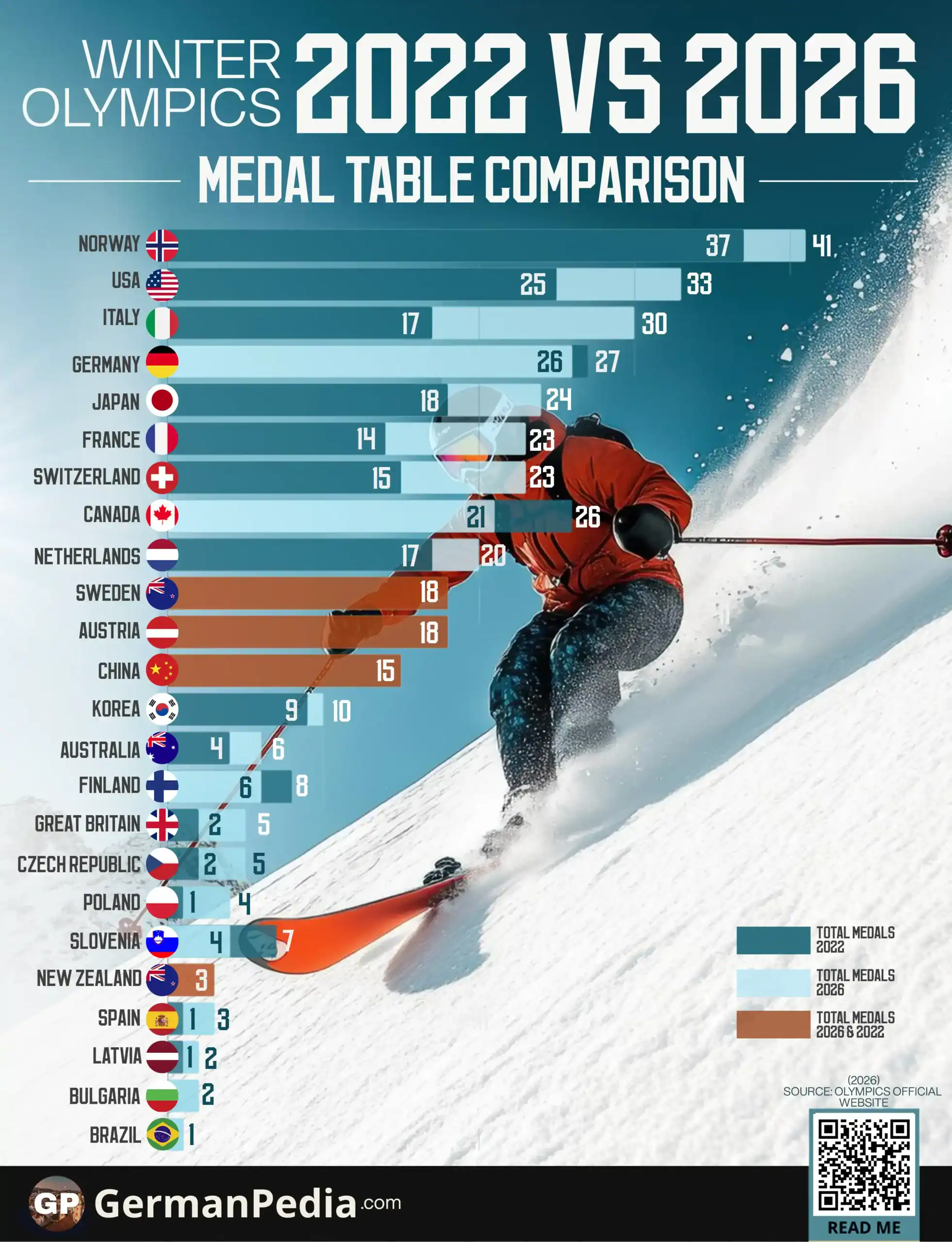
Use this Visualization: You may use this image for free with proper attribution to GermanPedia (i.e., by linking back to GermanPedia).
Need help communicating complex ideas visually? We help you turn data into your most persuasive story. Contact us to learn more.
Winter Olympics Medal Tally 2022 vs 2026
| Rank | Country | Gold Medals | Total Medals | ||
|---|---|---|---|---|---|
| 2022 | 2026 | 2022 | 2026 | ||
| 1 (=) | Norway | 16 | 18 | 37 | 41 |
| 2 (+1) | United States | 9 | 12 | 25 | 33 |
| 3 (+3) | Netherlands | 8 | 10 | 17 | 20 |
| 4 (+9) | Italy | 2 | 10 | 17 | 30 |
| 5 (-3) | Germany | 12 | 8 | 27 | 26 |
| 6 (+4) | France | 5 | 8 | 14 | 23 |
| 7 (-2) | Sweden | 8 | 8 | 18 | 18 |
| 8 (=) | Switzerland | 7 | 6 | 15 | 23 |
| 9 (-2) | Austria | 7 | 5 | 18 | 18 |
| 10 (+2) | Japan | 3 | 5 | 18 | 24 |
| 11 (=) | Canada | 4 | 5 | 26 | 21 |
| 12 (-8) | China | 9 | 5 | 15 | 15 |
| 13 (+1) | Republic of Korea | 2 | 3 | 9 | 10 |
| 14 (+4) | Australia | 1 | 3 | 4 | 6 |
| 15 (+4) | Great Britain | 1 | 3 | 2 | 5 |
| 16 (+5) | Czech Republic | 1 | 2 | 2 | 5 |
| 17 (-2) | Slovenia | 2 | 2 | 7 | 4 |
| 18 (+7) | Spain | 0 | 1 | 1 | 3 |
| 19 (NEW) | Brazil | — | 1 | — | 1 |
| 19 (NEW) | Kazakhstan | — | 1 | — | 1 |
| 21 (+6) | Poland | 0 | 0 | 1 | 4 |
| 22 (-5) | New Zealand | 2 | 0 | 3 | 3 |
| 23 (-7) | Finland | 2 | 0 | 8 | 6 |
| 24 (-4) | Latvia | 0 | 0 | 1 | 2 |
| 25 (NEW) | Denmark | — | 0 | — | 1 |
| 25 (-4) | Estonia | 0 | 0 | 1 | 1 |
| 25 (NEW) | Georgia | — | 0 | — | 1 |
| 28 (NEW) | Bulgaria | — | 0 | — | 2 |
| 29 (-7) | Belgium | 1 | 0 | 2 | 1 |
| — | Hungary* | 1 | — | 3 | — |
| — | Slovakia* | 1 | — | 2 | — |
| — | Ukraine* | 0 | — | 1 | — |
| — | ROC** | 5 | — | 32 | — |
| — | Belarus** | 0 | — | 2 | — |
Source: Olympics Official Website
*Did not win a medal at the 2026 Winter Olympics.
**Banned at the 2026 Winter Olympics.

Four years after the Beijing 2022 Winter Olympics, familiar names still dominate the top of the medal table. But beneath Norway, the order has shifted.
After leading Beijing with 16 gold medals and 37 in total, Norway once again finishes the Milan Cortina 2026 Winter Olympics as the nation to beat.
Eighteen gold medals.
Forty-one in total.
Cross-country skiing. Biathlon. Nordic combined.
When endurance meets depth, Norway delivers.
The gold count rises. The structure holds. The dynasty rolls on.
Winter dominance is not built in a single Olympic cycle. Norway’s layered, patient, relentless system continues to define the benchmark of the Game
If Norway remains the summit, the United States is climbing steadily behind it.
The U.S. moves from third to second in the official gold ranking, scaling up from nine gold medals in 2022 to twelve in 2026. Key U.S. disciplines include:
Freestyle skiing.
Snowboarding.
Ice hockey.
Figure skating.
Few nations compete across the country’s range with equal intensity. In 2026, American depth translated more efficiently into gold. Not enough to dislodge Norway, but enough to overtake Germany and reshape the top three.
Breadth remains the foundation. Gold conversion made the difference.
Then comes the surge.
Italy entered 2026 ranked 13th in gold medals in Beijing. It leaves Milano Cortina ranked fourth.
Two gold medals in 2022 became ten in 2026.
This is what a host cycle can look like at full strength.
Investment accelerates.
Athletes peak at home.
Venues are familiar.
Crowds amplify momentum.
History suggests these surges rarely last forever. China, for example, fell from 9 gold medals in 2022 to 5 in 2026, dropping from fourth to twelfth in the rankings. But in 2026, Italy still turned opportunity into outcome.
The jump was not incremental. It was structural and unmistakable.
Germany’s story is different.
In 2022, Germany ranked second in gold medals with twelve. In 2026, it stands fifth with eight.
The drop in rank is visible. The drop in total medals is not.
Germany’s story is different.
In 2022, Germany ranked second in gold medals with twelve. In 2026, it stands fifth with eight.
The drop in rank is visible. The drop in total medals is not.
The system still delivers.
Germany’s model remains rooted in luge, bobsleigh, and biathlon. These sports are decided by hundredths of a second. In Milano Cortina, several of those margins tilted just enough to shift gold into silver.
German Athletes with the Most Winter Olympic Medals ->
This was not erosion. It was compression.
Germany remains firmly among the winter elite. But the space between the second and the fifth has narrowed.
Beyond these shifts, the larger pattern is hard to ignore. The same nations continue to anchor the gold table.
Milano Cortina 2026 brought energy, storylines, and national highs. Yet when the snow settled, the conclusion felt familiar.
The winter heavyweights are still heavyweights.
Winter Olympic power remains concentrated in countries built on:
- Long-term training systems
- Strong federation funding
- Technical and endurance sport depth
- Decades of accumulated expertise
The medal table moved.
The structure beneath it largely did not.
And in winter sports, that long-term structure is the real champion.
More topics
- Who are Germany’s Most Decorated Winter Olympians?
- Germany’s Medal Race at the 2026 Winter Olympics
- Italy is the Old Man of Europe
- Top Relocation Destinations for Germans
- EU Unicorn Startups: Which Countries Lead and Why
- Germany’s Coldest Winters
- GDP of European Countries
- Countries Driving Germany’s Quarter Trillion Export Surplus
- Germany’s Top Export Partners: Where €1.55 Trillion in Goods Go
- European Union’s Debt Has Grown Sharply Over Two Decades
- Where Do Immigrants in Germany Come From?
- Silver Production in Europe by Country
- How Educated Are Europeans?
- Two Decades of Renewable Energy Growth in Europe
- Life Expectancy in European Countries