
Key Takeaways
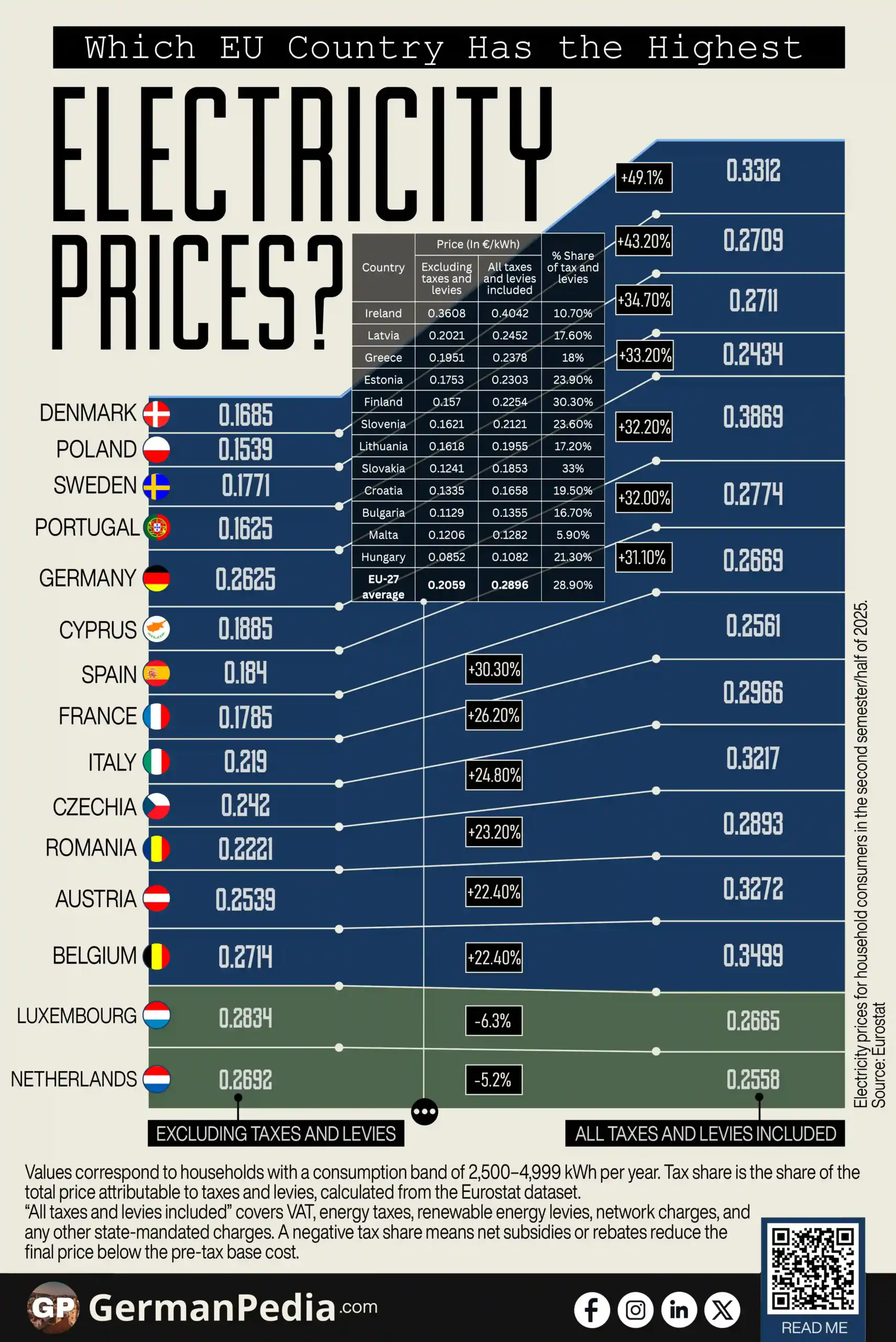
- Ireland has the highest household electricity prices in the EU at €0.40 per kilowatt-hour. Only 11% of that price is taxes. The base electricity cost alone, before any levies, is the highest in the EU. It is driven by gas dependency, a large rural grid, and limited interconnection with other markets.
- Denmark pays €0.33 per kilowatt-hour. However, 49% of that electricity price is taxes and levies. Its base electricity cost sits below the EU average. Denmark plans to cut its electricity levy to the EU minimum rate from January 2026.
- Germany ranks second in the EU at €0.39 per kilowatt-hour. Taxes and levies account for 32% of the total bill. It is added through the offshore wind grid surcharge, the grid fee surcharge, and the Combined Heat and Power levy.
- Poland ranks eleventh in the EU for total price but has the second-highest tax share at 43%. Its base electricity cost falls below the EU average.
- Luxembourg and the Netherlands are the only two EU countries where government subsidies and allowances exceed electricity taxes. Their total prices with subsidies applied are lower than their base electricity costs before taxes.
- The EU average tax share rose from 28% in the first half of 2025 to 29% in the second half. Governments continue to scale back energy subsidies introduced during the 2022 price shock.
Use this Visualization: You may use this image for free with proper attribution to GermanPedia (i.e., by linking back to GermanPedia).
Need help communicating complex ideas visually? We help you turn data into your most persuasive story. Contact us to learn more.
Electricity Prices for Household Consumers Across EU Countries
| Country | Price (In €/kWh) | % Share of tax and levies | |
|---|---|---|---|
| Excluding taxes and levies | All taxes and levies included | ||
| Ireland | 0.3608 | 0.4042 | +10.7% |
| Germany | 0.2625 | 0.3869 | +32.2% |
| Belgium | 0.2714 | 0.3499 | +22.4% |
| Denmark | 0.1685 | 0.3312 | +49.1% |
| Austria | 0.2539 | 0.3272 | +22.4% |
| Czechia | 0.2420 | 0.3217 | +24.8% |
| Italy | 0.2190 | 0.2966 | +26.2% |
| Romania | 0.2221 | 0.2893 | +23.2% |
| Cyprus | 0.1885 | 0.2774 | +32.0% |
| Sweden | 0.1771 | 0.2711 | +34.7% |
| Poland | 0.1539 | 0.2709 | +43.2% |
| Spain | 0.1840 | 0.2669 | +31.1% |
| Luxembourg | 0.2834 | 0.2665 | −6.3% |
| France | 0.1785 | 0.2561 | +30.3% |
| Netherlands | 0.2692 | 0.2558 | −5.2% |
| Latvia | 0.2021 | 0.2452 | +17.6% |
| Portugal | 0.1625 | 0.2434 | +33.2% |
| Greece | 0.1951 | 0.2378 | +18.0% |
| Estonia | 0.1753 | 0.2303 | +23.9% |
| Finland | 0.1570 | 0.2254 | +30.3% |
| Slovenia | 0.1621 | 0.2121 | +23.6% |
| Lithuania | 0.1618 | 0.1955 | +17.2% |
| Slovakia | 0.1241 | 0.1853 | +33.0% |
| Croatia | 0.1335 | 0.1658 | +19.5% |
| Bulgaria | 0.1129 | 0.1355 | +16.7% |
| Malta | 0.1206 | 0.1282 | +5.9% |
| Hungary | 0.0852 | 0.1082 | +21.3% |
| EU-27 average | 0.2059 | 0.2896 | +28.9% |
Source: Eurostat
Values correspond to households with a consumption band of 2,500–4,999 kWh per year. Tax share is the share of the total price attributable to taxes and levies, calculated from the Eurostat dataset.
“All taxes and levies included” covers VAT, energy taxes, renewable energy levies, network charges, and any other state-mandated charges. A negative tax share means net subsidies or rebates reduce the final price below the pre-tax base cost.

The EU average household electricity price in the second half of 2025 was €0.29 per kilowatt-hour. Taxes and levies made up 29% of that total on average. That share has risen from 28% in the first half of 2025 as governments continue to scale back the energy subsidies introduced during the 2022 price shock.
Ireland and Denmark both rank among the top four most expensive countries for household electricity in the EU. Ireland pays €0.40 per kilowatt-hour. Denmark pays €0.33. In Denmark, 49 cents of every euro on the electricity bill goes to taxes and levies. In Ireland, only 11 cents does. The same ranking places two countries at the top for completely different reasons.
Hungary, Malta, and Bulgaria paid the lowest prices in the EU, each below €0.14. The spread from cheapest to most expensive runs from €0.11 in Hungary to €0.40 in Ireland.
Denmark Reaches the Top Four Electricity Prices on Taxes Alone
Some countries pay high total electricity prices despite cheap underlying energy costs. Taxes and levies account for the difference. Denmark is the clearest example.
Denmark’s base electricity cost is €0.17 per kilowatt-hour. That is below the EU average of €0.21. Taxes and levies add €0.16 on top. The tax layer is almost as large as the energy cost itself.
Poland follows the same pattern. The base electricity cost of €0.15 rises to €0.27 once taxes are added. Levies account for 43% of Poland’s final price.
Denmark plans to cut its electricity levy to the EU minimum rate from January 2026. Poland moves in the opposite direction. A household electricity price cap expired at the end of 2025 with no replacement measure. Poland’s prices are likely to rise further in 2026.
Germany sits near the top of the ranking for different reasons.
Germany’s High Bill Combines an Elevated Base Electricity Cost With Policy Levies
Unlike Denmark, Germany’s base electricity cost is already high at €0.26 per kilowatt-hour, in the upper third of EU countries. Taxes and levies add a further €0.12. This pushes the total to €0.39.
Germany abolished the Renewable Energy Act surcharge in 2022. Germany also raised capacity-related charges in 2025. The main levies include the offshore wind grid surcharge, the grid fee surcharge, and the Combined Heat and Power levy. Germany’s second-place position in the EU ranking follows from two separate cost pressures. It has a high base price and accumulated policy levies.
Ireland’s High Prices Come From Generation Costs, Not Taxes
Ireland ranks first in the EU for total household electricity prices at €0.40 per kilowatt-hour. Only 11% of that price is taxes. The base electricity cost of €0.36 is the highest in the EU before any levies are applied. Ireland’s problem is structural.
- Gas generates over 40% of Irish electricity. The generation cost of gas-fired power sets the market price for all electricity sold in any given hour. This applies even to electricity generated from cheaper sources.
- Grid costs: Ireland’s distribution network covers a large rural territory relative to its population. Moving electricity across that network costs proportionally more than in densely populated EU countries.
- Interconnection: Ireland connects to external electricity markets through two interconnectors with the United Kingdom. A new connection with France is due in 2028. Limited interconnection reduces Ireland’s ability to source cheaper electricity from abroad when domestic generation is expensive.
Luxembourg and the Netherlands Pay Less in Taxes
Luxembourg and the Netherlands are the only two countries in the EU where taxes and levies reduce the final electricity price below the base electricity cost. Luxembourg’s base cost is €0.28 per kilowatt-hour. Its total price after taxes is €0.27. The Netherlands follows the same pattern. It has a base cost of €0.27, which falls to €0.26 once taxes are applied. Government subsidies and allowances in both countries exceed the taxes collected on electricity. The tax share is −6.3% in Luxembourg and −5.2% in the Netherlands.
The EU electricity price table tells you what households pay at the meter. It does not separate energy market costs from policy costs. For Denmark, Poland, and Germany, the gap between base electricity cost and total price reflects decisions on levies and subsidies. Those can change by legislation. For Ireland, the gap traces to fuel dependency, grid geography, and limited market access. These factors change slowly.
More topics
- Which EU Country Uses the Most Electricity?
- The Best EU Countries to Retire In
- EU Passports Are Among the Strongest in the World
- How Do Germans Perceive Other Countries as Allies and Threats?
- Which EU Cities Have the Most Millionaires?
- Which Are the Busiest Airports in the EU?
- Popular Study Destinations for German Students
- The Busiest Container Ports in Europe by TEU
- Countries Driving Germany’s Quarter Trillion Export Surplus
- Which EU Countries Have the Most Soft Power?
- Which EU Countries Have the Highest Equity Risk Premiums?
- Most Surveilled Major Cities in the EU
- EU Wage Growth In The Last Two Decades
- Which EU Countries Have the Highest Obesity Rates?
- EU House Price Index Rises Over 60% Since 2010
- EU Unicorn Startups: Which Countries Lead and Why
- Adoption of Electric and Hybrid Passenger Cars in the EU
References
- https://ec.europa.eu/eurostat/statistics-explained/index.php?title=Electricity_price_statistics
- https://ec.europa.eu/eurostat/databrowser/view/nrg_pc_204/default/table?lang=en
- https://www.rte.ie/news/ireland/2026/0523/1574815-ireland-electricity-prices/
- https://www.thejournal.ie/esri-electricity-prices-7011725-Apr2026/
- https://www.thelocal.dk/20251217/how-much-will-denmarks-new-minimum-electricity-tax-save-you-in-2026/
- https://www.bundesregierung.de/breg-en/federal-government/renewable-energy-sources-act-levy-abolished-2011854