Key Takeaways
- Germany and France have the largest number of unicorns in the EU. This reflects the advantages of large domestic markets, deep pools of venture and growth capital, and long-established scaling ecosystems.
- A middle tier of countries with four to nine unicorns tends to produce unicorns through internationalisation rather than market size. They rely on early cross-border expansion and global demand.
- Countries with few or no unicorns are not less entrepreneurial. Instead, they face structural constraints. These include smaller home markets, limited access to late-stage funding, and fewer pathways for seamless cross-border scaling.
- Unicorn counts are best understood as a signal of where scale and capital converge, rather than where innovation or entrepreneurship begins.
Use this Visualization: You may use this image for free with proper attribution to GermanPedia (i.e., by linking back to GermanPedia).
Need help communicating complex ideas visually? We help you turn data into your most persuasive story. Contact us to learn more.
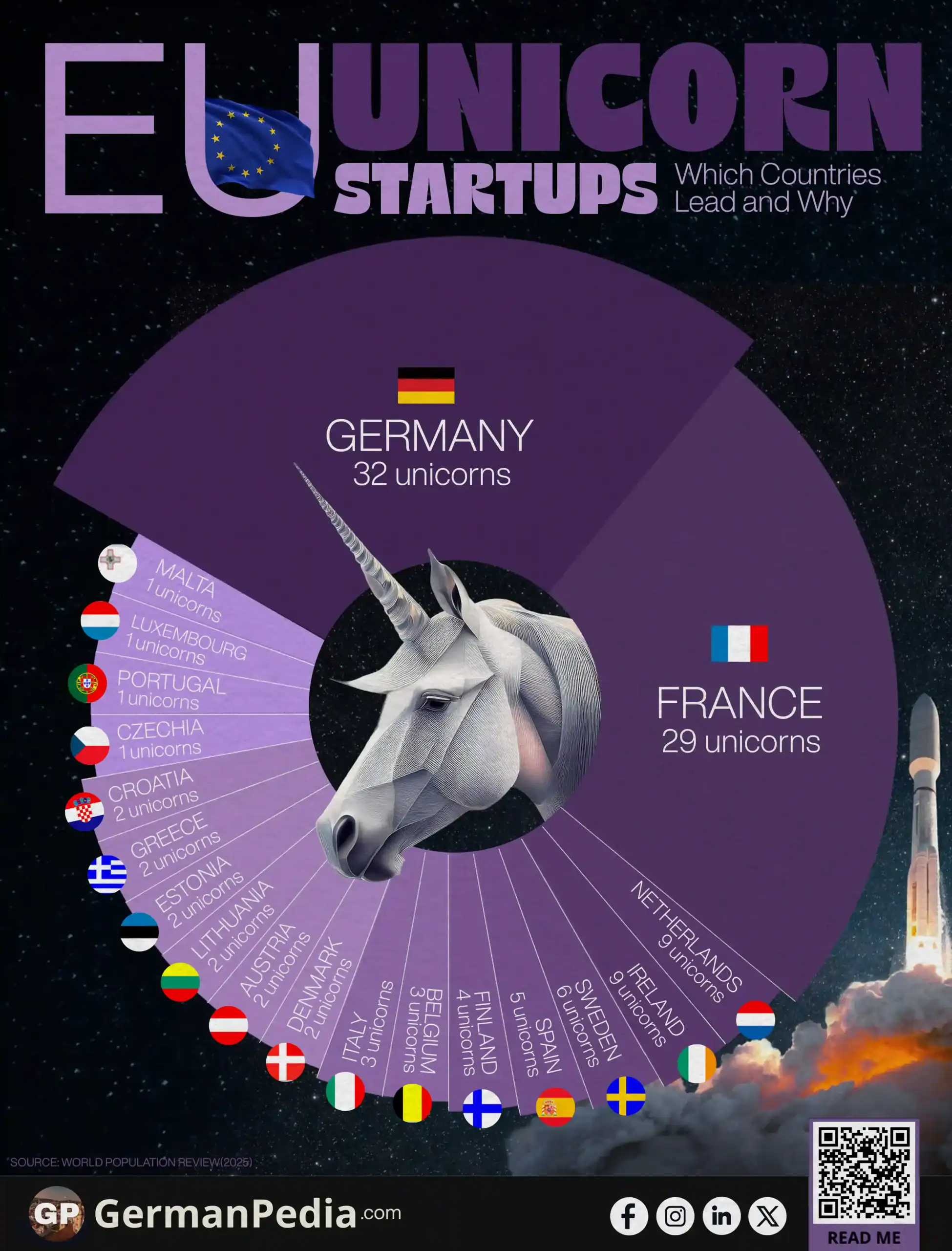
The distribution of unicorn startups within the European Union is highly uneven. A small group of countries accounts for the majority of EU unicorns, while many member states have few or none at all.
Number of Unicorns by EU Country
| Country | Number of Unicorns |
|---|---|
| Germany | 32 |
| France | 29 |
| Netherlands | 9 |
| Ireland | 9 |
| Sweden | 6 |
| Spain | 5 |
| Finland | 4 |
| Belgium | 3 |
| Italy | 3 |
| Denmark | 2 |
| Austria | 2 |
| Lithuania | 2 |
| Estonia | 2 |
| Greece | 2 |
| Croatia | 2 |
| Portugal | 1 |
| Czechia | 1 |
| Luxembourg | 1 |
| Malta | 1 |
| Poland | — |
| Hungary | — |
| Slovakia | — |
| Slovenia | — |
| Latvia | — |
| Bulgaria | — |
| Romania | — |
| Cyprus | — |
Source: World Population Review

Germany hosts the largest number of unicorn startups in the European Union, with 32 unicorns. France follows closely with 29 unicorns. Together, the two countries account for the largest shares of all EU unicorns.
This reflects their structural advantages:
- large domestic markets
- strong industrial or consumer bases
- deep pools of venture and growth capital
Germany & France’s GDPs are the Highest in the EU ->
Germany’s GDP growth over time ->
In both Germany and France, unicorn creation has been gradual rather than explosive. It is shaped by long development cycles and late-stage valuation recognition.
Behind Germany and France sits a smaller group of countries with mid-sized unicorn ecosystems.
- The Netherlands (9) and Ireland (9) benefit from highly internationalised business environments and strong links to global capital markets.
- Sweden’s unicorn count (6) shows its long-standing strength in export-oriented technology and digital platforms despite its smaller population.
- Spain (5) and Finland (4) show that smaller markets can produce unicorns when startups are tightly connected to international demand and able to scale beyond national borders early.
Most EU countries have one to three unicorns, and several have none at all. This is especially visible across parts of Central, Eastern, and Southern Europe.
This does not mean that countries with fewer unicorns lack entrepreneurship. Instead, it highlights how difficult it is to reach billion-dollar valuations without:
- a large home market to scale into,
- access to late-stage funding,
- easy cross-border expansion
For this reason, unicorn counts are a weak indicator of early-stage innovation. Instead, it is a strong indicator of where scale and capital come together. They show where companies are able to grow large, remain private, and attract global capital.
More topics
- Top 25 Richest People in Germany (2025)
- Germany’s Smoking Rate Has Declined Over Two Decades
- Germany’s Electricity Mix: From Coal to Renewables
- Changes in Harvest of Germany’s Five Key Crops
- Top German Companies by Revenue
- Germany’s Top Car Brands by New Registrations
- Unemployment Across Germany: A Federal State Breakdown
- Where Germany’s Tourists Come From
- Germany’s Largest National Parks, Ranked by Size
- Which Federal States Drive Germany’s Economy?
- Here’s Why Divorces in Germany Are Falling
- Germans Are Marrying Later Than Ever
- How Marriage Rates Have Fallen in Germany: 1990–2023
- How Germany’s Birth Rates Dropped and Deaths Rose
- Leading Causes of Death in Germany