Key Takeaways
- Soft power reflects how well a country can influence others through reputation, trust, and global visibility, rather than force.
- Germany ranks as the EU’s leading soft-power country and 5th globally, supported by strengths in education, technology, business, and trade. However, its score declined in 2026, reflecting weaker perceptions of its economic outlook, innovation leadership, and political transition.
- France, Italy, and Spain remain in the global top tier, but each draws on different sources of soft power, from culture and diplomacy to tourism and global brands.
- Many Western countries, including those in the EU, are seeing a softening in global perceptions, linked to economic uncertainty, political factors, and shifting geopolitical dynamics.
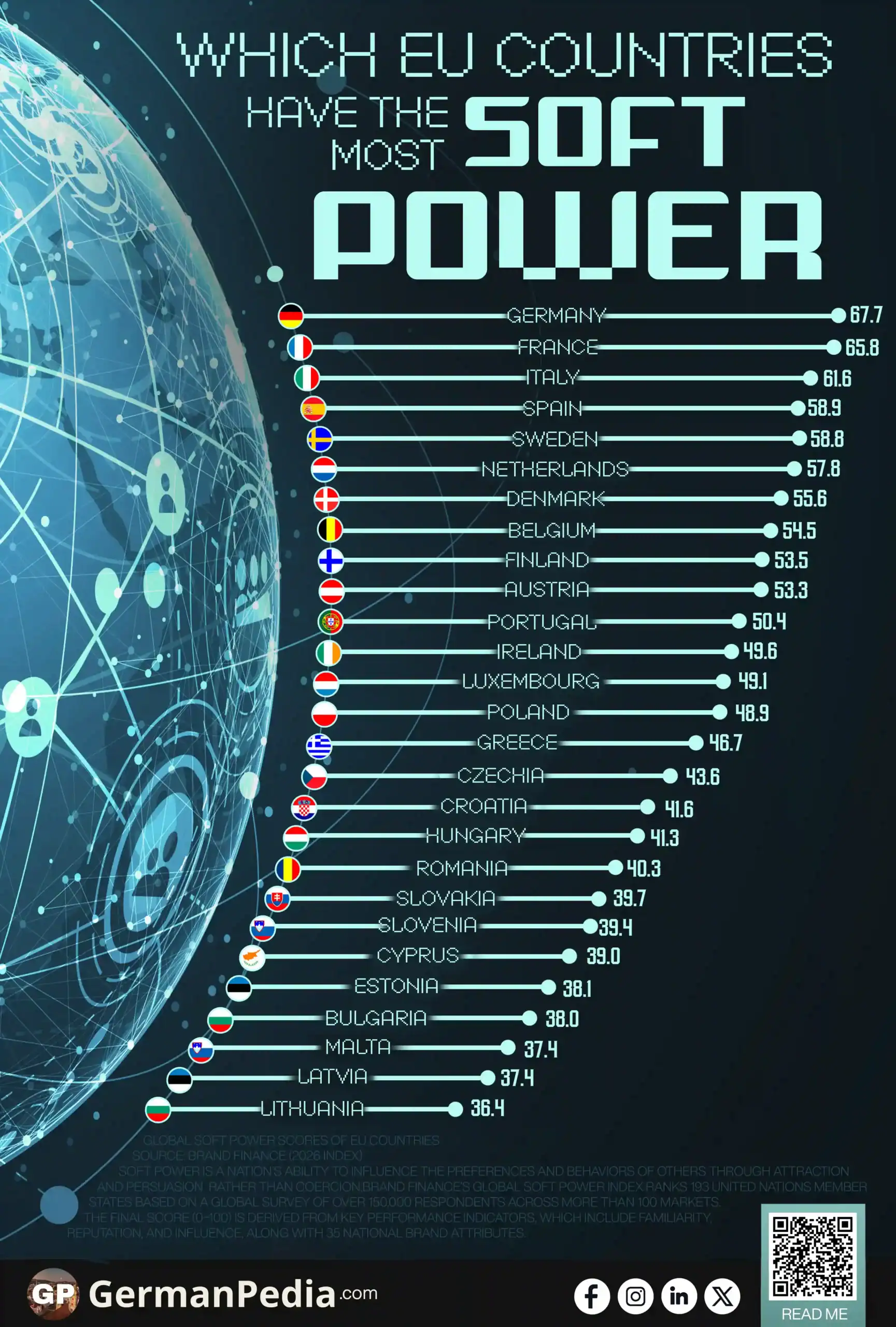
Use this Visualization: You may use this image for free with proper attribution to GermanPedia (i.e., by linking back to GermanPedia).
Need help communicating complex ideas visually? We help you turn data into your most persuasive story. Contact us to learn more.
EU Global Soft Power Index
| Global Rank | Country | Soft Power Score (Change vs. Previous Year) |
|---|---|---|
| 5 | Germany | 67.7 (-2.4) |
| 6 | France | 65.8 (-2.7) |
| 9 | Italy | 61.6 (-0.8) |
| 12 | Spain | 58.9 (-0.8) |
| 13 | Sweden | 58.8 (-1.5) |
| 15 | Netherlands | 57.8 (-0.9) |
| 18 | Denmark | 55.6 (-0.9) |
| 22 | Belgium | 54.5 (-1.5) |
| 23 | Finland | 53.5 (-1.0) |
| 24 | Austria | 53.3 (-0.6) |
| 27 | Portugal | 50.4 (-0.7) |
| 28 | Ireland | 49.6 (-0.9) |
| 30 | Luxembourg | 49.1 (-0.9) |
| 31 | Poland | 48.9 (+0.2) |
| 33 | Greece | 46.7 (-0.1) |
| 44 | Czechia | 43.6 (+0.1) |
| 46 | Croatia | 41.6 (+0.4) |
| 48 | Hungary | 41.3 (-0.6) |
| 53 | Romania | 40.3 (+0.8) |
| 55 | Slovakia | 39.7 (+0.7) |
| 57 | Slovenia | 39.4 (-0.1) |
| 60 | Cyprus | 39.0 (+0.1) |
| 67 | Estonia | 38.1 (-0.2) |
| 68 | Bulgaria | 38.0 (+0.3) |
| 69 | Malta | 37.4 (-0.5) |
| 70 | Latvia | 37.4 (+0.9) |
| 79 | Lithuania | 36.4 (-1.0) |
Source: Brand Finance (2026 Index)
Soft Power is a nation’s ability to influence the preferences and behaviors of others through attraction and persuasion rather than coercion.
Brand Finance’s Global Soft Power Index ranks 193 United Nations member states based on a global survey of over 150,000 respondents across more than 100 markets. The final score (0–100) is derived from key performance indicators, which include familiarity, reputation, and influence, along with 35 national brand attributes.

Soft power is a country’s ability to influence others through attraction rather than force. In the Global Soft Power Index 2026, a higher score reflects a stronger reputation, familiarity, and global influence, showing how a country is perceived internationally.
In 2026, many EU countries rank relatively high in global soft power.
At the top is Germany, which ranks 5th globally with a score of 67.7. Its position is supported by strong perceptions in education, technology, business, and trade, alongside a broad international presence.
However, Germany’s soft power score declined compared to the previous year. Several factors have weighed on its global image, including:
- a slower economic outlook
- a less prominent role in emerging areas such as AI
- a period of political transition, as Friedrich Merz has yet to establish the same international authority associated with Angela Merkel
It is followed by other leading countries that are highly visible globally and influential across multiple areas, but whose strengths differ:
- France (65.8) — Strong in culture, diplomacy, and global visibility, which shape its international image
- Italy (61.6) — Most resilient in Top 10 nation brands; with soft power driven by global brands, and cultural appeal
- Spain (58.9) — Strong international appeal driven by tourism, culture, and heritage, and a globally recognized sports culture
At the same time, many Western countries, including those in the EU, are seeing a softening in global perceptions. This is linked to weaker confidence in economic performance, political leadership, and long-term direction, as well as broader geopolitical shifts.
This trend is visible even among top performers, like Germany. Meanwhile, countries like Italy have been able to limit declines by maintaining relevance in global narratives and international partnerships.
Overall, Europe remains a significant soft-power region, shaped by different strengths across countries. But as global perceptions shift, maintaining that influence increasingly depends on how countries sustain credibility and adapt to changing expectations.
More topics
- EU Wage Growth In The Last Two Decades
- 49% of Young Adults Live With Their Parents in the EU
- EU Unicorn Startups: Which Countries Lead and Why
- Germany’s Top Car Brands by New Registrations
- US Oil Exports to the EU Are Highly Concentrated
- Homeownership Rate in the EU
- EU Countries Are Only Partly Self-Sufficient in Food
- Internet Freedom in the EU Is High but Shaped by National Rules
- EU Wage Growth In The Last Two Decades
- Adoption of Electric and Hybrid Passenger Cars in the EU
- Net Household Saving Rates in the EU Over Time
- Countries Driving Germany’s Quarter Trillion Export Surplus
- Where are Data Centers Concentrated in the EU?
- Most Surveilled Major Cities in the EU
- EU Relies on Imports for Natural Gas