
Key Takeaways
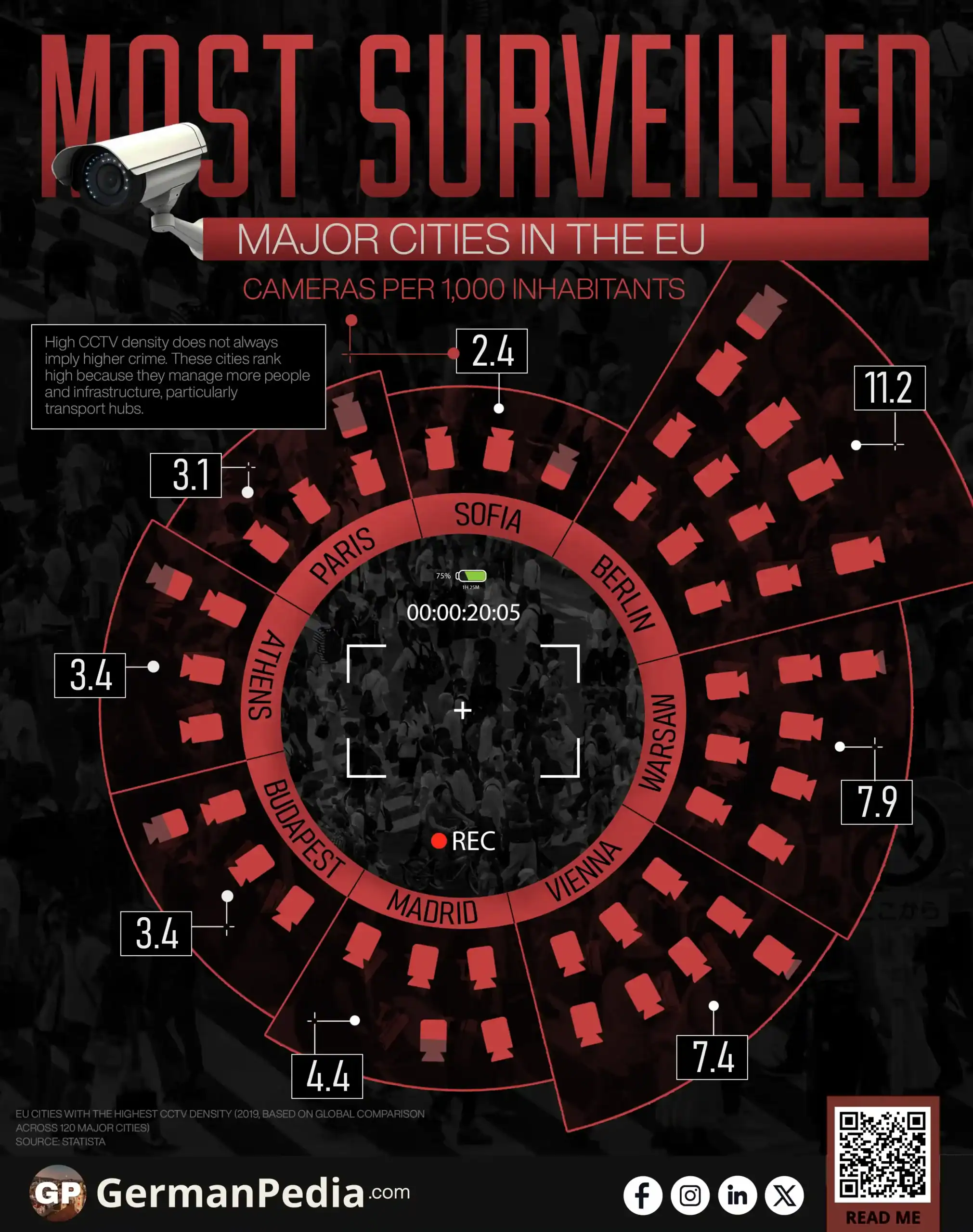
- Berlin has the highest CCTV density in the EU with 11.2 cameras per 1,000 residents. This is mainly driven by its position as the country’s capital and a major transport hub. This is amplified by Germany’s legal framework on surveillance.
- High CCTV density does not always imply higher crime. These cities rank high because they manage more people and infrastructure, particularly transport hubs.
Use this Visualization: You may use this image for free with proper attribution to GermanPedia (i.e., by linking back to GermanPedia).
Need help communicating complex ideas visually? We help you turn data into your most persuasive story. Contact us to learn more.
EU Cities With the Most CCTV Cameras
| City | Cameras per 1,000 inhabitants |
|---|---|
| Berlin | 11.2 |
| Warsaw | 7.9 |
| Vienna | 7.4 |
| Madrid | 4.4 |
| Budapest | 3.4 |
| Athens | 3.4 |
| Paris | 3.1 |
| Sofia | 2.4 |
Source: Statista

Across the EU, some major cities stand out with much higher camera density.
Berlin leads this comparison with 11.2 cameras per 1,000 residents. As Germany’s capital and a major transport hub, Berlin has more concentrated surveillance than most other German cities.
At the same time, Germany has clear legal frameworks around surveillance that balance safety with privacy. This includes:
- Privacy law matters. Surveillance must follow data-protection rules.
- Public-space monitoring is regulated. Cameras in streets, stations, and other public areas need a legal basis.
- Footage use is limited. Rules affect not only where cameras can be placed, but also how footage is stored and accessed.
Cities like Vienna, Warsaw, and Madrid also tend to have more cameras in busy transport areas and central public spaces. This is usually linked to dense transit networks, heavy daily movement, and large public gathering areas.
These figures are often misunderstood. They do not always indicate which cities are the most dangerous. Instead, they often reflect how busy, complex, and heavily used a city is, especially in transport hubs and other major public spaces.
More topics
- Which Countries Use AI the Most in the EU?
- Sexual Violence and Rape Increased in the EU
- Claude Usage in the EU: Which Countries Lead and Why?
- Top 10 Biggest EU Companies Led by Women
- Top 13 Most Valuable Brands in the EU
- Top 10 Richest Women in the EU
- Where are Billionaires Concentrated in the EU?
- Employment by Federal State in Germany
- Germany’s Median Wage by Federal State
- Italy is the Old Man of Europe
- Which Federal States Drive Germany’s Economy?
- EU Unicorn Startups: Which Countries Lead and Why
- Women Are Increasing in Managerial Roles Across the EU
- Top EU Countries Where People Say They Don’t Need AI
- Happiness vs Income in the EU