
Key Takeaways
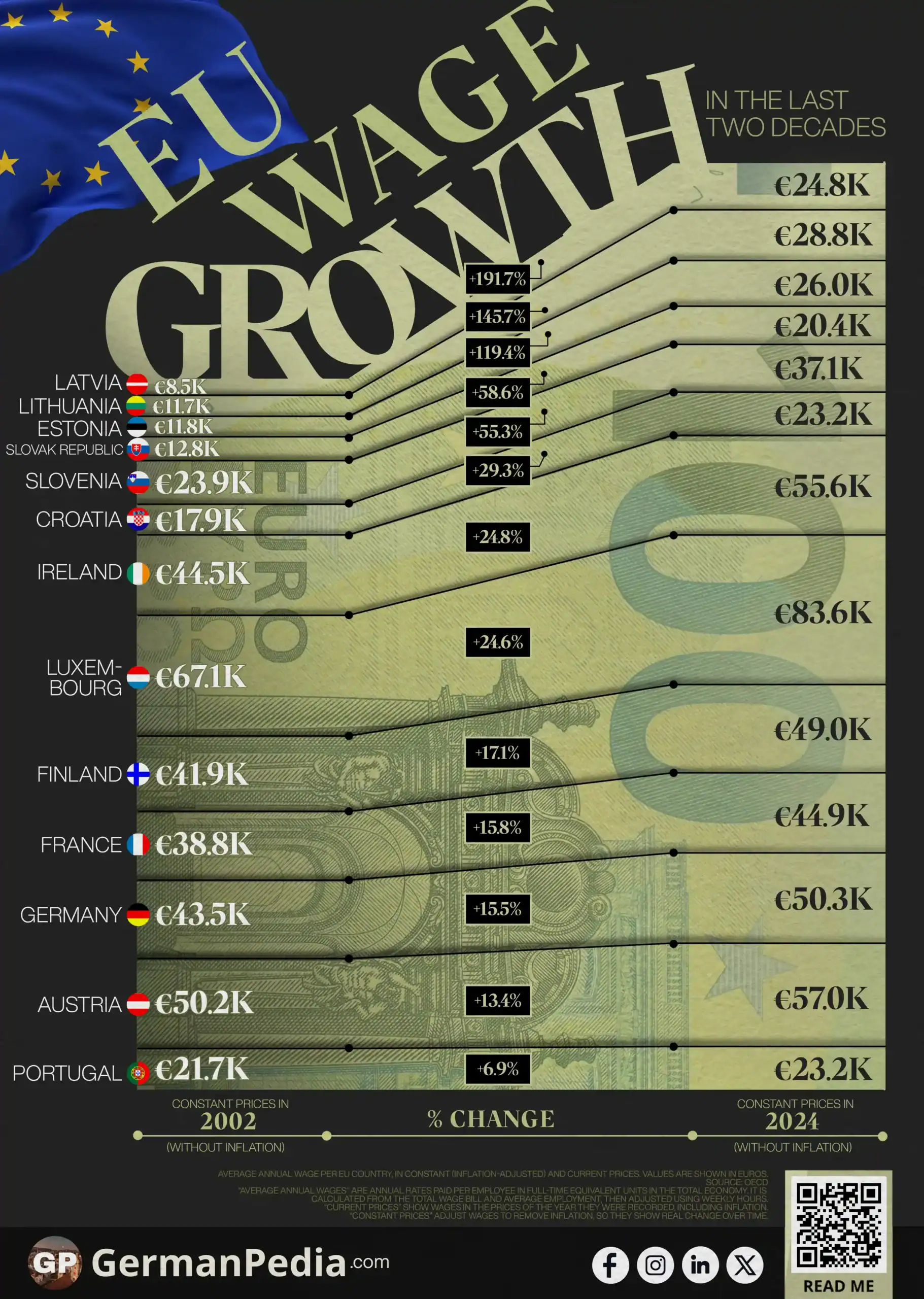
- Latvia (+191.7%), Lithuania (+145.7%), and Estonia (+119.4%) had the fastest real wage growth in the EU between 2002 and 2024. These are lower-wage countries catching up to richer EU economies.
- Wages in Western Europe, including Germany (+15.5%), France (+15.8%), and Austria (+13.4%), grew more slowly after inflation. These countries already had higher wage levels to begin with.
- In Southern Europe, wage growth after inflation was weaker, with declines in Greece (−16.8%) and Italy (−2.3%). This reflects factors such as slow productivity growth and the long-term effects of the eurozone crisis.
- Across the countries shown, nominal wage growth is consistently higher than real wage growth or inflation-adjusted numbers. This highlights the impact of inflation over time.
- Wage levels across the EU are slowly moving closer together. However, local economic conditions mean some countries are catching up at different speeds.
Use this Visualization: You may use this image for free with proper attribution to GermanPedia (i.e., by linking back to GermanPedia).
Need help communicating complex ideas visually? We help you turn data into your most persuasive story. Contact us to learn more.
EU Annual Wage Growth
| Country | Constant Prices (In € thousands) | Current Prices (In € thousands) | ||
|---|---|---|---|---|
| 2002 / 2024 | % Change | 2002 / 2024 | % Change | |
| Latvia | 8.5 / 24.8 | +191.7% | 4.3 / 24.8 | +472.7% |
| Lithuania | 11.7 / 28.8 | +145.7% | 6.6 / 28.8 | +336.7% |
| Estonia | 11.8 / 26.0 | +119.4% | 6.2 / 26.0 | +320.2% |
| Slovak Republic | 12.8 / 20.4 | +58.6% | 7.3 / 20.4 | +177.7% |
| Slovenia | 23.9 / 37.1 | +55.3% | 15.9 / 37.1 | +133.9% |
| Croatia | 17.9 / 23.2 | +29.3% | 11.5 / 22.9 | +99.5% |
| Ireland | 44.5 / 55.6 | +24.8% | 34.9 / 55.6 | +59.3% |
| Luxembourg | 67.1 / 83.6 | +24.6% | 45.5 / 83.6 | +83.9% |
| Finland | 41.9 / 49.0 | +17.1% | 32.0 / 49.0 | +53.2% |
| France | 38.8 / 44.9 | +15.8% | 29.0 / 44.9 | +55.0% |
| Germany | 43.5 / 50.3 | +15.5% | 30.2 / 50.3 | +66.5% |
| Austria | 50.2 / 57.0 | +13.4% | 29.2 / 57.0 | +94.9% |
| Portugal | 21.7 / 23.2 | +6.9% | 14.4 / 23.2 | +60.7% |
| Belgium | 55.6 / 59.1 | +6.3% | 34.3 / 59.1 | +72.0% |
| Spain | 31.4 / 33.0 | +5.1% | 20.7 / 33.0 | +59.8% |
| Netherlands | 56.7 / 58.2 | +2.7% | 36.9 / 58.2 | +57.8% |
| Italy | 33.9 / 33.1 | −2.3% | 24.1 / 33.1 | +37.7% |
| Greece | 22.2 / 18.5 | −16.8% | 18.3 / 18.5 | +0.8% |
Source: OECD
“Average annual wages” are annual rates paid per employee in full-time equivalent units in the total economy. It is calculated from the total wage bill and average employment, then adjusted using weekly hours.
“Current prices” show wages in the prices of the year they were recorded, including inflation.
“Constant prices” adjust wages to remove inflation, so they show real change in what wages could buy over time.

Between 2002 and 2024, wages increased across most EU countries. But how big that increase looks depends on how you measure it.
Wages are shown two ways:
- Current prices: the actual euro amount paid that year, including inflation.
- Constant prices: adjusted to remove inflation, showing the real change in what wages could buy.
For example, a 50% pay rise sounds big. But if prices also rose 40% over those years, the real gain, what that extra money can actually buy, is closer to 7%. That 7% gain is what “constant prices” captures.
This is why current prices usually show bigger gains, while constant prices give a clearer picture of changes in purchasing power.
Actual Consumption per Capita vs GDP Per Capita in the EU ->
The strongest increases in real wages were recorded in Eastern Europe, particularly the Baltic states:
- Latvia: 8.5 → 24.8 (+191.7%)
- Lithuania: 11.7 → 28.8 (+145.7%)
- Estonia: 11.8 → 26.0 (+119.4%)
In current prices, the increases are even larger:
- Latvia: +472.7%
- Lithuania: +336.7%
- Estonia: +320.2%
This gap shows how much of the current-price growth simply reflects rising prices. Even after removing inflation, wages in constant prices still rose strongly.
This fits a catch-up pattern. Economies that start with lower wages tend to grow faster as they close the gap with richer countries.
A few factors help explain this trend:
- Tight labor markets: There were not enough available workers to fill open jobs.
- Foreign investment and foreign-owned firms supported demand for workers and productivity in parts of the region.
- In the Baltic states, emigration helped tighten labor markets and add upward pressure on wages in some cases.
These patterns suggest that strong wage growth in constant prices can reflect catching up from a lower starting point, rather than an already high income level.
In Western Europe, wage growth in constant prices was more moderate than in the Baltic states:
- Germany: 43.5 → 50.3 (+15.5%)
- France: 38.8 → 44.9 (+15.8%)
- Austria: 50.2 → 57.0 (+13.4%)
In current prices, these increases are higher. They are often between 55% and 95%. That reflects the impact of inflation over time.
These countries also started from much higher wage levels. So a real increase in pay shows up as a smaller percentage here, even though current-price gains can look far more dramatic.
Wage growth after inflation was weakest in parts of Southern Europe. Greece (−16.8%) and Italy (−2.3%) saw real wages fall, while Spain (+5.1%) and Portugal (+6.9%) posted only modest gains.
These countries faced weaker economic conditions than faster-growing parts of Europe. A few factors help explain why:
- Low productivity growth: output per worker was rising slowly, which limited room for wage increases.
- Insufficient investment: businesses invested less in equipment and other capital. This held back productivity and long-term growth.
- Demographic decline: an aging or shrinking population weakens long-term economic momentum.
- The eurozone crisis was a debt crisis that forced deep government spending cuts across southern Europe in the early 2010s. Its long recovery weighed heavily on Southern Europe, especially Greece.
Overall, these patterns show that the annual wage growth across the EU is converging. However, regional differences play a part in the pace and direction of that convergence.
More topics
- GDP per Capita vs Actual Consumption per Capita in the EU
- Net Household Saving Rates in the EU Over Time
- Where are Billionaires Concentrated in the EU?
- Happiness vs Income in the EU
- Which Countries Use AI the Most in the EU?
- Electric and Hybrid Cars in the EU: Who Is Leading the Shift?
- Claude Usage in the EU: Which Countries Lead and Why?
- Petrol Prices Are Rising Across the EU
- Top 13 Most Valuable Brands in the EU
- EU Countries with the Most U.S. Troops
- Where are Billionaires Concentrated in the EU?
- Employment by Federal State in Germany
- Foreign-Born Population in the EU Is Rising
- Top EU Countries Where People Say They Don’t Need AI
- EU Alternatives to Common US Platforms
References
- https://data-explorer.oecd.org/vis?tm=average+annual+wage&pg=0&snb=26&vw=tb&df[ds]=dsDisseminateFinalDMZ&df[id]=DSD_EARNINGS%40AV_AN_WAGE&df[ag]=OECD.ELS.SAE&df[vs]=1.0&dq=AUT%2BBEL%2BBGR%2BHRV%2BROU%2BCZE%2BDNK%2BEST%2BFIN%2BFRA%2BDEU%2BGRC%2BHUN%2BIRL%2BITA%2BLVA%2BLTU%2BLUX%2BNLD%2BPOL%2BPRT%2BSVN%2BSVK%2BESP%2BSWE..EUR..Q..&pd=1990%2C2024&to[TIME_PERIOD]=false&ly[cl]=TIME_PERIOD&ly[rw]=REF_AREA
- https://www.oecd.org/en/data/indicators/average-annual-wages.html
- https://www.ecb.europa.eu/pub/pdf/other/ebbox201705_01.en.pdf
- https://d-nb.info/1097336476/34
- https://economic-research.bnpparibas.com/html/en-US/Southern-Europe-such-potential-growth-30/11/2020,39584
- https://www.cambridge.org/core/journals/european-journal-of-political-research/article/stateled-wage-devaluation-in-southern-europe-in-the-wake-of-the-eurozone-crisis/B1DAA475EEC6A7AA5CF4C29EDA87A862