
Key Takeaways
- Primary school teacher salaries in the EU are influenced by statutory pay scales, national wage levels, and GDP per capita.
- Luxembourg ($87.9) and Germany ($78.9) lead in terms of high starting salaries for primary school teachers.
- Luxembourg’s teacher pay growth is driven by centrally regulated salary scales and career progression.
- Central and Eastern European countries tend to have lower starting salaries for primary school teachers. It is a reflection of lower GDP per capita and overall wage levels.
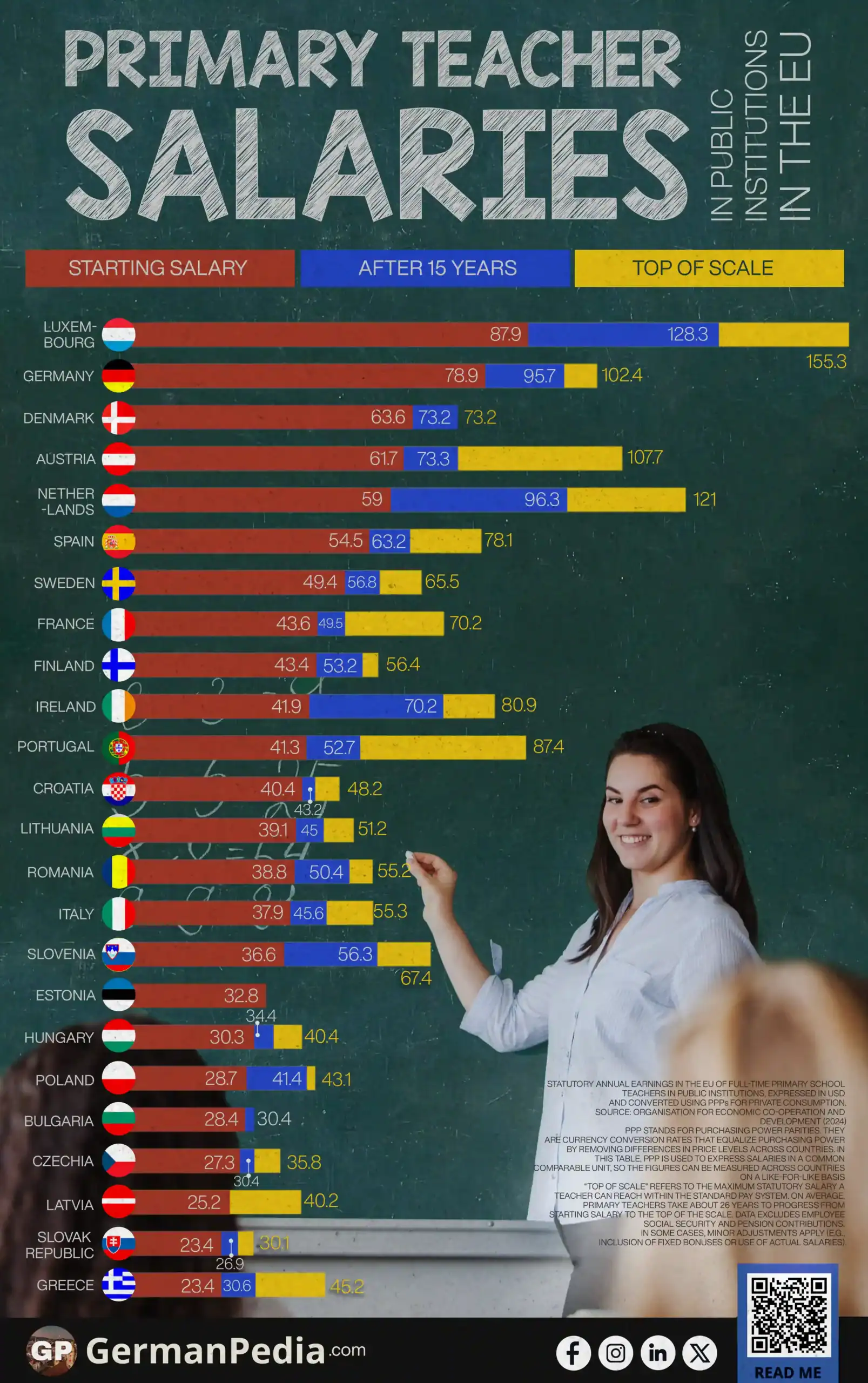
Use this Visualization: You may use this image for free with proper attribution to GermanPedia (i.e., by linking back to GermanPedia).
Need help communicating complex ideas visually? We help you turn data into your most persuasive story. Contact us to learn more.
Annual Salary of EU Primary School Teachers in Public Institutions
| Country | Annual Salary (In USD thousands, PPP-adjusted) | ||
|---|---|---|---|
| Starting | After 15 years (% growth from starting salary) | Top of scale (% growth from starting salary) | |
| Luxembourg | 87.9 | 128.3 (+46.0%) | 155.3 (+76.7%) |
| Germany | 78.9 | 95.7 (+21.3%) | 102.4 (+29.8%) |
| Denmark | 63.6 | 73.2 (+15.1%) | 73.2 (+15.1%) |
| Austria | 61.7 | 73.3 (+18.8%) | 107.7 (+74.5%) |
| Netherlands | 59.0 | 96.3 (+63.2%) | 121.0 (+105.1%) |
| Spain | 54.5 | 63.2 (+16.0%) | 78.1 (+43.3%) |
| Sweden | 49.4 | 56.8 (+15.0%) | 65.5 (+32.6%) |
| France | 43.6 | 49.5 (+13.5%) | 70.2 (+61.0%) |
| Finland | 43.4 | 53.2 (+22.6%) | 56.4 (+30.0%) |
| Ireland | 41.9 | 70.2 (+67.5%) | 80.9 (+93.1%) |
| Portugal | 41.3 | 52.7 (+27.6%) | 87.4 (+111.6%) |
| Croatia | 40.4 | 43.2 (+6.9%) | 48.2 (+19.3%) |
| Lithuania | 39.1 | 45.0 (+15.1%) | 51.2 (+30.9%) |
| Romania | 38.8 | 50.4 (+29.9%) | 55.2 (+42.3%) |
| Italy | 37.9 | 45.6 (+20.3%) | 55.3 (+45.9%) |
| Slovenia | 36.6 | 56.3 (+53.8%) | 67.4 (+84.2%) |
| Estonia | 32.8 | — | — |
| Hungary | 30.3 | 34.4 (+13.5%) | 40.4 (+33.3%) |
| Poland | 28.7 | 41.4 (+44.3%) | 43.1 (+50.2%) |
| Bulgaria | 28.4 | 30.4 (+7.0%) | — |
| Czechia | 27.3 | 30.4 (+11.4%) | 35.8 (+31.1%) |
| Latvia | 25.2 | — | 40.2 (+59.5%) |
| Slovak Republic | 23.4 | 26.9 (+15.0%) | 30.1 (+28.6%) |
| Greece | 23.4 | 30.6 (+30.8%) | 45.2 (+93.2%) |
Source: Organisation for Economic Co-operation and Development (2024)
PPP stands for purchasing power parities. They are currency conversion rates that account for differences in prices between countries, making salaries easier to compare.
“Top of scale” refers to the maximum statutory salary a teacher can reach within the standard pay system. On average, primary teachers take about 26 years to progress from starting salary to the top of the scale.
Data excludes employee social security and pension contributions. In some cases, minor adjustments apply (e.g., inclusion of fixed bonuses or use of actual salaries).

Salary levels and salary increases vary widely across EU countries. These are linked to various factors:
- National statutory pay scales. Teacher salaries are usually set by government-defined pay scales, not by individual schools.
- Salary progression. Pay typically rises with years of experience or with more qualification requirements.
- General wage levels and fiscal capacity. Countries with higher national income and stronger wage levels usually offer higher salaries, which is why wealthier countries often sit at the top of the table.
Luxembourg ($87.9) and Germany ($78.9) lead in terms of high starting salaries for primary school teachers.
This high ranking is often linked to high GDP per capita. It allows countries to offer more remuneration or financial incentives. This boosts the attractiveness of the teaching profession.
GDP per capita of EU countries ->
The difference between Luxembourg and Germany lies in salary increases or growth.
- Luxembourg: +46.0% (15 yrs.), +76.7% (top of scale)
- Germany: about +21.3% (15 yrs.), +29.8% (top of scale)
While both countries depend on a public service or government-defined pay scales, the structures differ.
In Luxembourg, teacher pay is centrally regulated, and progression depends on years of service and additional qualifications. This creates a steeper pay scale, so the gap between starting pay and top pay is relatively large.
In Germany, teacher salaries are organized within state-level frameworks, so pay levels can vary across the Länder and typically rise more gradually over a career.
On the lower end of the scale, primary school teacher salaries in several Central, Eastern, and parts of Southern Europe are among the lowest in the EU.
Starting salaries (PPP-adjusted) for primary school teachers include:
- Greece: $23.4k
- Slovakia: $23.4k
- Latvia: $25.2k
These lower salaries for teachers are associated with lower national wage levels and lower GDP per capita. Teacher salaries tend to be lower where GDP per capita is lower.
More topics
- Highest Paying Jobs in Germany
- Germans Earn More Than Foreign Workers Across Germany
- Germany’s Fastest-Growing Jobs by LinkedIn
- Germany’s Median Wage by Federal State
- Employment by Federal State in Germany
- Germany’s Average Working Age Is Getting Older
- Germany’s Gender Employment Gap Narrowed Over Six Decades
- Germany’s Gender Pay Gap in Full-Time Work Falls to 9%
- Employment in the EU Is Shifting Toward Higher Education
- Top German Companies by Revenue
- Women Are Increasing in Managerial Roles Across the EU
- Women Hold Less Than One Third of Managerial Roles in Germany
- Top 10 Largest Employers in Germany
- Top Companies in Germany by LinkedIn (2021-2025)
- Unemployment Across Germany: A Federal State Breakdown
References
- https://www.oecd.org/en/publications/education-at-a-glance-2025_1c0d9c79-en.html?
- https://www.csee-etuce.org/en/item/3337:new-eurydice-report-on-teachers-and-school-heads-salaries-and-allowances-in-europe-2021-2022
- https://www.euronews.com/next/2023/07/05/teachers-pay-which-countries-pay-the-most-and-the-least-in-europe
- https://eurydice.indire.it/wp-content/uploads/2021/10/Teacher_salaries_2019_20_report.pdf
- https://today.rtl.lu/news/luxembourg/germany-tops-luxembourg-for-highest-starting-salaries-1976673
- https://www.oecd.org/en/publications/education-at-a-glance-2025_1a3543e2-en/luxembourg_8f94ae45-en.html
- https://www.oecd.org/en/publications/education-at-a-glance-2025_1a3543e2-en/germany_fa91d155-en.html