
Key Takeaways
- In 1992, women accounted for 25.8% of managers in Germany. By 2009, their share had risen to 29.7%. It is a reflection of gradual convergence.
- Representation expanded during the 1990s and 2000s alongside rising female employment and higher educational attainment.
- Since 2009, progress has slowed. The female share of managers has stabilised at around 29–30%. By 2024, women held 29.1% of the total managerial roles in Germany.
- Structural factors such as occupational segregation, high female part-time employment rates, and career interruptions influence long-term representation.
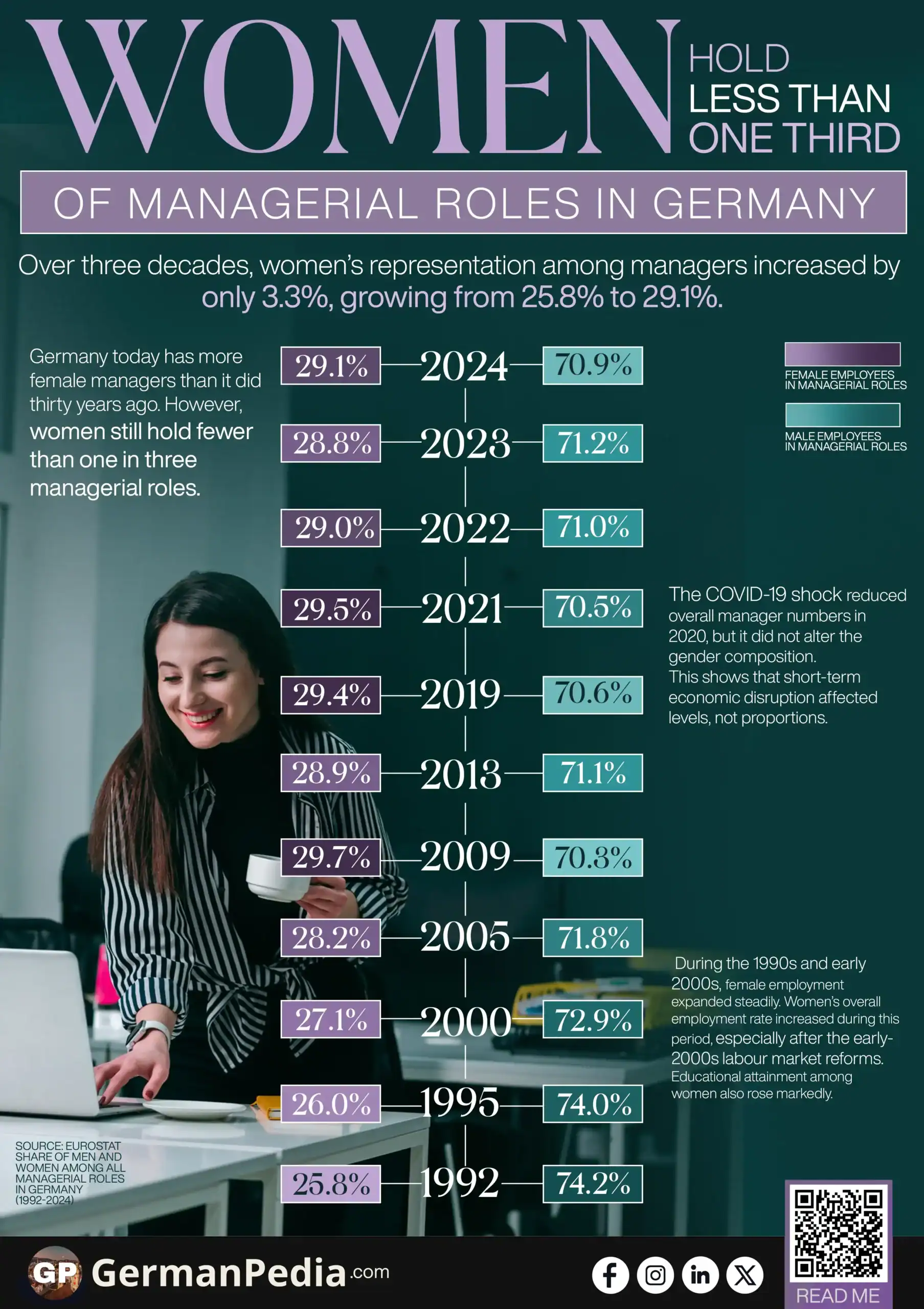
Use this Visualization: You may use this image for free with proper attribution to GermanPedia (i.e., by linking back to GermanPedia).
Need help communicating complex ideas visually? We help you turn data into your most persuasive story. Contact us to learn more.
Gender Distribution of Managers in Germany
| Year | Number of Employees in Managerial Roles (in Thousands, % of total) | ||
|---|---|---|---|
| Total | Female | Male | |
| 1992* | 1,963.0 | 506.8 (25.8%) | 1,456.1 (74.2%) |
| 1995 | 2,150.6 | 558.1 (26.0%) | 1,592.5 (74.0%) |
| 2000 | 2,081.0 | 564.5 (27.1%) | 1,516.5 (72.9%) |
| 2005* | 1,975.7 | 556.5 (28.2%) | 1,419.2 (71.8%) |
| 2009 | 2,221.7 | 658.9 (29.7%) | 1,562.8 (70.3%) |
| 2013 | 1,732.9 | 500.9 (28.9%) | 1,232.0 (71.1%) |
| 2019 | 2,098.9 | 617.8 (29.4%) | 1,481.1 (70.6%) |
| 2021* | 1,686.2 | 496.5 (29.5%) | 1,189.7 (70.5%) |
| 2022 | 1,741.5 | 505.3 (29.0%) | 1,236.2 (71.0%) |
| 2023 | 1,824.0 | 525.5 (28.8%) | 1,298.5 (71.2%) |
| 2024 | 1,859.1 | 540.2 (29.1%) | 1,318.9 (70.9%) |
Source: Eurostat
*Break in time series

Across OECD countries, women account for roughly one-third of managers [2]. Germany follows a similar pattern. This is affected by several structural factors:
- Occupational segregation: Senior management roles are often concentrated in sectors with historically male-dominated career tracks, such as engineering and manufacturing.
- High female part-time employment rates
- Career interruptions linked to parental leave patterns
Interrupted or reduced working hours can slow advancement into senior roles. This limits representation at higher managerial levels.
In 1992, women accounted for 25.8% of managers in Germany (507,000 out of 1.96 million total). By 2009, their share had risen to 29.7% (659,000 out of 2.22 million).
The increase was gradual. During the 1990s and early 2000s, female employment expanded steadily. Participation rose further after the labour market reforms of the early 2000s. Women’s educational attainment also increased significantly during this period.
As more women entered and remained in skilled employment, representation in managerial roles increased. The shift was incremental rather than abrupt.
However, the female share of managers has slowed down since 2009. It has stabilised around 29–30%:
- 2013: 28.9%
- 2019: 29.4%
- 2024: 29.1%
The gender balance shifted very little, even as total manager numbers fluctuated. The COVID-19 shock reduced overall manager numbers in 2020, but it did not alter the gender composition. This shows that short-term economic disruption affected levels, not proportions.
Over three decades, women’s representation among managers increased by roughly four percentage points, growing from 25.8% to 29.1%.
That reflects measurable progress. Germany today has more female managers than it did thirty years ago. However, women still hold fewer than one in three managerial roles.
More topics
- Women Are Increasing in Managerial Roles Across the EU
- Top 10 Biggest EU Companies Led by Women
- Top 10 Richest Women in the EU
- Germany’s Median Wage by Federal State
- Employment by Federal State in Germany
- Gender Pay Gap Across EU Countries
- Germans Earn More Than Foreign Workers Across Germany
- Top German Companies by Revenue
- Top Companies in Germany by LinkedIn (2021-2025)
- Unemployment Across Germany: A Federal State Breakdown
- Germany’s Fastest-Growing Jobs by LinkedIn
- Which Federal States Drive Germany’s Economy?
- Highest Paying Jobs in Germany
- How Marriage Rates Have Fallen in Germany: 1990–2023
- How Germany’s Birth Rates Dropped and Deaths Rose
References
- https://ec.europa.eu/eurostat/databrowser/view/LFSA_EGAIS__custom_20099658
- https://www.oecd.org/en/publications/gender-equality-in-a-changing-world_e808086f-en/full-report/women-still-lag-behind-men-in-reaching-leadership-roles_8367265b.html
- https://www.bertelsmann-stiftung.de/fileadmin/files/BiW/BSt_Factsheet_Gender_Equality_German_Labor_Market.pdf
- https://www.eurofound.europa.eu/en/publications/all/recent-trends-female-employment-examined
- https://www.diw.de/documents/publikationen/73/diw_01.c.44060.de/dp557.pdf
- https://www.oecd.org/content/dam/oecd/en/publications/reports/2022/10/the-role-of-firms-in-the-gender-wage-gap-in-germany_0b4391e5/e8623d6f-en.pdf