
Key takeaways
- In December 2024, the national median gross monthly wage was €4,177 for Germans and €3,204 for foreign nationals. This is a gap of €973, or 23%.
- In West Germany, the median wage is €4,310 for Germans and €3,239 for foreign nationals. In East Germany, it is €3,617 for Germans and €2,963 for foreign nationals.
- The largest percentage gaps are found in high-income western states such as Hamburg (30%) and Bremen (29.6%).
- In eastern Germany, the wage gap is smaller, at around 21%. However, overall wage levels are lower for both Germans and foreign nationals.
- Berlin stands out with the smallest wage gap at 14.2%. The city has a large international workforce in technology, research, and other higher-skilled service sectors.
- Foreign nationals are more concentrated in lower-paid sectors such as logistics, construction, and services. Qualification recognition and language requirements can limit their access to higher-paid roles, particularly for new arrivals.
- The wage difference reflects the structure of the labour market. It depends on how industries are organised and how workers are distributed across occupational levels, not geography alone.
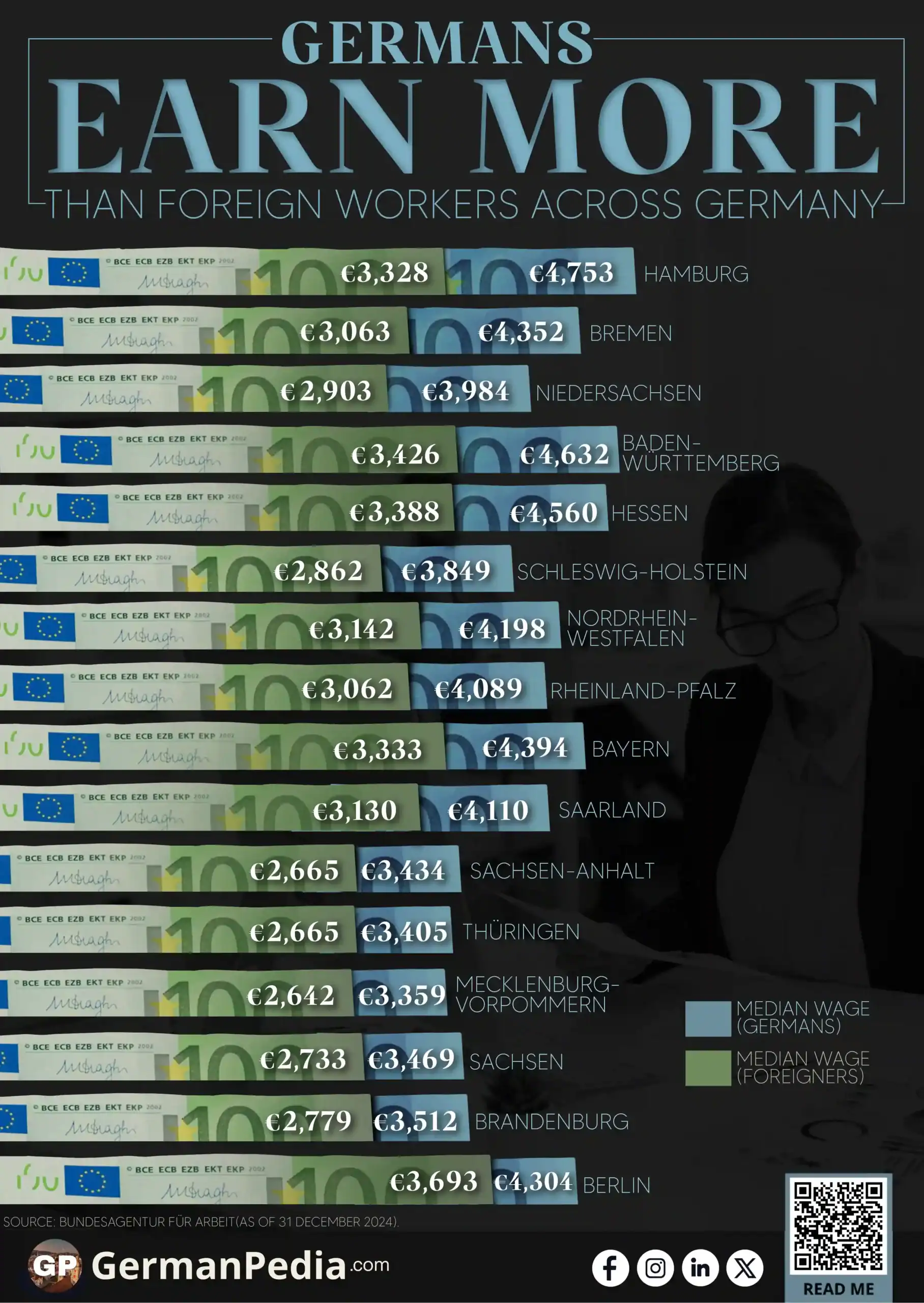
Use this Visualization: You may use this image for free with proper attribution to GermanPedia (i.e., by linking back to GermanPedia).
Need help communicating complex ideas visually? We help you turn data into your most persuasive story. Contact us to learn more.
The wage gap between German nationals and foreign nationals is visible across all federal states.
In December 2024, the national median gross monthly wage for full-time employees subject to social insurance contributions was:
- €4,177 for Germans
- €3,204 for foreign nationals
That is a wage gap of €973 per month, or roughly 23%.
This difference does not automatically mean unequal pay for identical work. Median wages reflect how workers are distributed across industries, occupations, qualification levels, and seniority positions.
New foreign workers are more likely to work in industries or occupations with lower average wages. Many also spend time having their qualifications recognised or improving their German language skills before moving into higher-paying professional or managerial roles.
As a result, the wage gap reflects differences in where people are positioned within the labour market, rather than a single nationwide pattern of unequal pay.
Median Wage Gap Between Germans and Foreigners
| State | Median Wage | ||
|---|---|---|---|
| Germans (In €) | Foreigners (In €) | Difference (in %) | |
| Hamburg | 4,753 | 3,328 | 30.0% |
| Bremen | 4,352 | 3,063 | 29.6% |
| Niedersachsen | 3,984 | 2,903 | 27.1% |
| Baden-Württemberg | 4,632 | 3,426 | 26.0% |
| Hessen | 4,560 | 3,388 | 25.7% |
| Schleswig-Holstein | 3,849 | 2,862 | 25.6% |
| Nordrhein-Westfalen | 4,198 | 3,142 | 25.2% |
| Rheinland-Pfalz | 4,089 | 3,062 | 25.1% |
| Bayern | 4,394 | 3,333 | 24.1% |
| Saarland | 4,110 | 3,130 | 23.8% |
| Sachsen-Anhalt | 3,434 | 2,665 | 22.4% |
| Thüringen | 3,405 | 2,665 | 21.7% |
| Mecklenburg-Vorpommern | 3,359 | 2,642 | 21.4% |
| Sachsen | 3,469 | 2,733 | 21.2% |
| Brandenburg | 3,512 | 2,779 | 20.9% |
| Berlin | 4,304 | 3,693 | 14.2% |
Source: Bundesagentur für Arbeit

Largest Income Gaps in High-Income States
The widest percentage differences appear in economically strong Western states.
In Hamburg, the gap reaches 30%. Many of the highest-paying roles are concentrated in headquarters functions, finance, media, and specialised technical occupations. These lift the upper end of the wage distribution.
Germany’s Median Wage by Federal State ->
Highest Paying Jobs in Germany ->
Foreign nationals, by contrast, are more commonly employed in operational logistics, hospitality, and service roles. These sectors are essential to the economy but offer lower median wages than corporate or financial positions.
A similar structure appears in Bremen (29.6%) and Baden-Württemberg (26%).
Bremen combines port logistics with industrial production. Meanwhile, Baden-Württemberg is driven by export-oriented manufacturing and engineering. In both states, higher wages are often linked to long-established industrial careers, advanced technical certifications, and senior positions within large firms.
Foreign nationals are present in these economies, but they are more concentrated in supplier industries, shift-based production, construction, and service occupations. These areas come with lower median pay levels.
The wage gap widens in regions where high-paying sectors lift the top of the wage scale, while foreign workers remain more concentrated in lower-paid roles.
A Different Income Gap Structure in the East
In eastern Germany, the percentage wage gap is smaller. However, median wages are lower for both Germans and foreign nationals than in western Germany.
For example:
- Sachsen: €3,469 (Germans) vs €2,733 (Foreigners) → 21%
- Mecklenburg-Vorpommern: €3,359 vs €2,642 → 21.4%
The difference narrows slightly compared to many Western states. But this occurs within a wage structure that is lower across the board.
The broader regional figures underline this pattern:
- West Germany: Germans: €4,310 | Foreigners: €3,239
- East Germany: Germans: €3,617 | Foreigners: €2,963
The East–West divide affects both groups. Median wages are lower in eastern states regardless of nationality. This reflects structural factors, such as fewer corporate headquarters, a smaller financial sector, and less concentration of high-paying service industries.
Meanwhile, Berlin is a notable exception:
- Germans: €4,304
- Foreigners: €3,693
- Wage Gap: 14.2%
This is the smallest wage gap among Germany’s federal states.
Berlin has a large international workforce. Technology firms, research institutions, startups, and creative industries employ a high share of foreign professionals in higher-skilled roles. That brings the median wage of foreign nationals closer to that of Germans.
Unicorn startups in Germany ->
The wage gap between Germans and foreign nationals exists in every federal state. It is closely linked to structural factors within regional labour markets.
The concentration of high-paying industries is one factor. Western states generally have higher wages, but they also tend to have larger wage gaps. The Eastern states have lower wage levels overall, resulting in smaller percentage differences.
The distribution of workers across occupational levels also matters. The organisation of industries, such as who occupies senior, technical, or operational roles, shapes both pay and opportunity.
More topics
- Top 25 Richest People in Germany (2025)
- Germany’s Smoking Rate Has Declined Over Two Decades
- Germany’s Electricity Mix: From Coal to Renewables
- Changes in Harvest of Germany’s Five Key Crops
- Top German Companies by Revenue
- Germany’s Top Car Brands by New Registrations
- Unemployment Across Germany: A Federal State Breakdown
- Where Germany’s Tourists Come From
- Germany’s Largest National Parks, Ranked by Size
- Which Federal States Drive Germany’s Economy?
- Here’s Why Divorces in Germany Are Falling
- Germans Are Marrying Later Than Ever
- How Marriage Rates Have Fallen in Germany: 1990–2023
- How Germany’s Birth Rates Dropped and Deaths Rose
- Leading Causes of Death in Germany
References
- https://statistik.arbeitsagentur.de/SiteGlobals/Forms/Suche/Einzelheftsuche_Formular.html?nn=21424&topic_f=beschaeftigung-entgelt-entgelt
- https://www.fau.eu/2025/08/news/research/pay-gap-immigrants-experience-difficulties-in-accessing-better-paid-jobs/
- https://mediendienst-integration.de/arbeitsmarkt/auslaendische-arbeitskraefte/migrant-pay-gap/