
Key Takeaways
- Turkey accounts for 1,520,400 foreigners in Germany. It contributed the largest number of individuals in Germany’s foreign population. Most arrived under a 1961 labor recruitment agreement that expected workers to return home after two years.
- EU member state citizens account for 4,976,410 foreigners in Germany. Non-EU states, which include Turkey, Ukraine, Syria, Afghanistan, and Kosovo, together account for 4,639,290. The two groups are nearly equal in size.
- Romania (903,770) and Poland (839,660) are the two largest EU source countries in Germany. Migration from both rose sharply once Germany lifted its transitional restrictions on free movement.
- Ukraine, Syria, and Afghanistan together account for 2.79 million foreigners in Germany. That is more than Romania and Poland combined.
- Germany raised its annual skilled worker visa quota for Indian nationals from 20,000 to 90,000 in October 2024. India represents a distinct third migration type: people who arrived through bilateral skilled worker agreements rather than EU free movement or humanitarian channels.
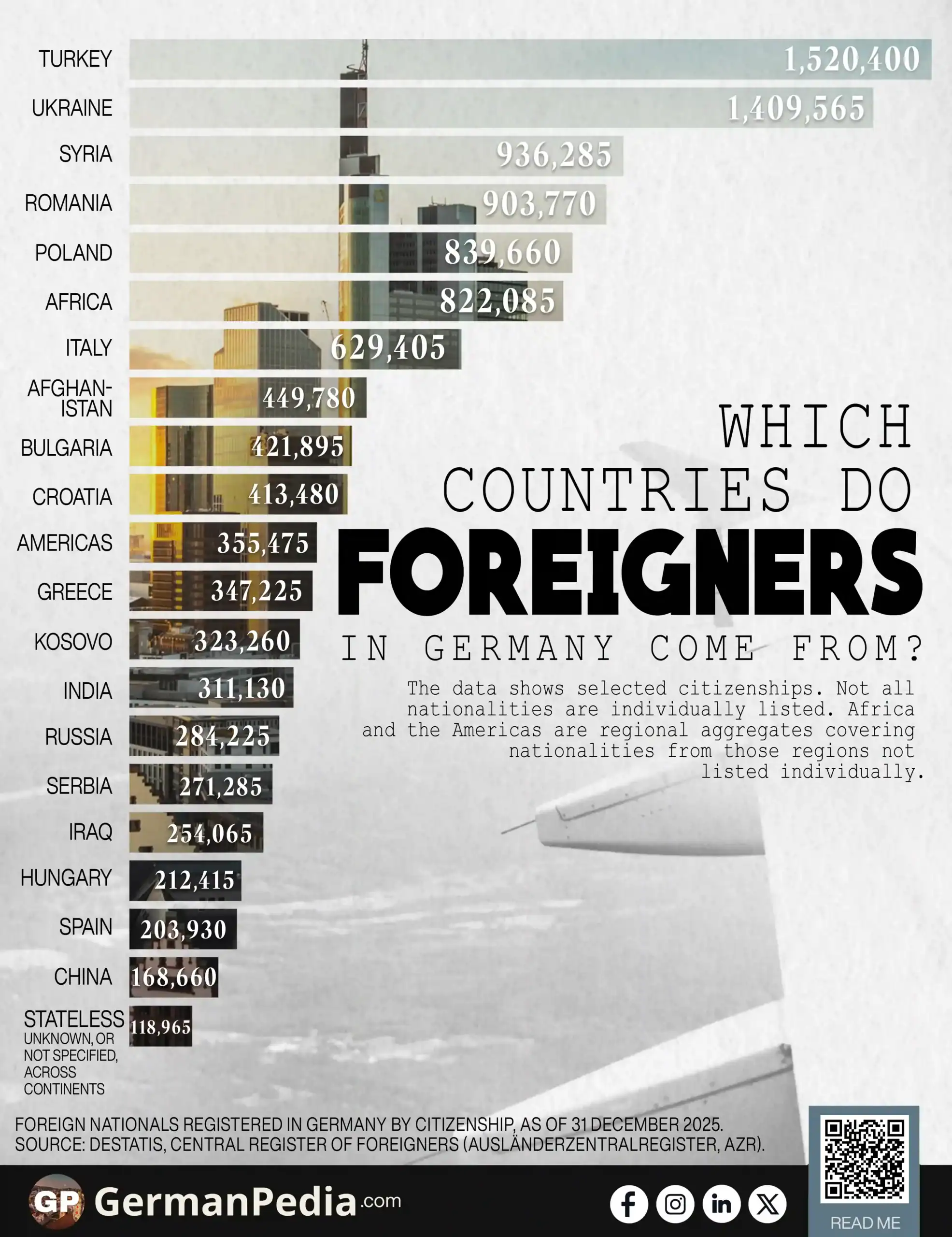
Use this Visualization: You may use this image for free with proper attribution to GermanPedia (i.e., by linking back to GermanPedia).
Need help communicating complex ideas visually? We help you turn data into your most persuasive story. Contact us to learn more.
Foreign Population in Germany by Country of Citizenship
| Country / Region | Foreign Nationals (As of 31 Dec 2025) |
|---|---|
| Turkey | 1,520,400 |
| Ukraine | 1,409,565 |
| Syria | 936,285 |
| Romania | 903,770 |
| Poland | 839,660 |
| Africa | 822,085 |
| Italy | 629,405 |
| Afghanistan | 449,780 |
| Bulgaria | 421,895 |
| Croatia | 413,480 |
| Americas | 355,475 |
| Greece | 347,225 |
| Kosovo | 323,260 |
| India | 311,130 |
| Russia | 284,225 |
| Serbia | 271,285 |
| Iraq | 254,065 |
| Hungary | 212,415 |
| Spain | 203,930 |
| China | 168,660 |
| Australia and Oceania (regional aggregate*) | 17,130 |
| Stateless, unknown, or not specified, across continents | 118,965 |
Source: Destatis, Central Register of Foreigners (Ausländerzentralregister, AZR).
The table shows selected citizenships. Not all nationalities are individually listed. Africa, the Americas, and *Australia & Oceania are regional aggregates covering nationalities from those regions not listed individually.

Germany’s 14,070,225 registered foreign nationals as of 31 December 2025 are not the product of a single migration wave. The composition reflects six decades of political decisions:
- bilateral labor agreements signed in the 1960s
- EU enlargement treaties from the 2000s
- humanitarian obligations triggered by wars in Syria, Afghanistan, and Ukraine
The origin of Germany’s foreigners depends on which of those decisions you are looking at.
Romania and Poland Are the Largest Source Countries Among EU Member States
Romania accounts for 903,770 foreigners registered in Germany. It is the largest single source country among all EU member states. Poland ranks second. It accounts for 839,660 foreigners.
Romania joined the EU in 2007. Poland joined in 2004. Germany maintained transitional restrictions on workers from both countries even after accession. Germany lifted restrictions on Polish workers in 2011. Restrictions on Romanian and Bulgarian workers were lifted in 2014. Migration from both countries rose sharply once they expired.
Italy ranks third among EU member states. It accounts for 629,405 foreigners in Germany. Italian migration is older than the Eastern European flows. It traces back to postwar labor agreements from the 1950s and 1960s. Growth has been slower than migration from Romania and Poland.
Turkey Has More Nationals in Germany Than Any EU Member State
Turkey accounts for 1,520,400 foreigners in Germany. It ranks first in the entire table. This is not a recent migration.
In 1961, West Germany signed a bilateral labor recruitment agreement with Turkey. The agreement aimed to fill industrial labor shortages during the postwar economic boom. It required workers to return home after two years. Most workers did not return. Many settled permanently in Germany. As of December 2025, 345,695 of Turkey’s 1.52 million registered foreigners were born in the country.
Three Wars Brought Nearly Three Million People to Germany
Three of the largest foreign populations in Germany arrived as refugees, each from a distinct conflict.
- Ukraine: 1,409,565 foreigners are registered in Germany. Russia’s full-scale invasion in February 2022 drove the arrivals.
- Syria: 936,285 foreigners are registered in Germany. Syrian migration accelerated after the 2011 civil war. It peaked during the 2015 refugee crisis. Germany approved 84% of Syrian asylum applications in 2024. It is the highest recognition rate among major origin countries that year.
- Afghanistan: 449,780 foreigners are registered in Germany. Afghan migration predates the Taliban’s return to power in 2021, but rose significantly after it. Germany granted protection to 62% of Afghan applicants in 2024.
Together, these three countries account for 2.79 million foreigners in Germany. That is more than Romania and Poland combined.
Germany Allocated 90,000 Annual Skilled Worker Visas to India in October 2024
India’s 311,130 registered foreigners represent a distinct third category. Germany raised its skilled work visa quota for Indian nationals from 20,000 to 90,000 per year in October 2024.
Germany and India signed the German-Indian Migration and Mobility Agreement in December 2022. The agreement created faster visa procedures and expanded cooperation structures for skilled worker placement. India represents the clearest example of a third migration type in Germany’s data: people who arrived through bilateral skilled worker agreements, not through EU free movement or humanitarian channels.
EU member state citizens account for 4,976,410 of Germany’s foreign nationals. Turkey, Ukraine, Syria, Afghanistan, and Kosovo together account for 4,639,290. The two groups have nearly reached parity. Behind that near-parity are three distinct reasons people came: treaty rights that made movement automatic, labor agreements that became permanent, and conflicts that left people with nowhere else to go.
More topics
- Which EU Cities Have the Most Millionaires?
- Which EU Country Has the Highest Trade-to-GDP Ratio?
- Most Popular EU Tourist Destinations by Overnight Stays
- How Much Water Do EU Households Use?
- Where are Billionaires Concentrated in the EU?
- Top 10 Richest Women in the EU
- Top 10 Biggest EU Companies Led by Women
- Top 13 Most Valuable Brands in the EU
- Income Millionaires In Germany by State
- The Best EU Countries to Retire In
- EU Passports Are Among the Strongest in the World
- GDP per Capita vs Actual Consumption per Capita in the EU
- Which Are the Busiest Airports in the EU?
- The Busiest Container Ports in Europe by TEU
- Which EU Countries Have the Most Soft Power?
References
- https://www.destatis.de/EN/Themes/Society-Environment/Population/Migration-Integration/Tables/foreigner-place-of-birth.html
- https://www.bamf.de/SharedDocs/Anlagen/DE/Statistik/AsylinZahlen/aktuelle-zahlen-dezember-2024.pdf
- https://www.bmi.bund.de/SharedDocs/pressemitteilungen/EN/2022/12/migration_agreement.html