
Key Takeaways
- GDPR is the EU’s data privacy law. It is seeing stricter enforcement. Several major US platforms have already been fined over how they transfer and store EU data.
- EU-based platforms are becoming practical alternatives to US tools. They reduce reliance on complex cross-border data transfer rules.
- This shift toward EU alternatives is most visible in analytics, cloud storage, and communication. These are areas with constant data handling concerns.
- Local fit matters in other categories. Tools like Personio and DeepL succeed by aligning with European workflows, languages, and business environments.
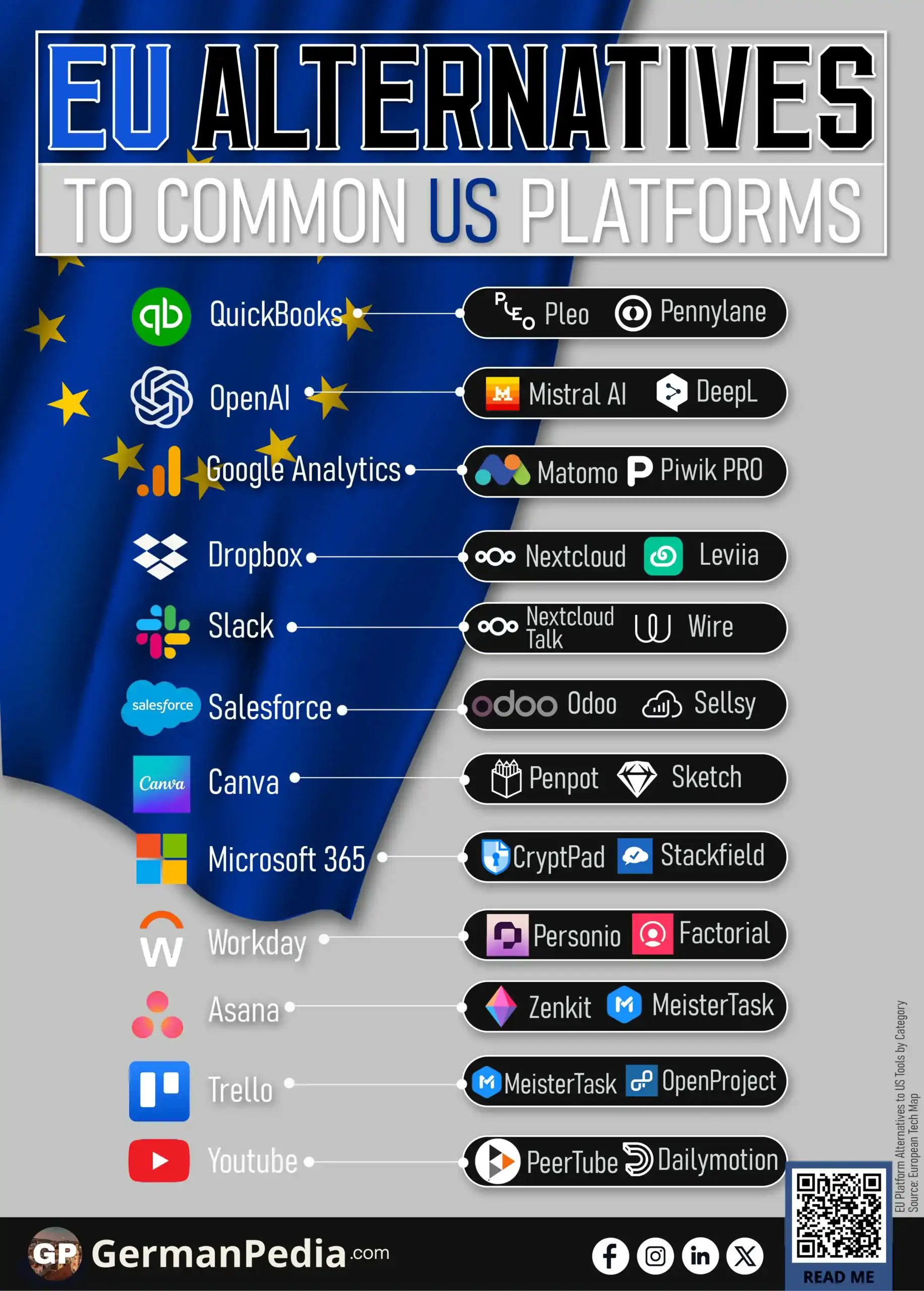
Use this Visualization: You may use this image for free with proper attribution to GermanPedia (i.e., by linking back to GermanPedia).
Need help communicating complex ideas visually? We help you turn data into your most persuasive story. Contact us to learn more.
EU Alternatives to US Platforms
| Category | US | EU Alternatives |
|---|---|---|
| Accounting & Finance | QuickBooks | Pleo (DK), Pennylane (FR) |
| AI & Machine Learning | OpenAI | Mistral AI (FR), DeepL (DE) |
| Analytics | Google Analytics | Matomo (FR), Piwik PRO (PL) |
| Cloud Storage | Dropbox | Nextcloud (DE), Leviia (FR) |
| Communication | Slack, Teams | Wire (DE), Nextcloud Talk (DE) |
| CRM | Salesforce | Odoo (BE), Sellsy (FR) |
| Design Tools | Canva | Penpot (ES), Sketch (NL) |
| Office Suites | Microsoft 365 | CryptPad (FR), Stackfield (DE) |
| HR & Recruitment | Workday | Personio (DE), Factorial (ES) |
| Productivity | Asana | Zenkit (DE), MeisterTask (AT) |
| Project Management | Trello | OpenProject (DE), MeisterTask (AT) |
| Video Platform | YouTube | PeerTube (FR), Dailymotion (FR) |
Source: European Tech Map

GDPR is the EU’s data privacy law. It has been in effect since 2018. It governs how companies collect, store, and transfer personal data belonging to people in the EU. It applies to any company handling EU residents’ data, no matter where the company is based.
In recent years, several U.S.-based platforms have faced major GDPR fines. These fines are often tied to how personal data is transferred and stored across borders.
For companies, this creates an ongoing compliance risk. Digital tools that are acceptable today may face new limits or obligations as EU guidance and court decisions evolve.
As a result, many German SMEs are showing more interest in EU-based or self-hosted software. This software is easier to align with GDPR, especially where personal data is involved.
This shift toward EU-based tools is most visible in areas where data processing and international transfers are unavoidable. European tools are often chosen because they keep data within the EU or under direct company control. This reduces reliance on complex legal mechanisms:
- Analytics (e.g., Matomo) → website tracking tools that keep data on EU servers or your own servers, instead of sending it outside the European Economic Area
- Cloud storage (e.g., Nextcloud) → file storage and sharing tools you can run on EU servers or your own servers, so you control where your data lives
- Communication (e.g., Wire) → messaging apps that encrypt conversations end to end and give admins full control over the account
In these cases, the advantage is consistent. The tools don’t just comply. They reduce the need to manage it constantly.
A second group is driven less by regulation and more by local fit and workflow alignment:
- In HR and recruitment, tools like Personio (DE) and Factorial (ES) are built around European labour laws, contracts, and payroll structures.
- In AI and language, alternatives focus on specific strengths. DeepL (DE) is preferred for accurate multilingual writing, and Mistral AI (FR) for more controlled AI deployment.
US tools still dominate many categories globally. But in Europe, especially in Germany, teams are becoming more open to mixing providers and replacing specific tools where EU alternatives fit better. For most professionals, this is a practical shift toward tools that fit their regulatory and operational environment and demand fewer compromises.
More topics
- Most Visited AI Websites in Germany
- Top 20 Most Visited Websites in Germany
- Top 20 Largest Employers in Berlin
- EU Unicorn Startups: Which Countries Lead and Why
- German Clubs With the Most Bundesliga Titles
- Bilateral Support to Ukraine Reached €342 Billion
- Germany’s 10 Most Expensive Diagnosis Groups
- Top 10 Richest Women in the EU
- EU Military Manpower Changed Since 2020
- Women Hold Less Than One Third of Managerial Roles in Germany
- Germany’s Civil Service Reached Near Gender Parity in 2019
- Germany’s Average Working Age Is Getting Older
- Germans Earn More Than Foreign Workers Across Germany
- Sexual Violence and Rape Increased in the EU
- Germany’s Gender Pay Gap in Full-Time Work Falls to 9%