
Key Takeaways
- ChatGPT generates the most CO₂ (69.9k kg) because it has the most users (194.3M visits). This shows that AI’s environmental impact is not only a carbon emission issue, but also a scale issue.
- Some platforms are becoming more efficient, like Gemini and DeepSeek. Optimized hardware, smaller models, and cleaner energy sources are reducing emissions per query.
- 100 kg of CO₂ is about what 5 mature German trees can absorb in a year. It’s also roughly equal to using a smartphone for 25 years or taking one short-haul flight within Germany.
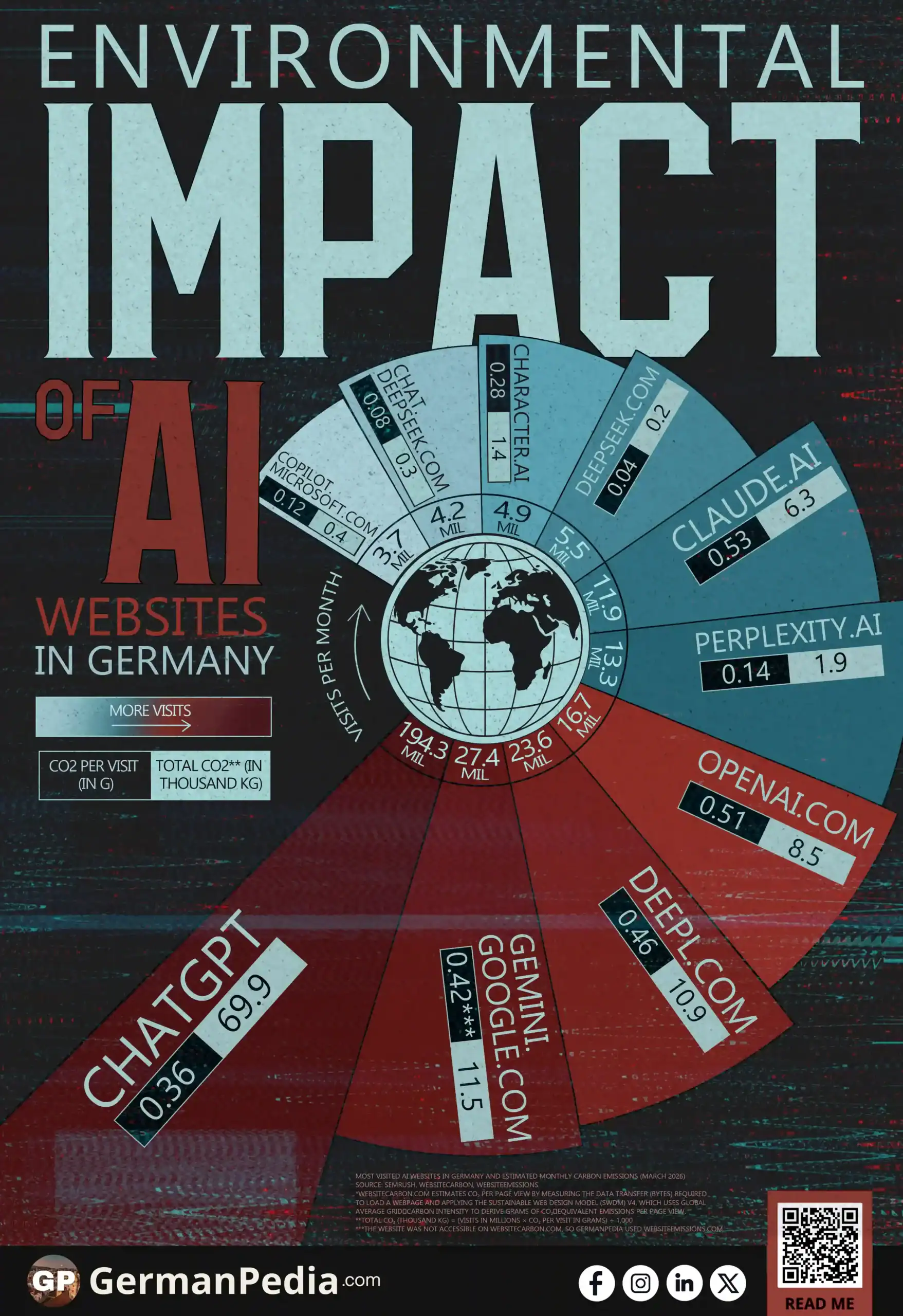
Use this Visualization: You may use this image for free with proper attribution to GermanPedia (i.e., by linking back to GermanPedia).
Need help communicating complex ideas visually? We help you turn data into your most persuasive story. Contact us to learn more.
Germany AI Websites’ Environmental Impact
| Rank | Platform | Visits (In Millions) | CO2 per visit (In g)* | Total CO2** (In thousand kg) |
|---|---|---|---|---|
| 1 | chatgpt.com | 194.3 | 0.36 | 69.9 |
| 2 | gemini.google.com | 27.4 | 0.42*** | 11.5 |
| 3 | deepl.com | 23.6 | 0.46 | 10.9 |
| 4 | openai.com | 16.7 | 0.51 | 8.5 |
| 5 | perplexity.ai | 13.3 | 0.14 | 1.9 |
| 6 | claude.ai | 11.9 | 0.53 | 6.3 |
| 7 | deepseek.com | 5.5 | 0.04 | 0.2 |
| 8 | character.ai | 4.9 | 0.28 | 1.4 |
| 9 | chat.deepseek.com | 4.2 | 0.08 | 0.3 |
| 10 | copilot.microsoft.com | 3.7 | 0.12 | 0.4 |
Source: SemRush, WebsiteCarbon, WebsiteEmissions
*WebsiteCarbon.com estimates CO₂ emissions per page view based on the amount of data transferred when a webpage loads. It uses the Sustainable Web Design Model (SWDM) v4 to convert that data into estimated CO₂-equivalent emissions.
**Total CO₂ (thousand kg) = (Visits in millions × CO₂ per visit in grams) ÷ 1,000
***The website was not accessible on WebsiteCarbon.com, so GermanPedia used WebsiteEmissions.com. It calculates CO₂e per visit by measuring the amount of data transferred when loading a web page and then applying a model that converts data transfer into energy use based on average grid‑carbon intensity. This energy use is expressed as grams of CO₂‑equivalent emissions per page view. It reflects only the front‑end page‑load process.

Artificial intelligence is transforming how we work and use digital tools, but it also comes with a growing environmental footprint. Behind each interaction are data centres that consume large amounts of energy and resources.
Where are Data Centers Concentrated in the EU? ->
The environmental impact of AI websites in Germany is not just about how efficient they are, but also how often they are used.
ChatGPT.com stands out immediately. It generates around 69.9 thousand kg of CO₂ with 194.3 million visits.
To help you imagine, 100 kg of CO₂ is roughly equivalent to:
- 25 years of smartphone use
- 1.6 years of video streaming
- 1 short‑haul flight within Germany (400–800 km, per person)
- 400-500 km of driving a combustion-engine car
- CO₂ absorbed by 5 mature German trees in one year
At this scale, ChatGPT’s total emissions are comparable to travelling from Berlin to Munich a thousand times.
This level of CO₂ consumption is evident across AI websites.
- Gemini (27.4M visits) → 11.5k kg CO₂
- DeepL (23.6M visits) → 10.9k kg CO₂
- Claude (11.9M visits) → 6.3k kg CO₂
Some platforms have higher emissions per visit, like Claude (0.53g), but lower total impact because they are used less.
Others, like Perplexity (0.14g) or DeepSeek (0.04g), show lower emissions per visit. However, their total emissions can still add up when they are used frequently.
Most of the environmental impact does not come from loading the website.
It comes from what happens behind it.
AI tools rely on data centres to process each request. These already consume around 4% of Germany’s gross power consumption in 2024, and AI workloads are a growing share.
Each interaction or AI query requires more computing power than a regular web search, which means it uses more electricity. A single query can use around 0.3 to 1 watt-hour of electricity, depending on the system.
Some AI platforms appear “greener”
Some platforms show lower emissions per visit because they are more efficient by design.
Gemini (Google) is one example. A typical query uses about 0.24 Wh, thanks to:
- Specialized hardware (TPUs): Custom-built chips that run AI more efficiently while using less electricity.
- Optimized model design: AI models designed to answer questions using less computing power.
- Access to lower-carbon electricity: Data centers powered by cleaner energy sources, such as renewables.
DeepSeek reduces energy use differently.
It has an efficient AI model designed to use less computing to reduce energy use. However, its actual emissions still depend on where its servers are located. If they run on carbon-intensive electricity, emissions can be higher.
There are also simpler reasons.
Some platforms have lighter websites, which reduces front-end emissions. Others are used for short, simple prompts, while more complex tasks (e.g., coding, long responses) use more energy.
The “CO₂ per visit” values in the table mainly reflect website loading or front-end activity. They capture only a part of the AI processing behind each query, which is the largest source of emissions.
Even so, the pattern is clear.
ChatGPT is not the most carbon-intensive per visit, but its scale of use drives the largest total impact.
At the same time, some platforms are becoming more efficient. Tools like Gemini and newer AI models show that lower energy use per query is possible, especially with optimized hardware and cleaner energy sources.
But efficiency alone is not enough.
As AI becomes part of everyday work and digital activity, total emissions continue to rise. The environmental impact is still concentrated in the data centres and systems that power these tools.
This means the future impact of AI depends on two things: how efficiently it runs, and how widely it is used.
Which Countries Use AI the Most in the EU? ->
Greener infrastructure, better model design, and cleaner electricity can reduce emissions per interaction.
In the end, one of the most important questions is how AI’s growing use can be managed in a way that keeps its environmental cost under control.
More topics
- Most Visited AI Websites in Germany
- Claude Usage in the EU: Which Countries Lead and Why?
- Which Countries Use AI the Most in the EU?
- EU Alternatives to Common US Platforms
- Top 13 Most Valuable Brands in the EU
- Top 20 Most Visited Websites in Germany
- Germany’s Top 8 Most Valuable Brands
- Europe’s Population Shifted Over 20 Years
- Germany’s Average Working Age Is Getting Older
- Italy is the Old Man of Europe
- EU Unicorn Startups: Which Countries Lead and Why
- GDP of European Countries
- Top 10 Richest Women in the EU
- EU Military Manpower Changed Since 2020
- Employment in the EU Is Shifting Toward Higher Education
References
- https://www.semrush.com/website/top/germany/ai/
- https://www.websitecarbon.com/
- https://websiteemissions.com/
- https://cloud.google.com/blog/products/infrastructure/measuring-the-environmental-impact-of-ai-inference/
- https://www.unep.org/news-and-stories/story/ai-has-environmental-problem-heres-what-world-can-do-about
- https://www.fortomorrow.eu/en/blog/co2-tree
- https://climate.ec.europa.eu/document/download/4621277e-6032-400a-973f-22e53e8f8d3b_en?filename=de_2023_factsheet_en.pdf
- https://theicct.org/publication/electric-cars-life-cycle-analysis-emissions-europe-jul25/
- https://www.atmosfair.de/en/faqs/on_co2_calculation/
- https://www.oeko.de/en/blog/the-carbon-footprint-of-our-digital-lifestyles/
- https://www.cleanenergywire.org/news/germans-worried-about-new-data-centres-environmental-impact-favour-clean-power-sources-survey
- https://www.technologyreview.com/2025/08/21/1122288/google-gemini-ai-energy/
- https://www.ainews.com/p/google-reveals-energy-and-water-use-of-gemini-ai-prompts
- https://blog.google/company-news/outreach-and-initiatives/sustainability/google-ai-energy-efficiency/
- https://www.rinnovabili.net/business/markets/deepseeks-energy-consumption-ais-75-power-cut/