
Key Takeaways
- Around 49% of young adults aged 18–34 in the EU still live with their parents.
- Housing affordability is a key driver, as rising house prices and rent make it harder for young adults to enter the housing market.
- The highest shares are found in Southern and Eastern Europe, where living with parents is more socially accepted.
- Lower shares are seen in Northern and Western Europe (e.g., Denmark, Germany), where young adults tend to leave home earlier, with some countries offering support in their housing systems (e.g., social housing).
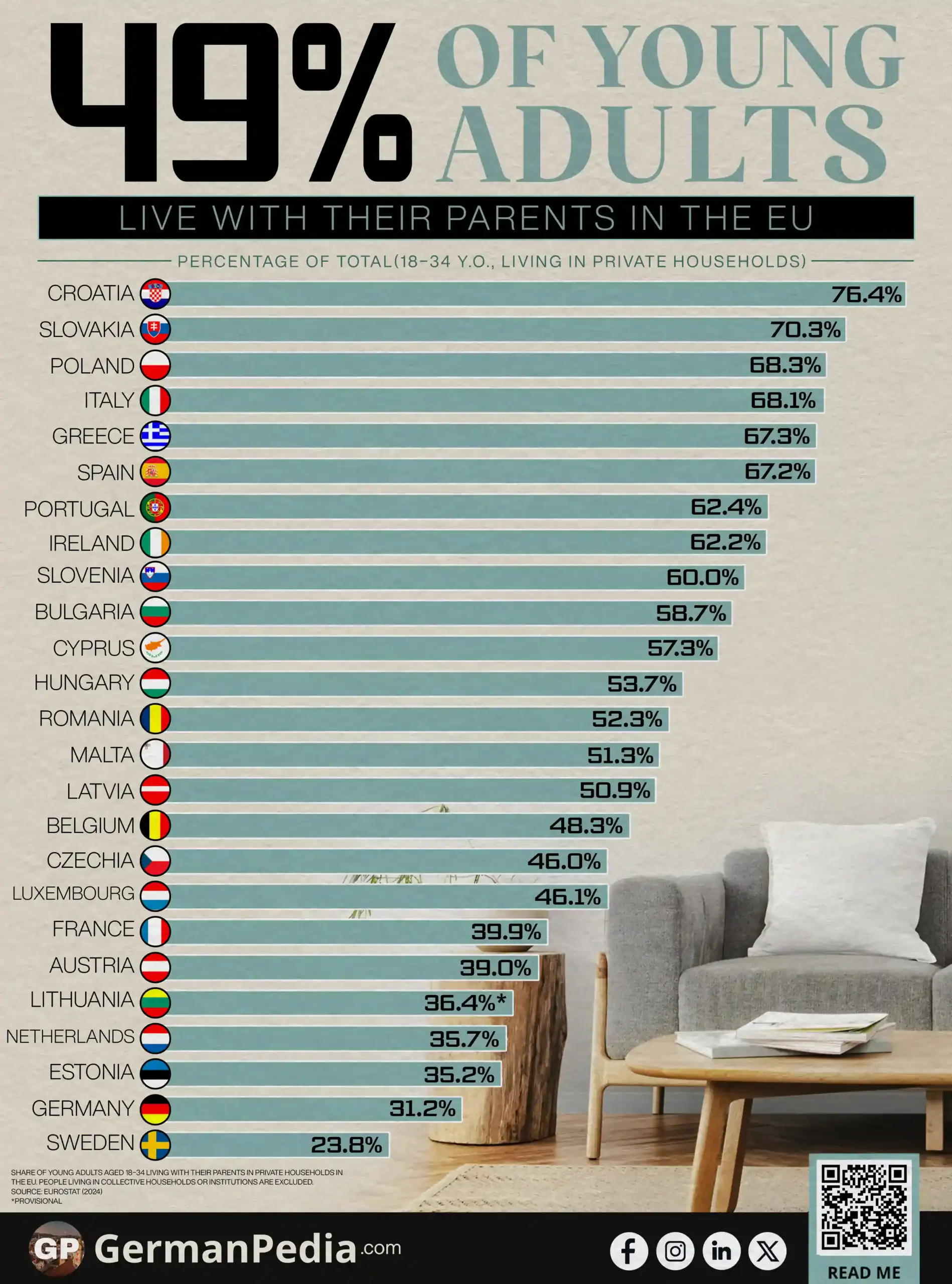
EU Young Adults Living with Parents
| Country | Percentage of total (18–34 y.o., living in private households) |
|---|---|
| Croatia | 76.4 |
| Slovakia | 70.3 |
| Poland | 68.3 |
| Italy | 68.1 |
| Greece | 67.3 |
| Spain | 67.2 |
| Portugal | 62.4 |
| Ireland | 62.2 |
| Slovenia | 60.0 |
| Bulgaria | 58.7 |
| Cyprus | 57.3 |
| Hungary | 53.7 |
| Romania | 52.3 |
| Malta | 51.3 |
| Latvia | 50.9 |
| Belgium | 48.3 |
| Czechia | 46.0 |
| Luxembourg | 46.1 |
| France | 39.9 |
| Austria | 39.0 |
| Lithuania | 36.4* |
| Netherlands | 35.7 |
| Estonia | 35.2 |
| Germany | 31.2 |
| Sweden | 23.8 |
| Denmark | 17.9 |
| Finland | 17.1 |
Source: Eurostat (2024)
*provisional

Across the European Union, around 49% of young adults aged 18–34 in private households still live with their parents. A key factor behind this divide is housing affordability.
House prices and rent have increased across much of Europe, often faster than wages. This makes it harder for young adults to afford independent housing. Limited housing supply and rising living costs reinforce this trend, especially in dense urban areas. While rural areas are more affordable, they usually offer fewer rental options.
Germany’s Home Prices Rise 13.8% as Growth Shifts Regions ->
As a result, many young adults still live with their parents, even when they are working.
Beyond affordability, there is also a clear regional divide that reflects differences in cultural norms.
The share of young adults living with their parents is highest in Southern and Eastern Europe. This includes:
- Croatia (76.4%)
- Slovakia (70.3%)
- Poland (68.3%)
- Italy (68.1%)
In these European countries, stronger family ties and social norms support multigenerational living. Living in the family home is often a normal and more permanent arrangement in these regions.
In Ireland, for example, many working young adults also live with their parents. Rising rent and housing costs play a major role in this decision, with some using the arrangement to save for a housing deposit.
In contrast, Northern and Western European countries have a lower percentage of young adults living with their parents, such as:
- Germany (31.2%)
- Sweden (23.8%)
- Denmark (17.9%)
- Finland (17.1%)
In these regions, young adults often move out earlier because early independence is more socially accepted. In some countries, independent living is supported by housing systems that make it easier to leave the parental home without needing to buy a home first. This may include
- more developed rental markets
- access to social housing
- housing allowances
Across the EU, the share of young adults living with their parents reflects more than individual choice. It is shaped by a mix of structural and cultural norms that vary across countries.
More topics
- Homeownership Rate in the EU
- EU Wage Growth In The Last Two Decades
- Net Household Saving Rates in the EU Over Time
- Germany’s Home Prices Rise 13.8% as Growth Shifts Regions
- Apartment Rents Are Rising Faster Than House Rents in Germany
- Where People Move Within Germany by Federal State
- GDP per Capita vs Actual Consumption per Capita in the EU
- Renting in Germany
- Rent Increase in Germany [Tenant Rights And Regulations]
- Rental Property Scams in Germany
- 12 Mistakes Foreigners Make While Living in Germany
- EU Countries Are Only Partly Self-Sufficient in Food
- Internet Freedom in the EU Is High but Shaped by National Rules
- Foreign-Born Population in the EU Is Rising
- Adoption of Electric and Hybrid Passenger Cars in the EU
References
- https://ec.europa.eu/eurostat/databrowser/view/ilc_lvps08__custom_21116061/default/table
- https://ec.europa.eu/eurostat/statistics-explained/index.php?title=EU_statistics_on_income_and_living_conditions_%28EU-SILC%29_methodology_-_population_structure
- https://www.demographic-research.org/volumes/vol45/2/45-2.pdf
- https://www.pewresearch.org/short-reads/2023/05/03/in-the-u-s-and-abroad-more-young-adults-are-living-with-their-parents/
- https://www.eurofound.europa.eu/en/publications/all/foundational-challenges-the-housing-struggles-of-europes-youth
- https://www.theguardian.com/news/article/2024/may/21/data-shows-rise-in-employed-young-people-living-with-parents-across-eu
- https://www.ssoar.info/ssoar/bitstream/handle/document/100274/ssoar-poldevrev-2023-1-hogendoorn_et_al-Single_Motherhood_and_Multigenerational_Coresidence.pdf?sequence=1
- https://www.europarl.europa.eu/workingpapers/soci/w14/text2_en.htm
- https://www.tandfonline.com/doi/full/10.1080/02673037.2022.2153107
- https://pmc.ncbi.nlm.nih.gov/articles/PMC6472495/