
Key Takeaways
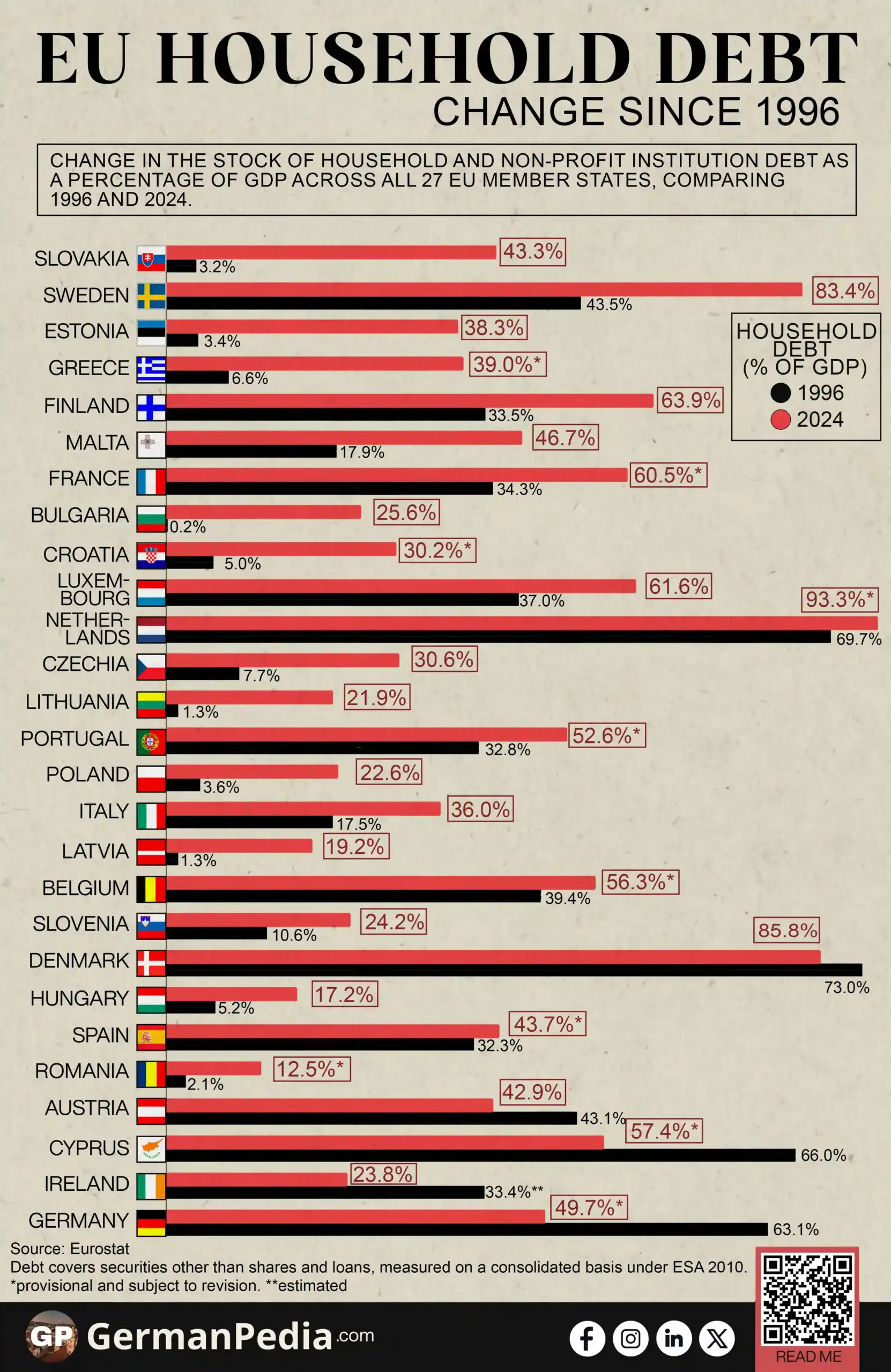
- Between 1996 and 2024, 23 of the EU’s 27 member states increased their household debt as a share of GDP. The EU average rose from 41.1% to 49.9% over those 28 years.
- Slovakia recorded the biggest rise in household debt. It climbed 40.1 percentage points, from 3.2% to 43.3% of GDP. Sweden followed with a rise of 39.9 percentage points, from 43.5% to 83.4%.
- Most of the steepest rises came from Central and Eastern EU countries, starting from near-zero bases in 1996. Despite large increases, none crossed the EU’s 55% warning threshold by 2024.
- Germany reduced household debt more than any other EU country, falling 13.4 percentage points from 63.1% to 49.7%. Post-reunification housing stagnation, flat wages, and a high rental rate drove the decline.
- Only four countries reduced household debt over 28 years: Germany (-13.4pp), Ireland (-9.6pp), Cyprus (-8.6pp), and Austria (-0.2pp).
Use this Visualization: You may use this image for free with proper attribution to GermanPedia (i.e., by linking back to GermanPedia).
Need help communicating complex ideas visually? We help you turn data into your most persuasive story. Contact us to learn more.
Change in Household Debt as a Share of GDP Across EU Countries
| Country | Household Debt (% of GDP) | Change (In percentage points) | |
|---|---|---|---|
| 1996 | 2024 | ||
| Slovakia | 3.2 | 43.3 | +40.1 |
| Sweden | 43.5 | 83.4 | +39.9 |
| Estonia | 3.4 | 38.3 | +34.9 |
| Greece | 6.6 | 39.0* | +32.4 |
| Finland | 33.5 | 63.9 | +30.4 |
| Malta | 17.9 | 46.7 | +28.8 |
| France | 34.3 | 60.5* | +26.2 |
| Bulgaria | 0.2 | 25.6 | +25.4 |
| Croatia | 5.0 | 30.2* | +25.2 |
| Luxembourg | 37.0 | 61.6 | +24.6 |
| Netherlands | 69.7 | 93.3* | +23.6 |
| Czechia | 7.7 | 30.6 | +22.9 |
| Lithuania | 1.3 | 21.9 | +20.6 |
| Portugal | 32.8 | 52.6* | +19.8 |
| Poland | 3.6 | 22.6 | +19.0 |
| Italy | 17.5 | 36.0 | +18.5 |
| Latvia | 1.3 | 19.2 | +17.9 |
| Belgium | 39.4 | 56.3* | +16.9 |
| Slovenia | 10.6 | 24.2 | +13.6 |
| Denmark | 73.0 | 85.8 | +12.8 |
| Hungary | 5.2 | 17.2 | +12.0 |
| Spain | 32.3 | 43.7* | +11.4 |
| Romania | 2.1 | 12.5* | +10.4 |
| Austria | 43.1 | 42.9 | -0.2 |
| Cyprus | 66.0 | 57.4* | -8.6 |
| Ireland | 33.4** | 23.8 | -9.6 |
| Germany | 63.1 | 49.7* | -13.4 |
Source: Eurostat
Debt covers securities other than shares and loans, measured on a consolidated basis under ESA 2010.
*provisional and subject to revision.
**estimated

Between 1996 and 2024, 23 of the EU’s 27 member states increased their household debt as a share of GDP. The EU average rose from 41.1% to 49.9% over those 28 years. Only four countries reduced it.
This article compares household debt as a percentage of GDP in 1996 and 2024 across all 27 EU member states. The change is expressed in percentage points.
Slovakia and Sweden Led the Biggest Rises in EU Household Debt
The five countries with the steepest increases over 28 years:
- Slovakia: +40.1pp (from 3.2% to 43.3%)
- Sweden: +39.9pp (from 43.5% to 83.4%)
- Estonia: +34.9pp (from 3.4% to 38.3%)
- Greece: +32.4pp (from 6.6% to 39.0%)
- Finland: +30.4pp (from 33.5% to 63.9%)
Sweden’s rise traces to financial deregulation in the late 1980s, which opened the mortgage market to broader borrowing. A prolonged period of low interest rates and rising housing prices followed. Credit to Swedish households grew twice as fast as incomes from the mid-1990s onward.
Slovakia followed a different path. A mortgage and housing boom drove debt higher through the 2000s and continued at the fastest sustained pace of any EU member state through the 2010s.
Eastern EU Countries’ Household Debts Rose Sharply, But Did Not Close the Gap
Most of the sharpest rises in household debt came from Central and Eastern EU countries starting from near-zero bases in 1996.
- Slovakia rose 40.1 percentage points and still sits at 43.3% in 2024.
- Estonia rose 34.9 percentage points and reached only 38.3%.
- Greece rose 32.4 percentage points and stands at 39.0%.
The gap between East and West narrowed over 28 years. It did not close. Every country above the EU’s 55% warning threshold in 2024 is still in Northern or Western Europe.
Germany Reduced Household Debt More Than Any Other EU Country
Germany is the sharpest exception to the EU-wide trend. It fell 13.4 percentage points, from 63.1% in 1996 to 49.7% in 2024. In 1996, Germany ranked fourth highest in the EU. By 2024, it sits just below the EU average.
Three structural factors drove the decline:
- Post-reunification housing stagnation played a central role. The eastern German housing market was overbuilt after reunification, producing mass vacancies and falling prices. Housing investment across Germany slowed through the 2000s.
- Wage growth stagnated through the same period. Households had less capacity to take on new debt.
- Germany has one of Europe’s highest rental rates. Around half of German households rent rather than own. Fewer homeowners means fewer mortgages and a structurally lower debt base.
The other three countries that reduced household debt were Ireland (-9.6pp), Cyprus (-8.6pp), and Austria (-0.2pp).
The near-universal rise in EU household debt over 28 years reflects the expansion of mortgage markets and a prolonged period of low interest rates that ran through the 2000s and 2010s. Debt-financed homeownership became the standard route into property across most of the bloc.
Germany moved the other way. Its decline was not a deliberate policy choice. It followed from specific structural conditions. These include a stalled housing market, flat wages, and a rental culture that made borrowing less common than anywhere else in the EU.
More topics
- GDP of European Countries
- European Union’s Debt Has Grown Sharply Over Two Decades
- Top 10 Foreign Holders of German Government Debt
- Most Prosperous EU Countries by Prosperity Index
- Which EU Country Has the Highest Trade-to-GDP Ratio?
- EU Rent Price Index by Country Over Time
- Europe’s Population Shifted Over 20 Years
- Which European Countries Hold the Most Gold Reserves?
- Top 10 Richest Women in the EU
- Life Expectancy in European Countries
- EU Unicorn Startups: Which Countries Lead and Why
- Women Are Increasing in Managerial Roles Across the EU
- Two Decades of Renewable Energy Growth in Europe
- EU Military Manpower Changed Since 2020