Key Takeaways
- The EU-27 spent 2.26% of GDP on R&D in 2023. That is up 0.44 percentage points from 1.82% in 2003. However, it is still short of the 3% target the bloc set in 2002.
- Six countries cleared the 3% threshold in 2023: Sweden (3.64%), Belgium (3.24%), Austria (3.22%), Germany (3.13%), Finland (3.09%), and Denmark (3.07%).
- Belgium made the largest climb (+1.40 pp) among countries now above 3%. It rose from 1.84% to 3.24%. It is driven by the recovery of business investment after the COVID-19 pandemic.
- Luxembourg and Finland are the only two EU countries with a lower R&D share in 2023 than in 2003.
- Luxembourg recorded the steepest drop. It fell by −0.56 pp from 1.62% to 1.06%. Financial services dominate its economy and carry low inherent R&D intensity.
- Several eastern member states more than doubled their R&D ratios over the period. However, most still sit below the EU-27 average of 2.26%.
- The private sector determines a country’s R&D ratio. Belgium’s businesses resumed investing after the pandemic and rose to 3.24%. Luxembourg’s financial services economy invests little in R&D by nature, which drove the ratio down.
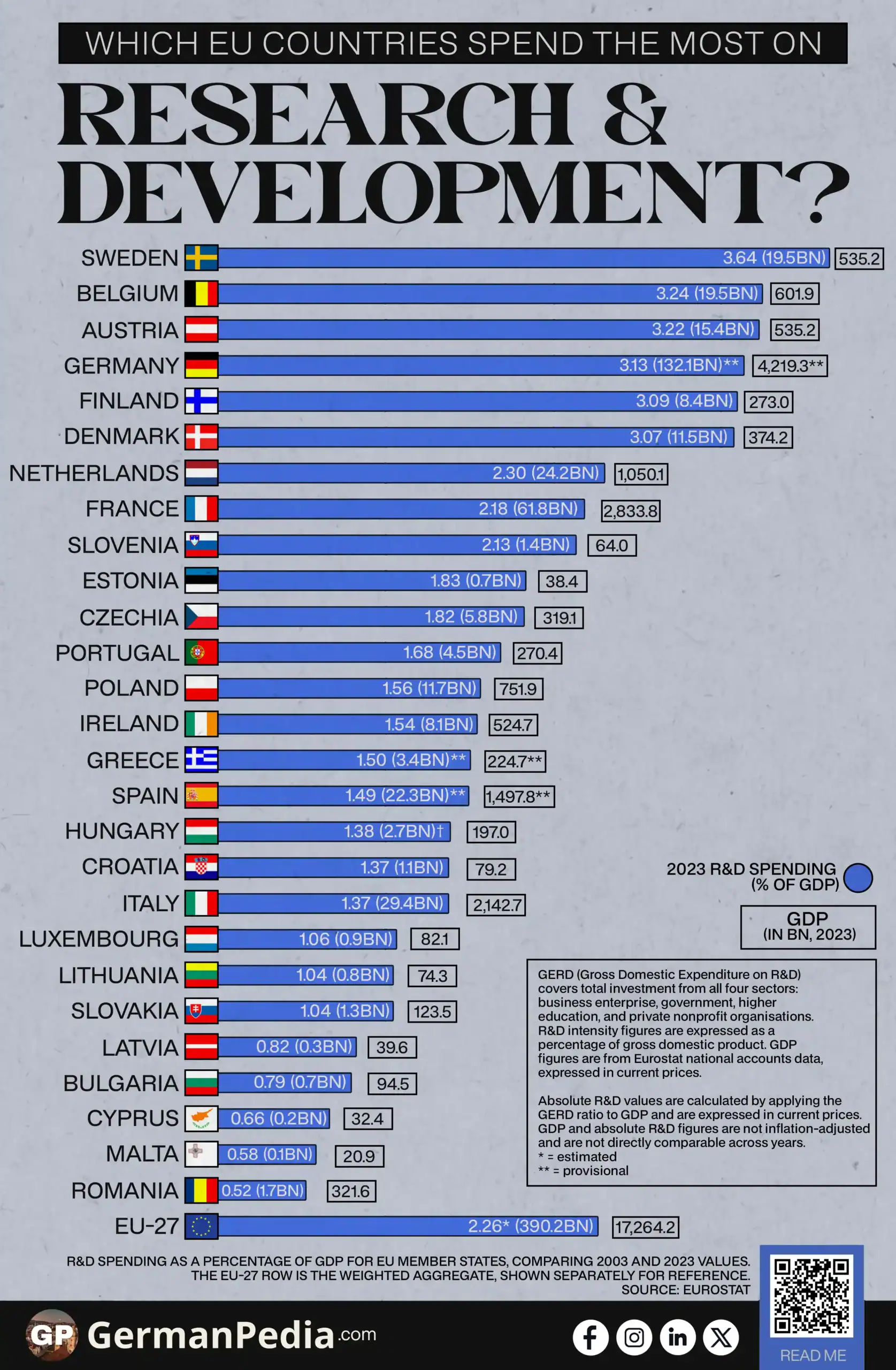
Use this Visualization: You may use this image for free with proper attribution to GermanPedia (i.e., by linking back to GermanPedia).
Need help communicating complex ideas visually? We help you turn data into your most persuasive story. Contact us to learn more.
Research and Development Investment Across EU Countries Over Time
| Country | R&D Spending (% of GDP) | Change (pp) | GDP (In bn, 2023) | |
|---|---|---|---|---|
| 2003 | 2023 | |||
| Sweden | 3.58* | 3.64 (19.5bn) | +0.06 | 535.2 |
| Belgium | 1.84 | 3.24 (19.5bn) | +1.40 | 601.9 |
| Austria | 2.19* | 3.22 (15.4bn) | +1.03 | 477.8 |
| Germany | 2.44 | 3.13 (132.1bn)** | +0.69 | 4,219.3** |
| Finland | 3.30 | 3.09 (8.4bn) | −0.21 | 273.0 |
| Denmark | 2.51 | 3.07 (11.5bn) | +0.56 | 374.2 |
| Netherlands | 1.78 | 2.30 (24.2bn) | +0.52 | 1,050.1 |
| France | 2.13 | 2.18 (61.8bn) | +0.05 | 2,833.8 |
| Slovenia | 1.26 | 2.13 (1.4bn) | +0.87 | 64.0 |
| Estonia | 0.76 | 1.83 (0.7bn) | +1.07 | 38.4 |
| Czechia | 1.14 | 1.82 (5.8bn) | +0.68 | 319.1 |
| Portugal | 0.70 | 1.68 (4.5bn) | +0.98 | 270.4 |
| Poland | 0.54 | 1.56 (11.7bn) | +1.02 | 751.9 |
| Ireland | 1.12 | 1.54 (8.1bn) | +0.42 | 524.7 |
| Greece | 0.56 | 1.50 (3.4bn)** | +0.94 | 224.7** |
| Spain | 1.02 | 1.49 (22.3bn)** | +0.47 | 1,497.8** |
| Hungary | 0.92† | 1.38 (2.7bn)† | +0.46 | 197.0 |
| Croatia | 0.94 | 1.37 (1.1bn) | +0.43 | 79.2 |
| Italy | 1.06 | 1.37 (29.4bn) | +0.31 | 2,142.7 |
| Luxembourg | 1.62 | 1.06 (0.9bn) | −0.56 | 82.1 |
| Lithuania | 0.66 | 1.04 (0.8bn) | +0.38 | 74.3 |
| Slovakia | 0.57 | 1.04 (1.3bn) | +0.47 | 123.5 |
| Latvia | 0.38 | 0.82 (0.3bn) | +0.44 | 39.6 |
| Bulgaria | 0.47 | 0.79 (0.7bn) | +0.32 | 94.5 |
| Cyprus | 0.32 | 0.66 (0.2bn) | +0.34 | 32.4 |
| Malta | 0.24 | 0.58 (0.1bn) | +0.34 | 20.9 |
| Romania | 0.40 | 0.52 (1.7bn) | +0.12 | 321.6 |
| EU-27 | 1.82* | 2.26* (390.2bn) | +0.44 | 17,264.2 |
Source: Eurostat
GERD (Gross Domestic Expenditure on R&D) covers total investment from all four sectors: business enterprise, government, higher education, and private nonprofit organisations. R&D intensity figures are expressed as a percentage of gross domestic product. GDP figures are from Eurostat national accounts data, expressed in current prices. Absolute R&D values are calculated by applying the GERD ratio to GDP and are expressed in current prices. GDP and absolute R&D figures are not inflation-adjusted and are not directly comparable across years.
* = estimated ** = provisional † = definition differs from standard

In 2002, EU member states committed to spending 3% of GDP on research and development by 2010. However, it was not met. In 2023, the EU-27 average stood at just 2.26%.
EU R&D spending by country ranges from 3.64% in Sweden to 0.52% in Romania. All but two EU member states raised their Gross Domestic Expenditure on R&D (GERD) ratio between 2003 and 2023.
Only Six EU Countries Have Cleared the 3% R&D Threshold
Six countries met or exceeded 3% of GDP in 2023:
- Sweden (3.64%)
- Belgium (3.24%)
- Austria (3.22%)
- Germany (3.13%)
- Finland (3.09%)
- Denmark (3.07%)
Sweden and Finland were the only two already above 3% in 2003.
Sweden ranks highest at 3.64% and held that position in 2003 as well. Business enterprise is the dominant driver. Technology and manufacturing companies account for a substantial share of total Swedish R&D investment. These companies included Ericsson, Volvo, and ABB.
Belgium made the largest climb. It rose from 1.84% in 2003 to 3.24% in 2023. The private sector led the increase. Businesses resumed investment after the disruption from the COVID-19 pandemic, rising inflation, and the war in Ukraine. Companies accounted for nearly 74% of total R&D spending in Belgium in 2023.
Luxembourg and Finland Are the Only Two EU Countries Whose R&D Shares Fell
Luxembourg and Finland are the only EU member states that recorded a lower R&D share in 2023 than in 2003.
Luxembourg’s decline was the more severe. It dropped from 1.62% to 1.06%. Its financial sector accounts for roughly 25% of the country’s GDP. Financial services carry low inherent R&D intensity. As the sector grew relative to the rest of the economy, it pulled Luxembourg’s overall ratio down.
Finland dropped from 3.30% to 3.09% and remained above the 3% threshold.
Across the rest of the bloc, most member states sit below the EU-27 average of 2.26%. Several eastern countries recorded the largest proportional gains:
- Estonia: 0.76% to 1.83%
- Greece: 0.56% to 1.50%
- Poland: 0.54% to 1.56%
All three more than doubled their 2003 figures. However, all of them still sit below the EU-27 average. Romania ranks lowest in the EU at 0.52%.
More topics
- Household Debt Rose in Most EU Countries Over Time
- GDP per Capita vs Actual Consumption per Capita in the EU
- Which EU Country Has the Highest Trade-to-GDP Ratio?
- GDP of European Countries
- Which EU Countries Attract the Most Foreign Investment?
- Gender Pay Gap Across EU Countries
- Which EU Country Has the Highest Cost of Living?
- EU Household Expenditure on Food and Non-Alcoholic Beverages
- EU Rent Price Index by Country Over Time
- Grocery Prices in Germany [2000 – 2025]
- Which EU Countries Had the Highest Inflation Rates?
- Minimum Wages Rose Fastest in Eastern Europe
- Which EU Countries Have the Highest Unemployment?
- The Best EU Countries to Retire In
- Most Prosperous EU Countries by Prosperity Index
References
- https://ec.europa.eu/eurostat/databrowser/view/SDG_09_10__custom_21790313/default/table
- https://sciencebusiness.net/news/r-d-funding/eu-budget/eu-rd-spending-increases-still-falls-short-3-target
- https://delano.lu/article/luxembourg-rd-spending-estimat
- https://invest.flandersinvestmentandtrade.com/en/belgium-leader-R&D
- https://ec.europa.eu/eurostat/databrowser/view/nama_10_gdp__custom_21831666/default/table