Key Takeaways
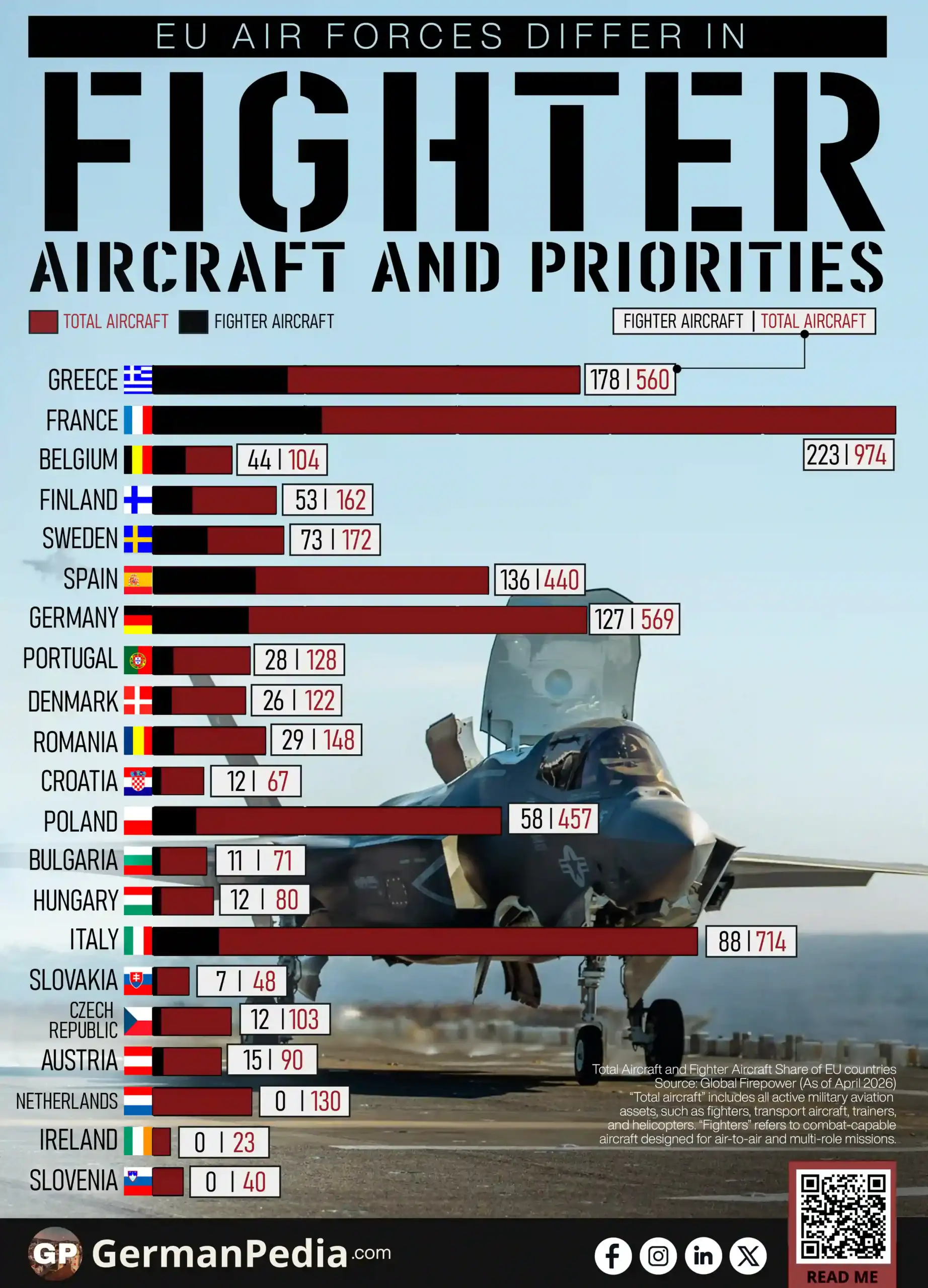
- Northern Europe prioritises air defence. Sweden (42.4% fighter fleet share out of total aircraft) and Finland (32.7%) have some of the highest fighter shares, reflecting a focus on territorial defence and proximity to Russia.
- Southern Europe combines scale with combat capability. Greece (178 fighters, 31.8%) and Spain (30.9%) maintain large fighter fleets due to regional tensions and broader geographic responsibilities.
- Larger countries often operate more diversified air forces. France (223 fighters, 22.9%), Germany (22.3%), and Italy (12.3%) balance fighter aircraft with other aircraft used for transport, surveillance, and support.
- Some smaller countries, like Belgium (42.3%), keep a high share of fighter jets but depend on NATO allies for supplies and other support.
- Air force structure reflects more than size. Across the EU, differences in fighter fleets show how countries balance geography, security needs, and alliance cooperation.
Use this Visualization: You may use this image for free with proper attribution to GermanPedia (i.e., by linking back to GermanPedia).
Need help communicating complex ideas visually? We help you turn data into your most persuasive story. Contact us to learn more.
Fighter Fleet Share in EU Countries
| Country | Total Aircraft | Fighter Fleet |
|---|---|---|
| Sweden | 172 | 73 (42.4%) |
| Belgium | 104 | 44 (42.3%) |
| Finland | 162 | 53 (32.7%) |
| Greece | 560 | 178 (31.8%) |
| Spain | 440 | 136 (30.9%) |
| France | 974 | 223 (22.9%) |
| Germany | 569 | 127 (22.3%) |
| Portugal | 128 | 28 (21.9%) |
| Denmark | 122 | 26 (21.3%) |
| Romania | 148 | 29 (19.6%) |
| Croatia | 67 | 12 (17.9%) |
| Austria | 90 | 15 (16.7%) |
| Bulgaria | 71 | 11 (15.5%) |
| Hungary | 80 | 12 (15.0%) |
| Slovakia | 48 | 7 (14.6%) |
| Poland | 457 | 58 (12.7%) |
| Italy | 714 | 88 (12.3%) |
| Czech Republic | 103 | 12 (11.7%) |
| Netherlands | 130 | 0 (0.0%) |
| Slovenia | 40 | 0 (0.0%) |
| Ireland | 23 | 0 (0.0%) |
| Malta | — | — |
| Cyprus | — | — |
Source: Global Firepower (As of April 2026)
“Total aircraft” includes all active military aviation assets, such as fighters, transport aircraft, trainers, and helicopters. “Fighters” refers to combat-capable aircraft designed for air-to-air and multi-role missions.

Air power is a key part of how European NATO countries protect their airspace and respond to threats.
Fighter aircraft are the main combat part of an air force. They are used to defend airspace, intercept unknown aircraft, and carry out combat missions. Looking at how many fighter jets a country has, and how big a share that is of its total aircraft, shows how much that country focuses on combat air power.
Northern European countries stand out both for their share of fighter jets and how their air forces are structured:
- Sweden operates 73 fighters out of 172 aircraft (42.4%)
- Finland has 53 out of 162 (32.7%)
These are among the highest shares in the EU.
This comes down to geography and security priorities. Both countries are close to Russia and have long focused on defending their own territory and reacting quickly to threats. Keeping a large fighter fleet lets them watch over and defend their airspace without relying much on help from other countries.
In Southern Europe, several countries have both large air forces overall and a strong number of fighter jets.
- Greece operates 178 fighters out of 560 aircraft (31.8%), one of the largest fighter fleets in the EU.
- Spain has 136 out of 440 (30.9%)
These levels reflect the different security situations in the region, such as:
- Greece keeps a strong combat air force because of long-running tensions in the Eastern Mediterranean, and because it plays a key role in defending NATO’s southern border.
- Spain also needs many combat aircraft because it has to defend both its mainland and its islands. It also helps NATO patrol the skies and watch over the seas in the western Mediterranean and along the Atlantic coast.
Beyond the differences between Northern and Southern Europe, the size of each air force also shows different priorities and roles within the EU and NATO.
Larger member states tend to operate more diversified air forces, as they take on broader responsibilities. These include not just defending their own airspace, but also international missions, supply operations, and long-range operations.
- France: 223 fighters out of 974 aircraft (22.9%)
- Germany: 127 out of 569 (22.3%)
- Italy: 88 out of 714 (12.3%)
These countries operate the largest air forces in the EU, as well as some of the largest fighter fleets. At the same time, their fleets include substantial numbers of transport, surveillance, tanker, and support aircraft.
Meanwhile, smaller air forces (e.g., Belgium: 44 fighters out of 104 aircraft) place greater emphasis on core combat capabilities. They rely on allies, especially NATO, for much of their transport, supplies, and other support.
Across the EU, differences in fighter fleets reflect how countries organise and prioritise their air power.
Beyond size alone, the structure of an air force shows how each country approaches security, geography, and cooperation within NATO.
Why Do Some EU Countries Not Have Fighter Fleets?
Some EU countries have few or no fighter jets at all. This includes Ireland, the Baltic states (Estonia, Latvia, and Lithuania), and Luxembourg.
Instead, they rely on shared defence arrangements such as NATO air‑policing missions. In these cases, air defence is provided collectively, with other NATO members deploying fighters to patrol their airspace, rather than through national fighter fleets.
More topics
- EU Military Manpower Changed Since 2020
- Bilateral Support to Ukraine Reached €342 Billion
- Air Defence Systems Drive Advanced Weapons Support to Ukraine
- Heavy Armour Support to Ukraine is Led by a Few Countries
- EU Countries with the Most U.S. Troops
- Germany’s Military Spending Increased 60-Fold Since 1953
- Germany’s Public Workforce: How Functions Shape Work
- Fuel Price Changes in Germany Amid US-Iran Tensions
- Petrol Prices Are Rising Across the EU
- Most Surveilled Major Cities in the EU
- Top 10 Foreign Holders of German Government Debt
- Environmental Impact of AI Websites in Germany
- Ukraine War Casualties Reach 1.8 Million After Four Years
- Electric and Hybrid Cars in the EU: Who Is Leading the Shift?
- Foreign-Born Population in the EU Is Rising
- EU Unicorn Startups: Which Countries Lead and Why
References
- https://www.globalfirepower.com/countries-listing.php
- https://www.heritage.org/sites/default/files/2024-07/BG3840.pdf
- https://www.nato.int/en/what-we-do/deterrence-and-defence/nato-integrated-air-and-missile-defence
- https://www.nato.int/en/what-we-do/deterrence-and-defence/nato-integrated-air-and-missile-defence
- https://www.nato.int/en/about-us/official-texts-and-resources/official-texts/2018/06/26/natos-joint-air-power-strategy