
Key Takeaways
- Germany hosts more U.S. troops than any other EU country. It has 36,436 active-duty service members and 11,416 civilian workers. The U.S. has kept a strong presence there since the Cold War.
- Italy and Spain are regional hubs. They connect U.S. military operations to the Mediterranean Sea and the Atlantic Ocean.
- Poland and Romania host smaller numbers of troops, but these numbers have become more important since Russia invaded Ukraine. Most of these troops rotate in and out rather than staying permanently.
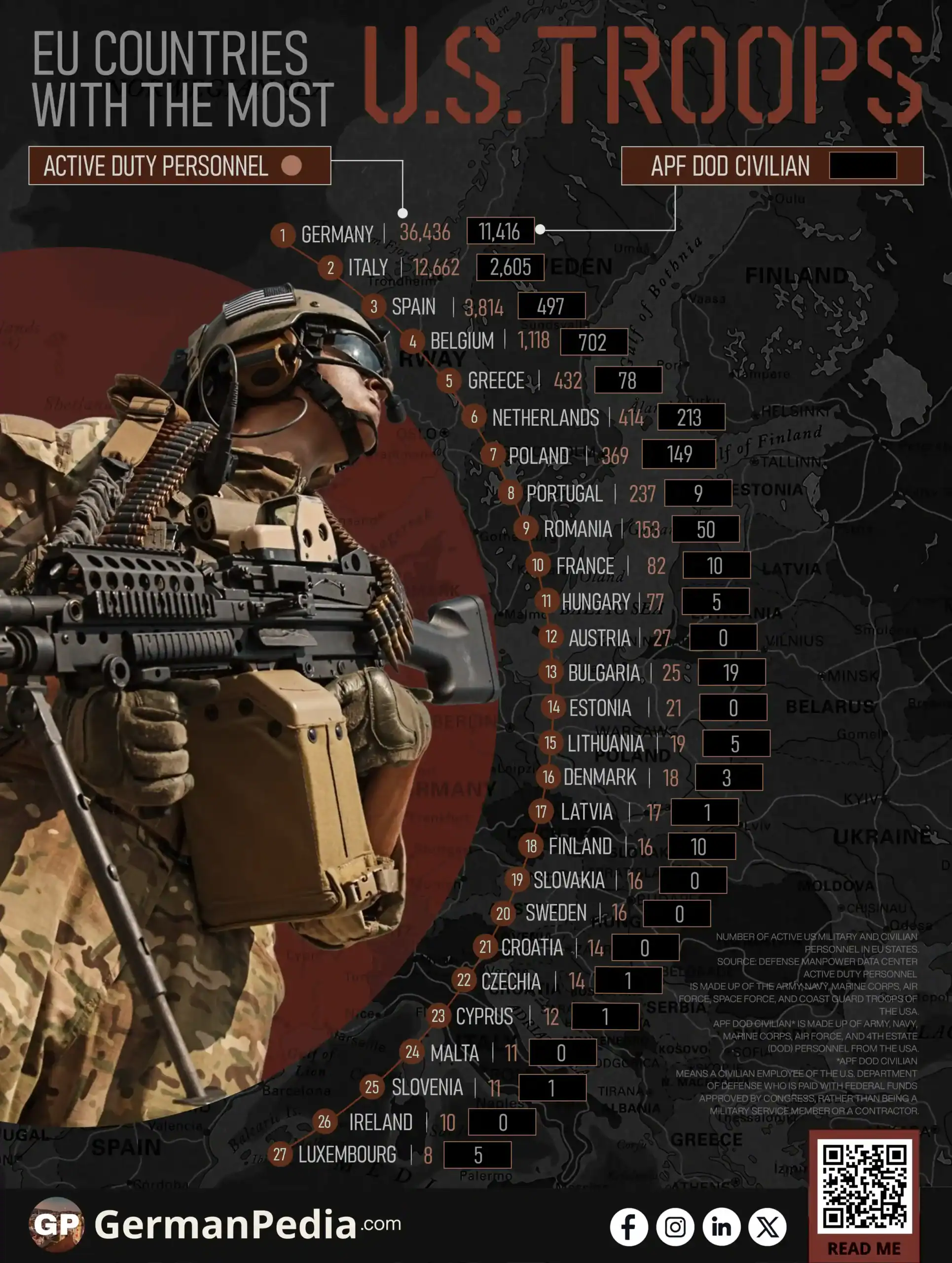
Use this Visualization: You may use this image for free with proper attribution to GermanPedia (i.e., by linking back to GermanPedia).
Need help communicating complex ideas visually? We help you turn data into your most persuasive story. Contact us to learn more.
US Military Personnel by EU Country
| Rank | Country | Active Duty Personnel | APF DoD Civilian |
|---|---|---|---|
| 1 | Germany | 36,436 | 11,416 |
| 2 | Italy | 12,662 | 2,605 |
| 3 | Spain | 3,814 | 497 |
| 4 | Belgium | 1,118 | 702 |
| 5 | Greece | 432 | 78 |
| 6 | Netherlands | 414 | 213 |
| 7 | Poland | 369 | 149 |
| 8 | Portugal | 237 | 9 |
| 9 | Romania | 153 | 50 |
| 10 | France | 82 | 10 |
| 11 | Hungary | 77 | 5 |
| 12 | Austria | 27 | 0 |
| 13 | Bulgaria | 25 | 19 |
| 14 | Estonia | 21 | 0 |
| 15 | Lithuania | 19 | 5 |
| 16 | Denmark | 18 | 3 |
| 17 | Latvia | 17 | 1 |
| 18 | Finland | 16 | 10 |
| 19 | Slovakia | 16 | 0 |
| 20 | Sweden | 16 | 0 |
| 21 | Croatia | 14 | 0 |
| 22 | Czechia | 14 | 1 |
| 23 | Cyprus | 12 | 1 |
| 24 | Malta | 11 | 0 |
| 25 | Slovenia | 11 | 1 |
| 26 | Ireland | 10 | 0 |
| 27 | Luxembourg | 8 | 5 |
Source: Defense Manpower Data Center
Active Duty personnel is made up of the army, navy, marine corps, air force, space force, and coast guard troops of the USA.
APF DoD Civilian* is made up of army, navy, marine corps, air force, and 4th estate (DoD) personnel from the USA.
*APF DoD civilian means a civilian employee of the U.S. Department of Defense who is paid with federal funds approved by Congress, rather than being a military service member or a contractor.

Most EU countries have few or no U.S. troops. That’s because the U.S. military doesn’t spread its people evenly across Europe. Instead, it concentrates them in a few key locations.
Germany holds the largest U.S. military footprint in the EU, with over 36,000 active-duty personnel and more than 11,000 civilian staff.
This concentration dates back to the Cold War, when West Germany became the front line of NATO’s defense system. Over time, the U.S. built a lasting network of bases there, along with command centers and supply operations.
The large number of civilian workers matters too. Unlike troops, who often get reassigned elsewhere, civilian staff usually stay in place for years. So Germany’s high number of civilian workers shows that the U.S. presence there is permanent and deeply built-in, not temporary.
Italy (12,662 troops) and Spain (3,814 troops) have fewer troops than Germany, but they’re still key parts of the system. Their job is more regional. They support U.S. operations in southern Europe and the surrounding area.
In Italy, the Sigonella base is a major support point linking U.S. forces in Europe to the Mediterranean Sea. In Spain, naval and air bases near the Strait of Gibraltar (the narrow water passage between Spain and Morocco) help the U.S. and NATO move forces between the Atlantic and the Mediterranean.
Both countries have a mix of troops and civilian workers, showing bases that are solid and long-running, but smaller in scale than Germany’s.
Further east, the structure looks different.
Poland (369 troops) and Romania (153 troops) have far fewer troops and civilian workers.
Since Russia invaded Ukraine in 2022, these countries have become more important for defending NATO’s eastern border. But the U.S. presence there is mainly meant to deter attacks and allow quick reinforcement, not to build large, permanent bases.
EU Military Manpower Changed Since 2020 ->
Most of these troops are rotational, meaning they cycle in and out rather than staying long-term. The small number of civilian workers also shows there isn’t much long-term infrastructure built up yet to support them.
Overall, the U.S. sets up its military in Europe differently country by country. Some countries have long-term bases and support staff, while others mainly host short-term or rotating deployments. This pattern reflects both current events and where the U.S. built its military infrastructure over the decades.
More topics
- Germany’s Military Spending Increased 60-Fold Since 1953
- EU Military Manpower Changed Since 2020
- Bilateral Support to Ukraine Reached €342 Billion
- Air Defence Systems Drive Advanced Weapons Support to Ukraine
- Heavy Armour Support to Ukraine is Led by a Few Countries
- Germany’s Public Workforce: How Functions Shape Work
- Fuel Price Changes in Germany Amid US-Iran Tensions
- Petrol Prices Are Rising Across the EU
- Most Surveilled Major Cities in the EU
- Top 10 Foreign Holders of German Government Debt
- Environmental Impact of AI Websites in Germany
- Ukraine War Casualties Reach 1.8 Million After Four Years
- Environmental Impact of AI Websites in Germany
- Where are Billionaires Concentrated in the EU?
- EU Unicorn Startups: Which Countries Lead and Why
References
- https://dwp.dmdc.osd.mil/dwp/app/dod-data-reports/workforce-reports
- https://www.aacvr-germany.org/us-military-bases-in-germany
https://www.nam.ac.uk/explore/active-edge-army-germany-during-cold-war - https://cepa.org/article/going-going-the-us-base-network-in-europe/
- https://www.cfr.org/articles/where-are-us-forces-deployed-europe
- https://www.geopoliticalmonitor.com/the-strategic-case-for-us-security-guarantees-in-europe/
- https://www.war.gov/News/News-Stories/Article/Article/2920844/us-to-deploy-3000-troops-to-romania-poland-germany/
- https://globalnation.inquirer.net/305146/us-troops-in-germany-what-you-need-to-know