Key Takeaways
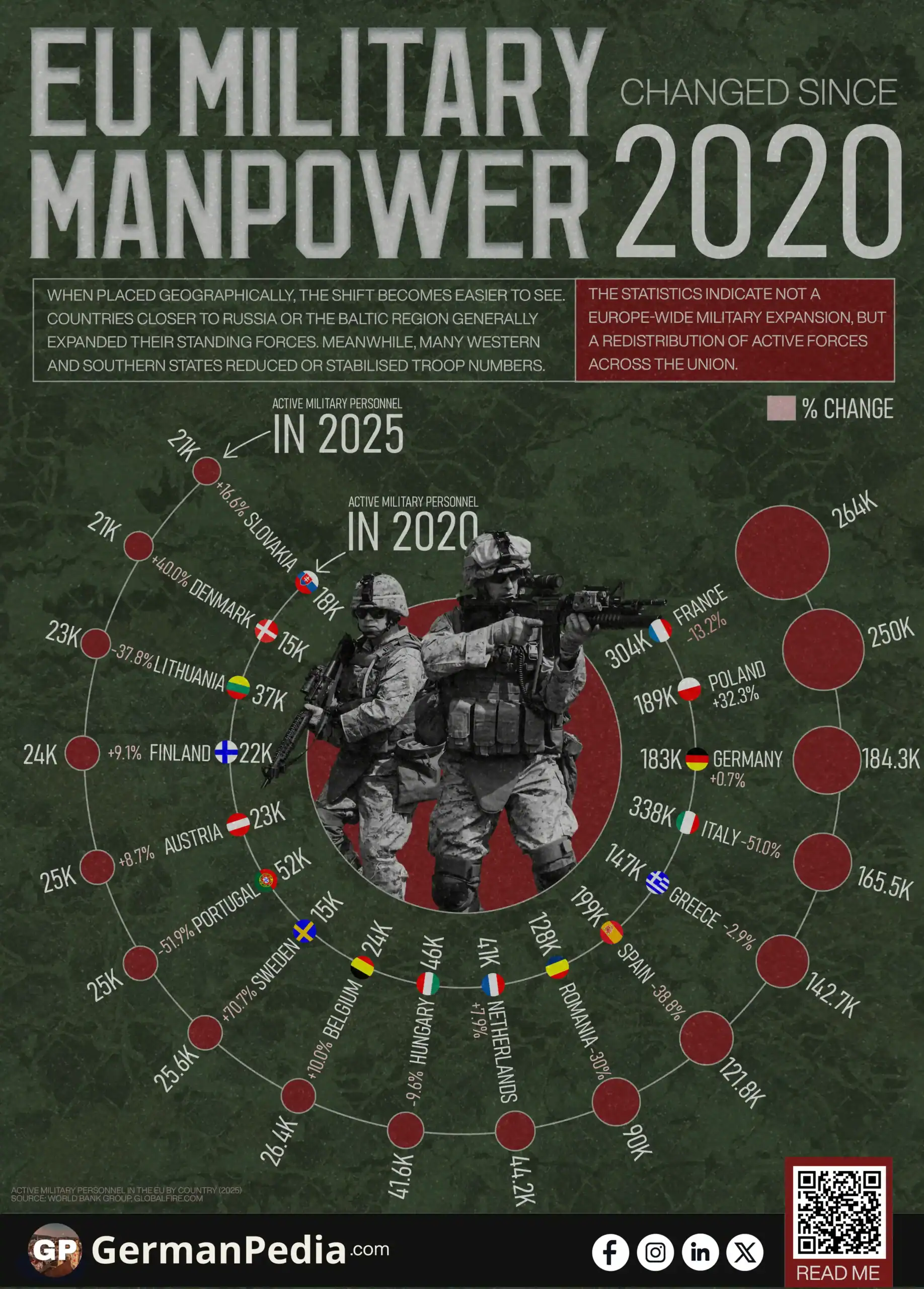
- France remains the EU’s largest standing army, estimated at 264,000 in 2025. However, its active personnel have declined by 13.2% since 2020.
- Poland recorded the strongest absolute expansion in terms of military manpower. It has increased its active forces by 32% since 2020.
- Northern and Eastern EU countries generally expanded their forces. Meanwhile, several Western and Southern member states reduced or stabilised troop numbers.
- The increases are concentrated in countries closer to Russia or the Baltic region. Many of these countries announced higher defence spending, stronger deterrence policies, and expanded recruitment after Russia invaded Ukraine in 2022.
- Long-term structural factors continue to shape force size. Professional armies, ageing populations, recruitment limits, and modernisation priorities constrain rapid expansion.
Use this Visualization: You may use this image for free with proper attribution to GermanPedia (i.e., by linking back to GermanPedia).
Need help communicating complex ideas visually? We help you turn data into your most persuasive story. Contact us to learn more.
Active military personnel refers to full-time soldiers currently serving in a country’s armed forces. It excludes reserves and paramilitary units.
Across the 27 EU member states, active manpower is highly concentrated in a few countries.
European Union’s Active Military Personnel
| Rank | Country | Active Military Personnel | ||
| 2020 | 2025 (Estimated) | % Change | ||
| 1 | France | 304,000 | 264,000 | -13.2% |
| 2 | Poland | 189,000 | 250,000 | +32.3% |
| 3 | Germany | 183,000 | 184,324 | +0.7% |
| 4 | Italy | 338,000 | 165,500 | -51.0% |
| 5 | Greece | 147,000 | 142,700 | -2.9% |
| 6 | Spain | 199,000 | 121,802 | -38.8% |
| 7 | Romania | 128,000 | 90,000 | -29.7% |
| 8 | Netherlands | 41,000 | 44,245 | +7.9% |
| 9 | Hungary | 46,000 | 41,600 | -9.6% |
| 10 | Bulgaria | 37,000 | 37,000 | 0.0% |
| 11 | Czech Republic | 27,000 | 27,000 | 0.0% |
| 12 | Belgium | 24,000 | 26,390 | +10.0% |
| 13 | Sweden | 15,000 | 25,600 | +70.7% |
| 14 | Portugal | 52,000 | 25,000 | -51.9% |
| 15 | Austria | 23,000 | 25,000 | +8.7% |
| 16 | Finland | 22,000 | 24,000 | +9.1% |
| 17 | Lithuania | 37,000 | 23,000 | -37.8% |
| 18 | Denmark | 15,000 | 21,000 | +40.0% |
| 19 | Slovakia | 18,000 | 20,982 | +16.6% |
| 20 | Croatia | 20,000 | 14,325 | -28.4% |
| 21 | Cyprus | 13,000 | 12,000 | -7.7% |
| 22 | Estonia | 7,000 | 7,700 | +10.0% |
| 23 | Ireland | 9,000 | 7,557 | -16.0% |
| 24 | Slovenia | 7,000 | 7,000 | 0.0% |
| 25 | Latvia | 9,000 | 6,500 | -27.8% |
| 26 | Malta | 2,000 | 2,000 | 0.0% |
| 27 | Luxembourg | 1,000 | 900 | -10.0% |
Source: World Bank Group, GlobalFire.com

France maintains the largest standing force in the EU. It has 264,000 active troops. However, that number represents a 13% decline since 2020.
Poland now stands just behind France with 250,000 active personnel. Unlike France, Poland expanded rapidly. Since 2020, its active force has grown by more than 60,000 troops. That is an increase of 32%.
That contrast captures the broader pattern inside the European Union.
Several Western and Southern member states reduced their active forces between 2020 and 2025:
- Portugal (–51.9%)
- Italy (–51.0%)
- Spain (–38.8%)
- Romania (–29.7%)
Germany remained broadly stable (+0.7%).
At the same time, several Northern and Eastern member states moved in the opposite direction:
- Sweden (+71%)
- Denmark (+40%)
- Slovakia (+17%)
- Finland (+9.1%)
- Netherlands (+7.9%)
When placed geographically, the shift becomes easier to see. Countries closer to Russia or the Baltic region expanded their standing forces. Meanwhile, many Western and Southern states reduced or stabilised troop numbers.
The timing overlaps with a major security event: Russia’s invasion of Ukraine in 2022. The largest increases in active personnel are observed in countries that made stronger defence commitments after that point.
These commitments generally included:
- Higher defence spending targets
- Expanded recruitment programmes
- Faster mobilisation plans
- Greater emphasis on territorial defence
Poland’s expansion is the clearest example. It significantly increased defence spending and accelerated recruitment in response to the changed security environment. Sweden and Finland also adjusted their security posture during this period. These reinforced readiness and expanded their forces.
At the same time, the EU did not move in one direction. Several of its largest economies recorded fewer active troops in 2025 than in 2020. This indicates that the shift is regional rather than collective.
Several long-term factors help explain why military expansion differs across EU countries.
- Most member states rely on professional armed forces instead of mandatory military service. This means they must recruit people who choose to join the military, which takes time.
- Expanding the armed forces is expensive. Governments need time and long-term funding to recruit, train, and retain more personnel.
- Ageing populations reduce the number of young adults available for service.
- Some governments prioritise equipment modernisation and technological upgrades instead of expanding manpower.
Life Expectancy in European Countries ->
Even in a more uncertain security climate, increasing troop numbers is neither immediate nor automatic. Expanding the size of the army requires time, resources, and sufficient recruits.
Taken together, the numbers do not point to a Europe-wide surge in military size. Instead, they show a redistribution of active forces within the Union.
Northern and Eastern member states have generally strengthened their standing armies. Western and Southern states have often reduced or stabilised them.
The result is a more uneven military landscape across the EU. Geography appears to shape force size more clearly than a single common trend.
More topics
- EU Unicorn Startups: Which Countries Lead and Why
- Europe’s Population Shifted Over 20 Years
- GDP of European Countries
- Life Expectancy in European Countries
- European Union’s Debt Has Grown Sharply Over Two Decades
- Germany’s Murder Cases Have Halved Since 2000
- Apartment Rents Are Rising Faster Than House Rents in Germany
- Top German Companies by Revenue
- Germans Earn More Than Foreign Workers Across Germany
- Unemployment Across Germany: A Federal State Breakdown
- Germany’s Fastest-Growing Jobs by LinkedIn
- Silver Production in Europe by Country
- Highest Paying Jobs in Germany
- How Educated Are Europeans?
- Two Decades of Renewable Energy Growth in Europe