
Key Takeaways
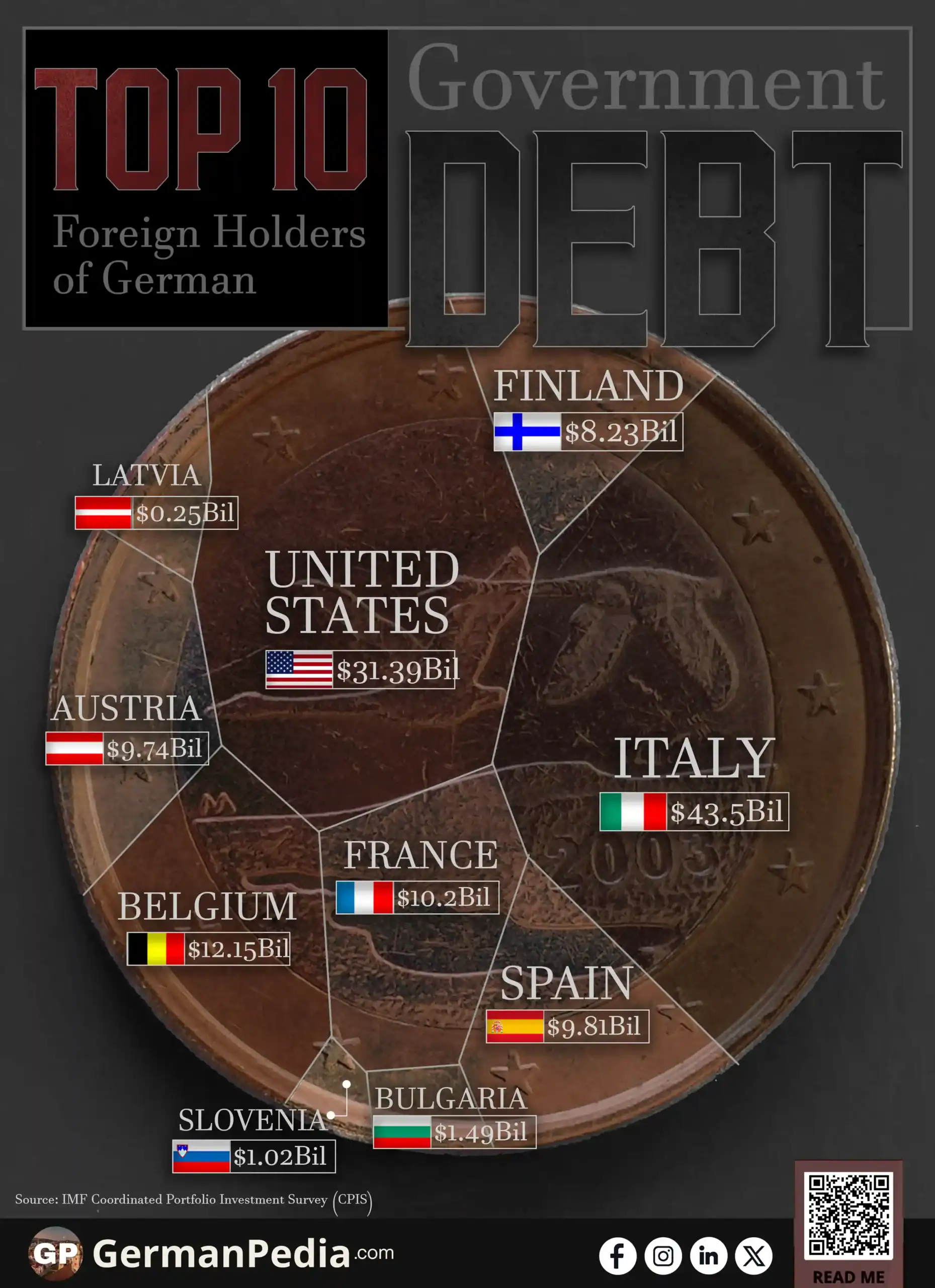
- Italy is the largest foreign holder of German government debt. Italian investors held about $43.5 billion worth of Bunds in 2024.
- The United States ranks second. U.S.-based investors held around $31.4 billion worth of German government bonds in 2024. That figure shows how widely Bunds are held in investment portfolios around the world.
- Nine of the top 10 foreign holders of German government debt are European Union member states. Only the US is the non-EU country on the list.
- German government bonds (Bunds) are widely held because they are highly liquid. That means they are easy to buy and sell quickly. Investors also consider them one of the safest assets in the euro area.
Use this Visualization: You may use this image for free with proper attribution to GermanPedia (i.e., by linking back to GermanPedia).
Need help communicating complex ideas visually? We help you turn data into your most persuasive story. Contact us to learn more.
Biggest Holders of German Government Debt by Country
| Rank | Country | Holdings (In USD billions) |
|---|---|---|
| 1 | Italy | 43.5 |
| 2 | United States | 31.39 |
| 3 | Belgium | 12.15 |
| 4 | France | 10.23 |
| 5 | Spain | 9.81 |
| 6 | Austria | 9.74 |
| 7 | Finland | 8.23 |
| 8 | Bulgaria | 1.49 |
| 9 | Slovenia | 1.02 |
| 10 | Latvia | 0.25 |
“Long-term” means the bond was originally set up to be repaid more than one year after it was issued. These bonds make up the main part of Germany’s government bond market.
Holdings include every kind of investor located in the reporting country, such as banks, investment funds, insurance companies, firms, and households. These bonds are also called portfolio investments. That means investors bought them purely to earn a return, not to gain ownership or control over the German government.
The securities counted here are ones issued by Germany’s general government sector. That includes the federal government together with state and local governments. Figures are reported in U.S. dollars and reflect holdings as of the end of 2024.
Source: IMF Coordinated Portfolio Investment Survey (CPIS)

Nine of the ten biggest foreign holders of German government bonds are European Union member states. Italy ranks as the largest holder of German government bonds. Italian investors held about $43.5 billion worth of Bunds in 2024.
A government bond works like an IOU (“I owe you”). Germany borrows money from investors. It agrees to pay the money back later with interest. Bonds can also be bought and sold between investors. This works differently from a typical bank loan, more like how stocks trade.
The high number of EU countries on this list shows how closely connected Europe’s financial markets are. Banks, insurance companies, pension funds, and investment funds across Europe regularly buy government bonds issued by other euro-area countries. They hold these bonds as part of a broader mix of investments, the same way a person might split their savings between stocks and a savings account.
Foreign investors own a large share of Germany’s government debt overall.
Bunds are widely held for a few reasons. They are highly liquid. That means investors can buy or sell them quickly without the price moving much. They’re also considered one of the safest assets in the euro area. Banks and other financial institutions also use Bunds as collateral. This means they pledge the bonds as a guarantee when they take out short-term loans. This often happens through what are called repo transactions. In a repo, one party temporarily hands over a bond in exchange for cash. They agree to buy the bond back later. This works similarly to a pawn shop loan, where the bond acts as the item put up for security.
As a result, investors across Europe often hold Bunds alongside the government bonds of their own country.
Outside Europe, the United States also appears prominently in the ranking. U.S.-based investors held about $31.4 billion worth of Bunds in 2024.
These holdings reflect how far U.S. financial firms reach into markets abroad. American asset managers, pension funds, insurance companies, and banks invest in government bond markets across the world, not just in the U.S.
Bunds are also widely used as a benchmark for European government debt. That means other European countries’ bond prices are often compared to Germany’s as a reference point. Bunds’ liquidity and benchmark status are why they commonly show up in international bond portfolios. Investors often hold them alongside other major government bonds, such as U.S. Treasuries.
The countries shown in this ranking reflect where the investors are located, not their nationality. Some countries are home to large investment fund industries. In those cases, German bonds may be held through a fund based in that country even though the people investing in the fund live elsewhere.
Together, these patterns show that German government bonds serve two roles. Within the euro area, they act as a financial anchor that other countries’ institutions regularly invest in. Globally, they function as one of the world’s most trusted safe assets.
More topics
- GDP of European Countries
- European Union’s Debt Has Grown Sharply Over Two Decades
- Europe’s Population Shifted Over 20 Years
- Which European Countries Hold the Most Gold Reserves?
- Top 10 Richest Women in the EU
- Life Expectancy in European Countries
- EU Unicorn Startups: Which Countries Lead and Why
- Women Are Increasing in Managerial Roles Across the EU
- Italy is the Old Man of Europe
- Silver Production in Europe by Country
- Two Decades of Renewable Energy Growth in Europe
- Germans Earn More Than Foreign Workers Across Germany
- EU Military Manpower Changed Since 2020
- Top 20 Largest Employers in Berlin
- Employment in the EU Is Shifting Toward Higher Education
References
- https://data.imf.org/en/Data-Explorer?datasetUrn=IMF.STA:PIP(5.0.0)
- https://www.suerf.org/publications/suerf-policy-notes-and-briefs/the-german-and-italian-government-bond-markets-the-role-of-banks-versus-non-banks/
- https://www.bundesbank.de/resource/blob/895586/679d039d4773416c34b969f841cf3f1d/mL/2022-07-glaeubigerstruktur-data.pdf