Key Takeaways
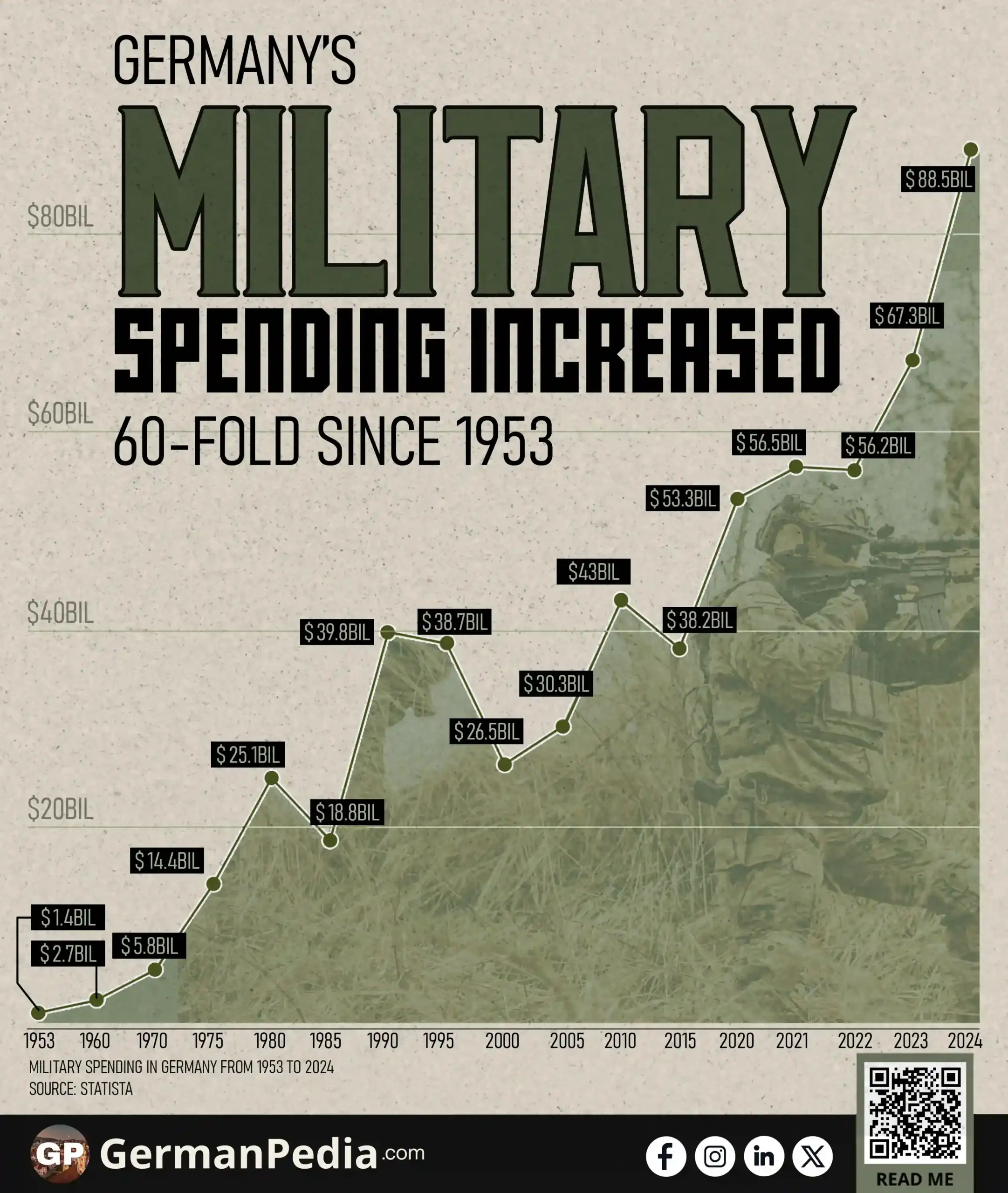
- Germany’s military spending rose from $1.4 billion in 1953 to $88.5 billion in 2024.
- Spending increased steadily during the Cold War. It is when West Germany became a NATO frontline state.
- After the Cold War ended, military spending declined as perceived security risks in Europe declined. Germany reduced troop numbers, restructured the Bundeswehr, and focused less on territorial defence.
- Between 2022 and 2024, military spending rose by more than $30 billion. This was the fastest sustained increase in decades.
- The rise followed Russia’s full-scale invasion of Ukraine. Germany responded by creating a $100 billion special defence fund and recommitting to NATO’s 2% spending target.
Use this Visualization: You may use this image for free with proper attribution to GermanPedia (i.e., by linking back to GermanPedia).
Need help communicating complex ideas visually? We help you turn data into your most persuasive story. Contact us to learn more.
Germany’s Military Expenditure Over Time
| Year | Military spending (in USD billions) |
|---|---|
| 2024 | 88.5 |
| 2023 | 67.3 |
| 2022 | 56.2 |
| 2021 | 56.5 |
| 2020 | 53.3 |
| 2015 | 38.2 |
| 2010 | 43 |
| 2005 | 30.3 |
| 2000 | 26.5 |
| 1995 | 38.7 |
| 1990 | 39.8 |
| 1985 | 18.8 |
| 1980 | 25.1 |
| 1975 | 14.4 |
| 1970 | 5.8 |
| 1960 | 2.7 |
| 1953 | 1.4 |
Source: Statista

Germany’s military spending increased from $1.4 billion in 1953 to $88.5 billion in 2024. It is now roughly 60 times larger than in 1953.
In the early 1950s, West Germany was rebuilding after World War II. It had no armed forces of its own. The Bundeswehr was established in 1955. It is the same year the country joined NATO. Because of Germany’s military history, rearmament was politically sensitive. The new armed forces were therefore integrated into NATO and formed part of a collective Western defence system.
As a NATO frontline state during the Cold War, West Germany expanded the Bundeswehr under conscription and maintained large troop numbers for territorial defence.
Military spending rose from $1.4 billion in 1953 to $39.8 billion in 1990. This was a period of structural military expansion shaped by alliance commitments and East–West confrontation in Europe. By the end of the Cold War, defence spending was nearly 30 times higher than in the early post-war years.
Germany reduced its military footprint after reunification and the collapse of the Soviet Union. Spending fell to $26.5 billion (2000).
Even as budgets later recovered modestly (e.g., $38.2 billion in 2015), defence was not a central fiscal priority for roughly 25 years.
Key structural changes included:
- Downsizing of the Bundeswehr
- Suspension of conscription in 2011
- Lower perceived territorial risk in Europe
In nominal terms, military spending fluctuated. In strategic terms, Germany operated under the assumption of relative stability in Europe.
The turning point came after Russia’s full-scale invasion of Ukraine in February 2022.
EU Military Manpower Changed Since 2020 ->
Germany’s defence budget moved from $56.2 billion (2022) to $88.5 billion (2024). That is an increase of over $30 billion in just two years.
This marks the fastest sustained rise in modern German defence spending.
The change was reinforced by:
- The €100 billion special defence fund
- A renewed commitment to NATO’s 2% target
- Greater emphasis on equipment readiness and procurement
This is not a cyclical fluctuation. It represents a structural reprioritisation of defence within Germany’s federal budget.
Germany’s military spending today reflects a system adjusting to a changed security environment. The long-term trend is growth, but recent years mark a clear shift away from decades of defence restraint toward stronger military preparedness.
More topics
- Germany is Losing €100 Billion Every Year
- Germany’s GDP Growth: Three Decades of Economic Evolution
- Germany’s Public Debt Over Time: A 30-Year Overview
- How Germany’s Debt-to-GDP Ratio Has Changed Since 2000s
- Debt per Capita in Germany: Fourfold Growth Since Reunification
- Germany’s GDP per Capita Has Nearly Tripled Since 1991
- European Union’s Debt Has Grown Sharply Over Two Decades
- GDP of European Countries
- Where Do Immigrants in Germany Come From?
- Germany’s Live Births Per Federal State
- Germany’s Murder Cases Have Halved Since 2000
- Germany Passes Voluntary Military Service Law
- Germany’s Median Wage by Federal State
- Average Pension in Germany by Federal State
- Leading Causes of Death in Germany