
Key Takeaways
- North Rhine-Westphalia and Bavaria are the top two states by the number of income millionaires. They recorded 7,871 and 7,707 millionaires, respectively.
- Regions such as Hamburg and Schleswig-Holstein rank among the highest when measured by the number of millionaires per €100 billion of GRDP.
- Eastern states report fewer income millionaires. It reflects differences in concentration of large firms, high-paying industries, and dense urban economic activity.
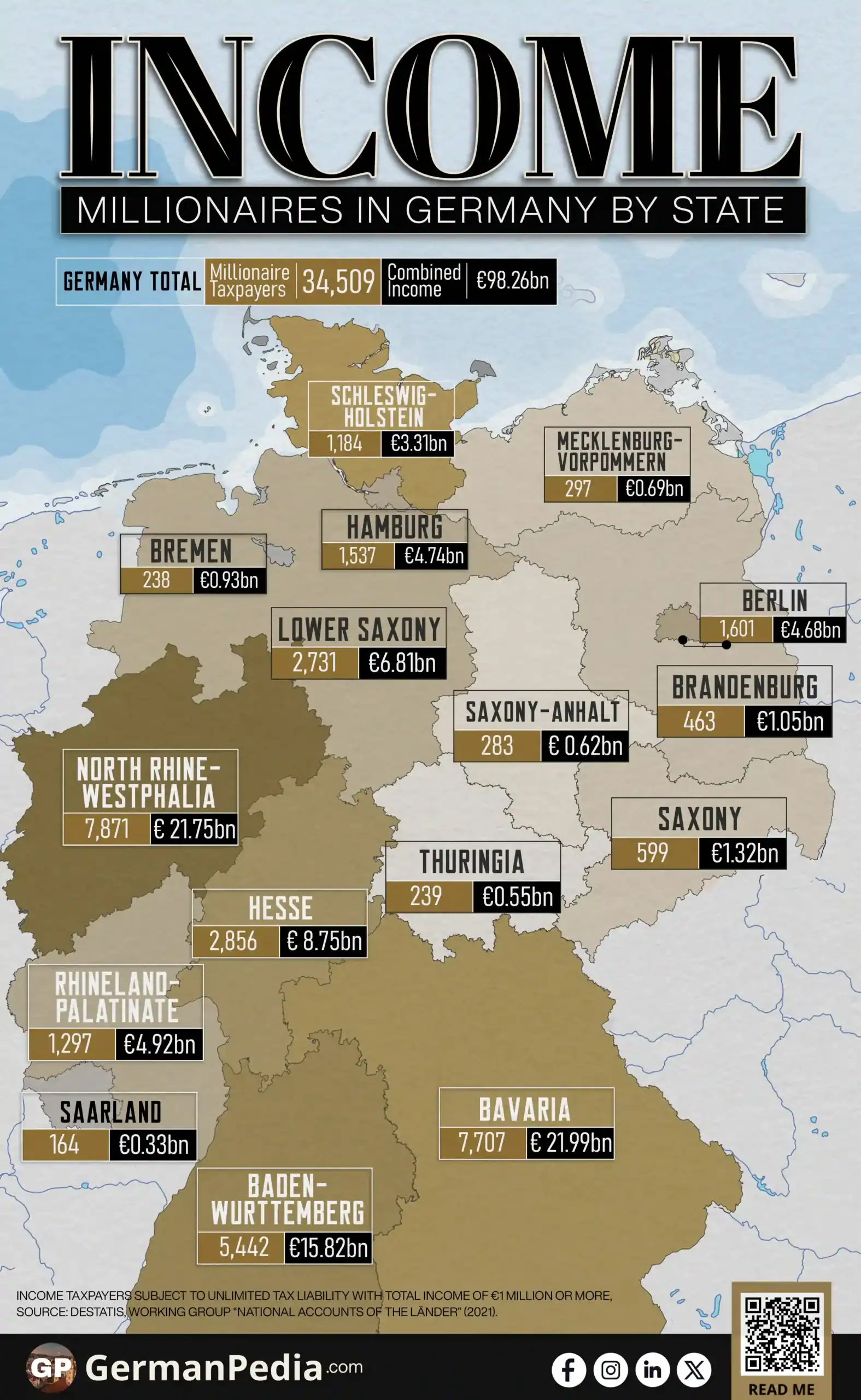
Use this Visualization: You may use this image for free with proper attribution to GermanPedia (i.e., by linking back to GermanPedia).
Need help communicating complex ideas visually? We help you turn data into your most persuasive story. Contact us to learn more.
Millionaire taxpayers in Germany by federal state
| Federal state | Adjusted gross income | GRDP (In bn. €) | |
| Millionaire Taxpayers | Combined Income (In bn. €) | ||
| North Rhine-Westphalia | 7,871 | 21.75 | 760.1 |
| Bavaria | 7,707 | 21.99 | 674.5 |
| Baden-Württemberg | 5,442 | 15.82 | 554.6 |
| Hesse | 2,856 | 8.75 | 314.0 |
| Lower Saxony | 2,731 | 6.81 | 321.8 |
| Berlin | 1,601 | 4.68 | 170.3 |
| Hamburg | 1,537 | 4.74 | 138.7 |
| Rhineland-Palatinate | 1,297 | 4.92 | 167.2 |
| Schleswig-Holstein | 1,184 | 3.31 | 106.5 |
| Saxony | 599 | 1.32 | 136.0 |
| Brandenburg | 463 | 1.05 | 81.2 |
| Mecklenburg-Vorpommern | 297 | 0.69 | 50.2 |
| Saxony-Anhalt | 283 | 0.62 | 67.7 |
| Thuringia | 239 | 0.55 | 66.8 |
| Bremen | 238 | 0.93 | 35.8 |
| Saarland | 164 | 0.33 | 37.1 |
| Germany (Total) | 34,509 | 98.26 | 3,682.3 |
Source: Destatis, Working Group “National Accounts of the Länder” (2021).

In Germany, income millionaires are taxpayers with an annual income of €1 million or more. In 2021, there were 34,509 such taxpayers nationwide. They had a combined adjusted gross income of €98.26 billion.
Germany’s income millionaires cluster in the largest economies
Income millionaires in Germany are concentrated in states with the largest and most developed economies.
This becomes clearer when comparing the number of high-income taxpayers with regional economic output (GRDP):
- North Rhine-Westphalia, the largest state economy (€760.1 billion), also has the highest number of income millionaires (7,871)
- Bavaria, with a slightly smaller economy (€674.5 billion), follows closely (7,707)
This suggests a strong link between economic scale and the concentration of top incomes.
Which Federal States Drive Germany’s Economy? ->
However, the differences between states become clearer once economic size is taken into account. Some regions generate more income millionaires relative to their economic output than others. This suggests that the type of economic activity matters as much as the size of the economy.
When measured by the number of millionaires per €100 billion of GRDP, several states stand out, including:
- Hamburg → ~1,140 millionaires per €100 billion GRDP
- Bavaria → ~1,110
- Schleswig-Holstein →~1,110
- North Rhine-Westphalia →~1,040
Millionaires per €100 billion = (Number of millionaire taxpayers / GRDP in € billions) × 100
Hamburg is especially notable because it ranks among the highest despite having a relatively small economy. That reflects its role as a dense economic hub, where finance, trade, and corporate activity are concentrated, and high incomes are more likely to cluster.
By contrast, Lower Saxony shows the opposite pattern. Despite its relatively large economy, it has fewer income millionaires (~840 per €100B) than might be expected.
East–West Divide in Germany’s Income Millionaires
At the lower end of the distribution, eastern states combine smaller economies with fewer income millionaires. This includes:
- Mecklenburg-Vorpommern → 297 millionaires
- Saxony-Anhalt → 283
- Thuringia → 239
This reflects bigger structural differences. That includes a concentration of large corporations, high-paying sectors, and capital-intensive activity.
The distribution of income millionaires in Germany reflects the country’s economic geography. Larger and more economically dense regions tend to produce more high-income taxpayers, but economic structure and urban concentration also play a major role.
Economic size provides the foundation, but the type of economy still shapes how many top earners a region produces.
More topics
- Top 10 Largest Employers in Germany
- Employment by Federal State in Germany
- Germany’s Top 8 Most Valuable Brands
- Which Federal States Drive Germany’s Economy?
- Gender Employment Patterns Across Germany’s Labour Market
- Which German States Have the Highest Abortion Ratios?
- Where Do People Arriving from Abroad Settle in Germany?
- Self-Employment and Employment in Germany Over Time
- Germany’s Civil Service Reached Near Gender Parity
- Germany’s Median Wage by Federal State
- Environmental Impact of AI Websites in Germany
- Hospital Capacity Across Germany: A State-by-State Comparison
- Germany’s Live Births Per Federal State
- Two Decades of Renewable Energy Growth in Europe
- Average Pension in Germany by Federal State