
Key Takeaways
- Germany leads Europe’s data center landscape with 515 facilities. This is supported by strong demand, infrastructure, and regulatory stability.
- Frankfurt is a critical connectivity hub, anchored by DE-CIX, reinforcing Germany’s role in European and global data traffic.
- Despite small populations, the Netherlands and Ireland show that connectivity and business environment can matter more than population size in data center location.
- Nordic countries attract large-scale facilities due to energy efficiency, abundant renewable power, low population density, stable regulation, and strong network connectivity.
- In the EU, data centers cluster where advantages in demand, connectivity, and energy overlap.
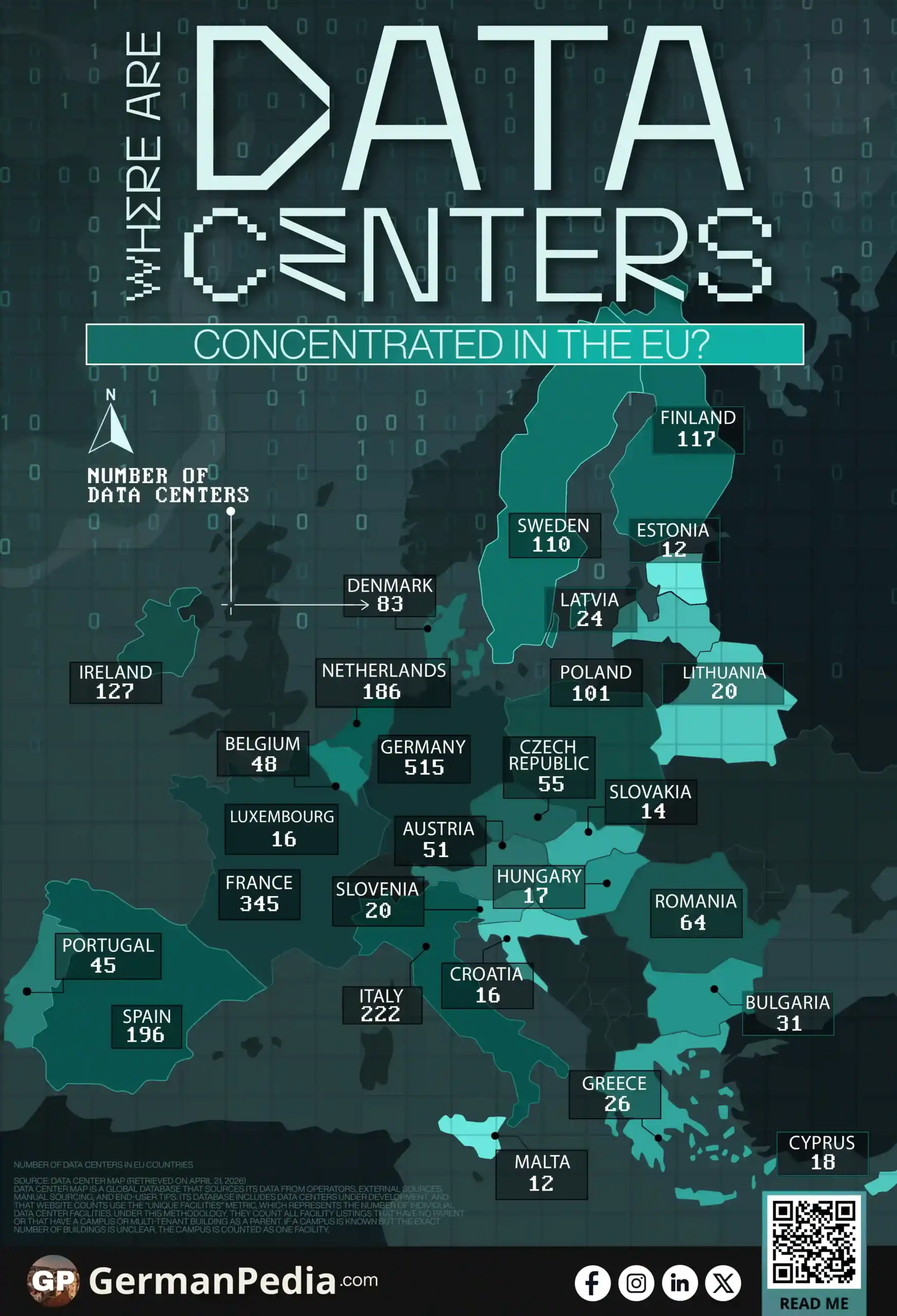
Use this Visualization: You may use this image for free with proper attribution to GermanPedia (i.e., by linking back to GermanPedia).
Need help communicating complex ideas visually? We help you turn data into your most persuasive story. Contact us to learn more.
A data center is a physical facility that houses the IT infrastructure used to store, process, and deliver data and applications. It supports everyday digital activity, from messaging and streaming to cloud storage and work systems.
Each time a website loads or an app refreshes, that request is handled in a data center.
As demand for artificial intelligence, cloud services, and AI infrastructure grows, these data centers are becoming a core part of the EU’s digital economy.
Data Centers in the EU by Country
| Country | Number of Data Centers |
|---|---|
| Germany | 515 |
| France | 345 |
| Italy | 222 |
| Spain | 196 |
| Netherlands | 186 |
| Ireland | 127 |
| Finland | 117 |
| Sweden | 110 |
| Poland | 101 |
| Denmark | 83 |
| Romania | 64 |
| Czech Republic | 55 |
| Austria | 51 |
| Belgium | 48 |
| Portugal | 45 |
| Bulgaria | 31 |
| Greece | 26 |
| Latvia | 24 |
| Lithuania | 20 |
| Slovenia | 20 |
| Cyprus | 18 |
| Hungary | 17 |
| Croatia | 16 |
| Luxembourg | 16 |
| Slovakia | 14 |
| Estonia | 12 |
| Malta | 12 |
Source: Data Center Map (Retrieved on April 21, 2026)
Data Center Map is a global database that sources its data from operators, external sources, manual sourcing, and end-user tips. Its database includes data centers under development.
Counts are based on its “Unique Facilities” metric, which refers to individual data center facilities. A facility is counted if it has no parent facility or if its parent is a campus or multi-tenant building. If a campus is known but the exact number of buildings is unclear, it is counted as one facility.

At the top, Germany leads by a wide margin. It recorded 515 data centers as of April 2026.
This reflects several structural advantages:
- Central European location. Germany is well-positioned to serve both domestic and wider EU markets.
- Strong market demand. As Europe’s largest economy, it supports a strong demand for cloud services, enterprise IT, and data processing.
- Reliable infrastructure. Stable power supply and advanced telecom networks support consistent operations and high connectivity.
- Energy and regulatory framework. Policies (e.g., German Energy Efficiency Act) increasingly push data centers toward efficiency, waste heat reuse, and greater use of renewable energy.
- Data sovereignty and compliance. Germany’s strong data protection environment makes it attractive for enterprise, public-sector, and regulated workloads.
Frankfurt plays a key role in this position. As home to DE-CIX Frankfurt, the world’s leading Internet Exchange, it serves as a major hub for European and global data traffic.
This strengthens Germany’s importance for both domestic demand and cross-border connectivity.
France (345 data center facilities) and Italy (222) follow a similar pattern. They combine large domestic markets with growing digital demand.
In contrast, the Netherlands (186) and Ireland (127) rank highly despite having smaller populations compared to the other EU leaders. This shows that connectivity and business environment can outweigh size.
The Netherlands benefits from Amsterdam’s role as a major internet exchange and data transit hub, which supports international traffic and hyperscale deployments.
Meanwhile, Ireland is a key base for major hyperscale operators. That includes Amazon, Microsoft, Google, and Meta. This is supported by trans-Atlantic connectivity, skilled talent, and a strong concentration of data center capacity around Dublin.
Countries like Finland (117), Sweden (110), and Denmark (83) form another distinct cluster at the top of the list. Their appeal is often tied to:
- cooler climates that reduce cooling needs and help manage operating costs
- abundant low-carbon and reliable energy
- lower population density that can support large-scale sites
- stable regulation and strong network connections make it easier to integrate Nordic facilities into Europe’s wider digital infrastructure.
These factors matter more as data center capacity expands and electricity demand rises, especially for AI and other large-scale computing workloads.
Environmental Impact of AI Websites in Germany ->
Across the EU, data centers tend to cluster where multiple advantages overlap. Their distribution is shaped not by geography or economic size alone. It is a combination of market demand, connectivity, and energy supply.
Together, these factors determine where digital infrastructure is built and sustained.
More topics
- Environmental Impact of AI Websites in Germany
- Which Countries Use AI the Most in the EU?
- Most Visited AI Websites in Germany
- EU Alternatives to Common US Platforms
- Claude Usage in the EU: Which Countries Lead and Why?
- EU Wage Growth In The Last Two Decades
- EU Air Forces Differ in Fighter Aircraft and Priorities
- Net Household Saving Rates in the EU Over Time
- Top 13 Most Valuable Brands in the EU
- Europe’s Population Shifted Over 20 Years
- Most Surveilled Major Cities in the EU
- EU Unicorn Startups: Which Countries Lead and Why
- GDP of European Countries
- EU Countries with the Most U.S. Troops
- Top 10 Richest Women in the EU
References
- https://www.datacentermap.com/datacenters/
- https://www.gtai.de/en/invest/industries/digital-economy/data-center
- https://www.de-cix.net/en/locations/frankfurt
- https://www.dutchdatacenters.nl/en/nieuws/nl-ix-800g-amsterdam-datacenters/
- https://www.mordorintelligence.com/industry-reports/ireland-hyperscale-data-center-market
- https://apnews.com/article/ai-data-centers-ireland-6c0d63cbda3df740cd9bf2829ad62058
- https://www.jsa.net/why-nordic-data-centers-are-leading-the-way/