
Key Takeaways
- In 2024, the average gross pension in Germany is €1,692 per month for people with at least 35 insurance years. After deductions, the average monthly net payout is €1,501.
- Pension levels vary by federal state, ranging from €1,805 in Saarland to €1,572 in Thuringia. This is a reflection of long-term differences in wages and employment histories rather than today’s economic conditions.
- Western industrial states tend to have higher pensions, due to decades of stable, full-time employment and higher earnings.
- Eastern states remain below the national average, largely because of disrupted work histories and lower wages after reunification.
- A clear gender gap persists nationwide. On average, men receive significantly higher pensions than women, especially in Western states.
- Women in eastern Germany receive higher pensions, reflecting continuous full-time employment. By contrast, women in Western states faced longer work interruptions due to limited childcare, traditional role expectations, and tax incentives.
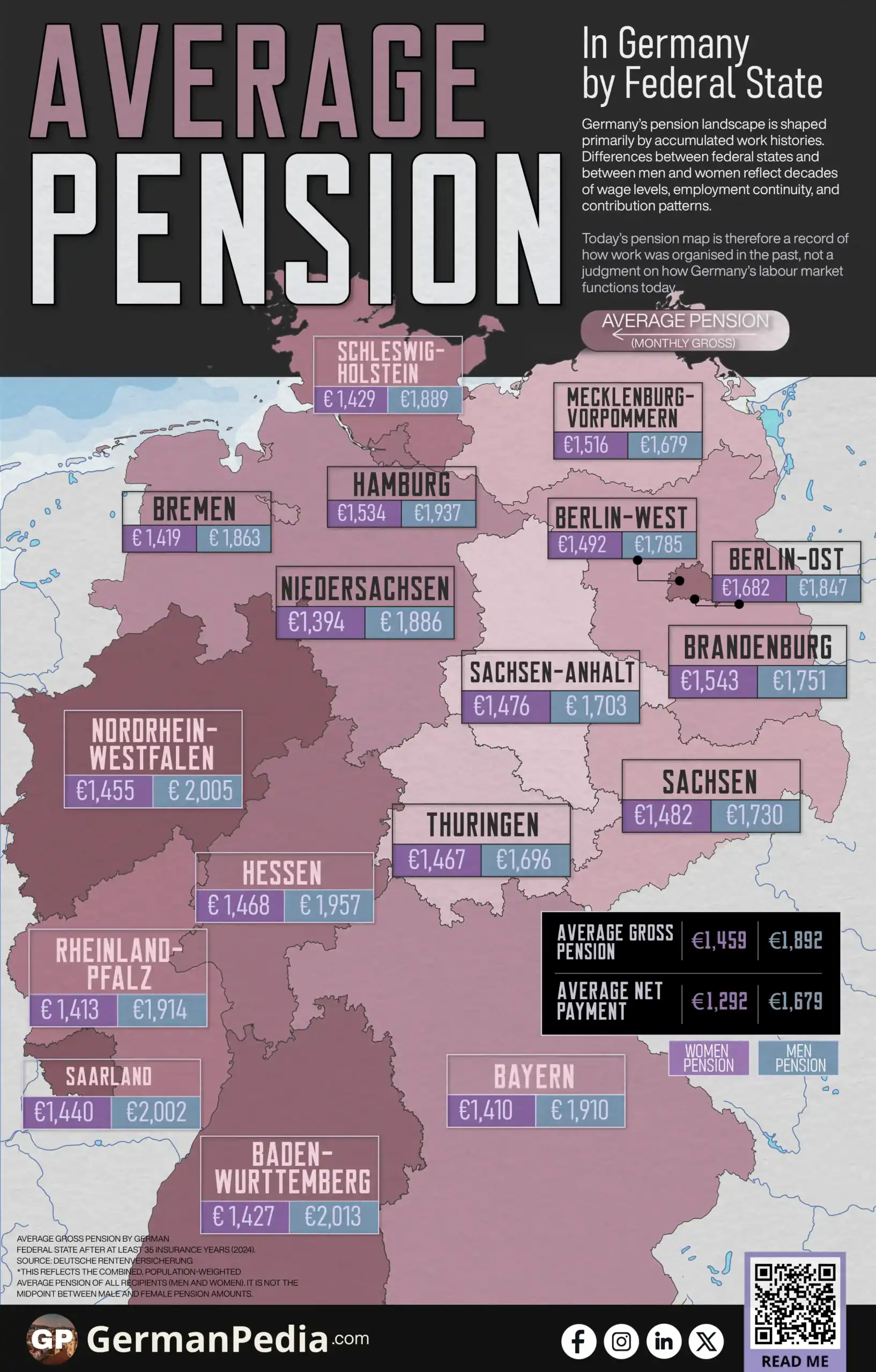
Use this Visualization: You may use this image for free with proper attribution to GermanPedia (i.e., by linking back to GermanPedia).
Need help communicating complex ideas visually? We help you turn data into your most persuasive story. Contact us to learn more.
Germany’s Average Pension by State
| State | Average Monthly Gross Pension Amount (In €) | ||
|---|---|---|---|
| Average* | Men | Women | |
| Saarland | 1,805 | 2,002 | 1,440 |
| Nordrhein-Westfalen | 1,773 | 2,005 | 1,455 |
| Berlin-Ost | 1,756 | 1,847 | 1,682 |
| Baden-Württemberg | 1,755 | 2,013 | 1,427 |
| Hessen | 1,752 | 1,957 | 1,468 |
| Hamburg | 1,743 | 1,937 | 1,534 |
| Rheinland-Pfalz | 1,716 | 1,914 | 1,413 |
| Schleswig-Holstein | 1,693 | 1,889 | 1,429 |
| Bayern | 1,691 | 1,910 | 1,410 |
| Niedersachsen | 1,685 | 1,886 | 1,394 |
| Bremen | 1,666 | 1,863 | 1,419 |
| Brandenburg | 1,640 | 1,751 | 1,543 |
| Berlin-West | 1,631 | 1,785 | 1,492 |
| Sachsen | 1,594 | 1,730 | 1,482 |
| Mecklenburg-Vorpommern | 1,591 | 1,679 | 1,516 |
| Sachsen-Anhalt | 1,580 | 1,703 | 1,476 |
| Thüringen | 1,572 | 1,696 | 1,467 |
| Average Gross Pension | 1,692 | 1,892 | 1,459 |
| Average Net Payment | 1,501 | 1,679 | 1,292 |
Source: Deutsche Rentenversicherung
*This reflects the combined, population-weighted average pension of all recipients (men and women). It is not the midpoint between male and female pension amounts.

Work Histories Shape Pensions in Germany
The average gross pension in Germany for people with at least 35 insurance years is €1,692 per month. Behind this national figure sit clear regional and gender differences rooted in how work was organised decades ago.
Pension outcomes today largely reflect lifetime earnings and contribution histories, typically built 30 to 45 years in the past. As a result, current pension levels say more about historical labour markets than about today’s economic conditions.
The highest average gross pensions are concentrated in Western industrial states. These include:
- Saarland (€1,805)
- North Rhine-Westphalia (€1,773)
- Baden-Württemberg (€1,755)
- Hessen (€1,752)
These states benefited from long periods of stable, full-time employment in mining, steel, and manufacturing industries. During the main contribution years of today’s retirees, wages were relatively high, and employment interruptions were less common.
Several other western states cluster close to the national average, such as Bavaria (€1,691), Lower Saxony (€1,685), and Schleswig-Holstein (€1,693). Differences within this group are modest, reflecting similar employment structures during key earning years.
By contrast, most eastern federal states remain below the national average:
- Saxony (€1,594)
- Mecklenburg-Vorpommern (€1,591)
- Saxony-Anhalt (€1,580)
- Thuringia (€1,572)
This pattern reflects shorter and more disrupted contribution histories following reunification. The early 1990s brought widespread job losses, lower wages, and periods of unemployment that permanently reduced pension entitlements. Even where employment later stabilised, missing contribution years could not be recovered.
Gender Divide in German Pensions
Across all federal states, pensions for women are significantly lower than for men. On average:
- Men: €1,892 per month
- Women: €1,459 per month
For men, the highest pensions are again found in western industrial regions where male-dominated sectors thrived. Meanwhile, the pattern differs for women, reflecting differences in work biographies.
In eastern Germany, women were more likely to work full-time and continuously, resulting in more contribution years. Women in East Berlin receive the highest average pensions in Germany (€1,682), well above the national female average.
In western Germany, limited childcare, traditional role expectations, and tax incentives encouraged many women to reduce hours or leave the workforce for extended periods.
These long-term choices are now visible in pension outcomes:
Baden-Württemberg
- Men: €2,013
- Women: €1,427
- Gap: €586 per month
Bavaria
- Men: €1,910
- Women: €1,410
- Gap: €500 per month
North Rhine-Westphalia
- Men: €2,005
- Women: €1,455
- Gap: €550 per month
Germany’s pension landscape is shaped primarily by accumulated work histories. Differences between federal states and between men and women reflect decades of wage levels, employment continuity, and contribution patterns.
Today’s pension map is therefore a record of how work was organised in the past, not a judgment on how Germany’s labour market functions today.
More topics
- Top 25 Richest People in Germany (2025)
- Germany’s Smoking Rate Has Declined Over Two Decades
- Germany’s Electricity Mix: From Coal to Renewables
- Changes in Harvest of Germany’s Five Key Crops
- Top German Companies by Revenue
- Germany’s Top Car Brands by New Registrations
- Unemployment Across Germany: A Federal State Breakdown
- Where Germany’s Tourists Come From
- Germany’s Largest National Parks, Ranked by Size
- Which Federal States Drive Germany’s Economy?
- Here’s Why Divorces in Germany Are Falling
- Germans Are Marrying Later Than Ever
- How Marriage Rates Have Fallen in Germany: 1990–2023
- How Germany’s Birth Rates Dropped and Deaths Rose
- Leading Causes of Death in Germany