Key Takeaways
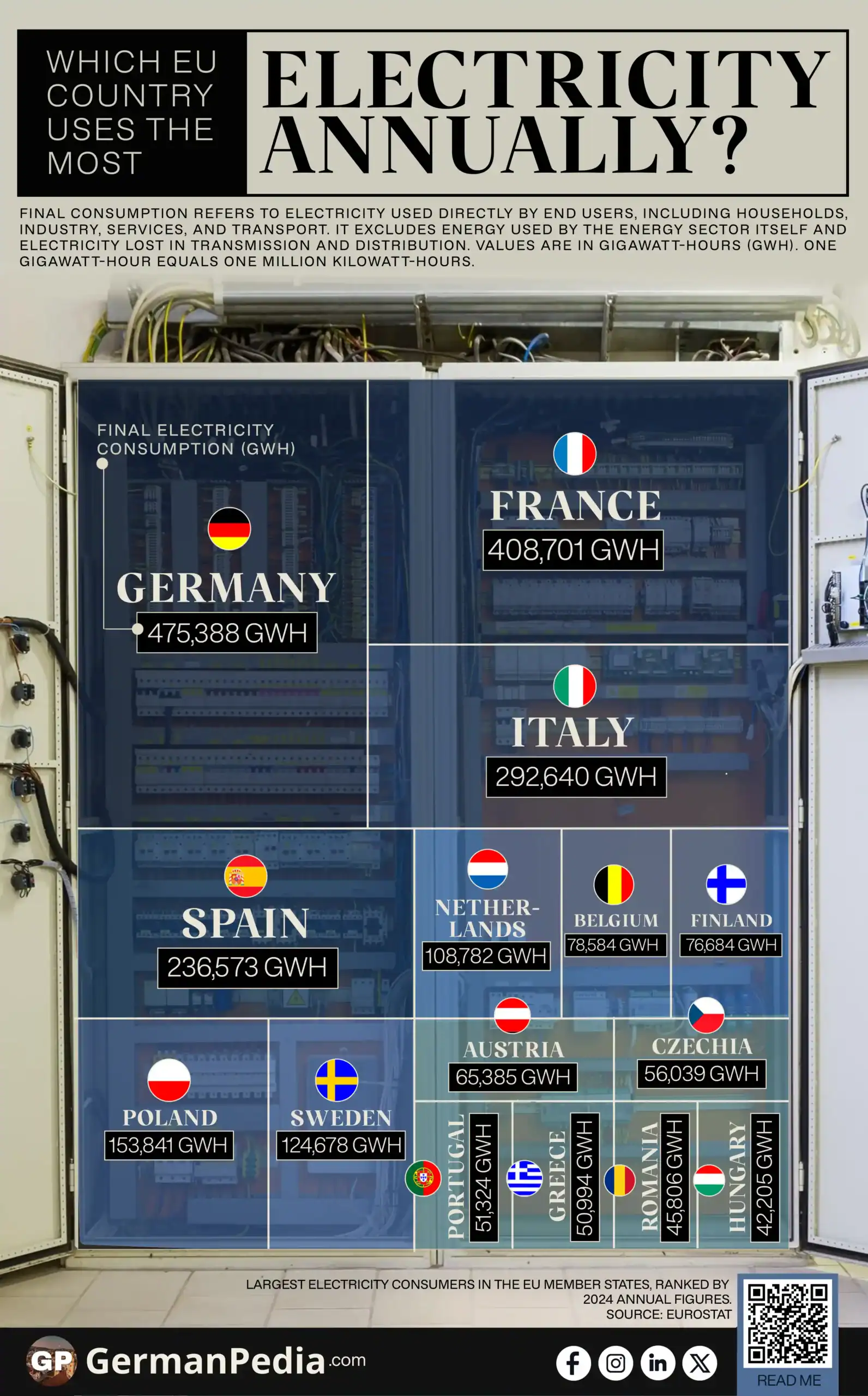
- Germany’s final electricity consumption reached 475,388 GWh in 2024. It ranks first in EU electricity consumption.
- Germany, France, Italy, and Spain together account for 57.5% of all EU final electricity consumption. The other 23 member states share the remaining 42.5%.
- Sweden ranks 6th in the EU overall. It consumed more electricity than the Netherlands despite having around 7 million fewer people. Energy-intensive forestry and pulp industries are estimated to account for roughly 15% of Sweden’s electricity use.
- Germany’s lead reflects its energy-intensive industrial base. The country leads in automotive, chemicals, and heavy manufacturing. Population size alone does not explain the gap.
- Malta consumes the least electricity in the EU at 2,868 GWh. Germany’s total is 166 times higher.
Use this Visualization: You may use this image for free with proper attribution to GermanPedia (i.e., by linking back to GermanPedia).
Need help communicating complex ideas visually? We help you turn data into your most persuasive story. Contact us to learn more.
EU Countries Ranked by Electricity Consumption
| Country | Final Electricity Consumption (GWh) |
|---|---|
| Germany | 475,388 |
| France | 408,701 |
| Italy | 292,640 |
| Spain | 236,573 |
| Poland | 153,841 |
| Sweden | 124,678 |
| Netherlands | 108,782 |
| Belgium | 78,584 |
| Finland | 76,684 |
| Austria | 65,385 |
| Czechia | 56,039 |
| Portugal | 51,324 |
| Greece | 50,994 |
| Romania | 45,806 |
| Hungary | 42,205 |
| Denmark | 33,163 |
| Ireland | 32,917 |
| Bulgaria | 32,495 |
| Slovakia | 22,122 |
| Croatia | 17,133 |
| Slovenia | 12,453 |
| Lithuania | 11,608 |
| Estonia | 7,030 |
| Latvia | 6,754 |
| Luxembourg | 6,196 |
| Cyprus | 5,289 |
| Malta | 2,868 |
Source: Eurostat
Final consumption refers to electricity used directly by end users, including households, industry, services, and transport. It excludes energy used by the energy sector itself and electricity lost in transmission and distribution. Values are in gigawatt-hours (GWh). One gigawatt-hour equals one million kilowatt-hours.

Only four countries use more than half of all the electricity consumed in the European Union. Germany, France, Italy, and Spain together accounted for 57.5% of the EU’s final electricity consumption in 2024. They had a combined 1,413,302 GWh. The EU-27 total reached 2,457,651 GWh that year. The top four alone consumed more than the remaining 23 member states combined.
Germany’s Industrial Base Accounts for Nearly a Fifth of EU Electricity Use
Germany ranks first in EU electricity consumption. The country’s final consumption reached 475,388 GWh in 2024. It accounts for 19.3% of the EU total. France ranks second at 408,701 GWh. Germany had 83.5 million people and France 68.6 million as of January 2024. Germany consumed 16% more electricity.
Europe’s Population Shifted Over 20 Years ->
The gap in electricity consumption comes from Germany’s industrial structure. The country holds the EU’s largest concentration of automotive manufacturing, chemical production, and steel processing. These sectors are among the most electricity-intensive in the bloc.
Italy ranks third at 292,640 GWh and Spain fourth at 236,573 GWh. Poland ranks fifth at 153,841 GWh. Poland has a large manufacturing base and a population of around 36.8 million (January 2024).
Austria and Czechia rank 10th (65,385 GWh) and 11th (56,039 GWh). Both countries are manufacturing-oriented economies in Central Europe.
Romania ranks 14th at 45,806 GWh despite having a population of around 19 million (January 2024). Its lower electricity consumption reflects a less industrialised economy compared to Western EU countries of similar size.
Sweden Consumes More Electricity Than the Netherlands Despite Having a Smaller Population
Sweden ranks 6th at 124,678 GWh. The Netherlands ranks 7th at 108,782 GWh. The Netherlands had a population of around 17.9 million as of January 2024, compared with roughly 10.5 million in Sweden. Sweden consumed more electricity despite having about 7 million fewer people. The forestry, pulp, and paper sector is estimated to account for roughly 15% of Sweden’s electricity use. It is one of the country’s most energy-intensive industries. Electric heating across a cold climate adds further demand throughout the year.
Finland ranks 9th at 76,684 GWh with a population of around 5.6 million (January 2024). Finland’s pattern mirrors Sweden’s. Energy-intensive industry combines with high residential heating demand in a northern climate.
14 of the 27 EU member states consume fewer than 50,000 GWh annually. Three countries sit at the bottom of the EU electricity table:
- Malta: 2,868 GWh
- Cyprus: 5,289 GWh
- Luxembourg: 6,196 GWh
Germany’s total electricity use is 166 times higher than Malta’s. Malta and Cyprus are small islands without a heavy industrial base. Luxembourg has a population of 661,000 (January 2024) and an economy concentrated in financial services.
Economic structure shapes EU electricity rankings more than geography does. Large industrial economies in colder climates consume the most. Countries with service-oriented economies and small populations sit at the bottom. Population size plays a role, but what a country produces and the climate it operates in determine where it lands on this table.
More topics
- The Best EU Countries to Retire In
- EU Passports Are Among the Strongest in the World
- How Do Germans Perceive Other Countries as Allies and Threats?
- Which EU Cities Have the Most Millionaires?
- Top Relocation Destinations for Germans
- Which Are the Busiest Airports in the EU?
- Popular Study Destinations for German Students
- The Busiest Container Ports in Europe by TEU
- Countries Driving Germany’s Quarter Trillion Export Surplus
- Which EU Countries Have the Most Soft Power?
- Which EU Countries Have the Highest Equity Risk Premiums?
- Most Surveilled Major Cities in the EU
- EU Wage Growth In The Last Two Decades
- Which EU Countries Have the Highest Obesity Rates?
- EU House Price Index Rises Over 60% Since 2010
- EU Unicorn Startups: Which Countries Lead and Why
- Adoption of Electric and Hybrid Passenger Cars in the EU
References
- https://ec.europa.eu/eurostat/web/interactive-publications/energy-2026
- https://ec.europa.eu/eurostat/statistics-explained/index.php/Electricity_and_heat_statistics
- https://www.forestindustries.se/forest-industry/materials-and-products/electricity-and-energy/
- https://www.bundeswirtschaftsministerium.de/Redaktion/EN/Artikel/Energy/electricity-market-of-the-future-facts-and-figures.html
- https://sweden.se/climate/sustainability/energy-use-in-sweden
- https://ec.europa.eu/eurostat/statistics-explained/index.php?title=Population_and_population_change_statistics