
Key Takeaways
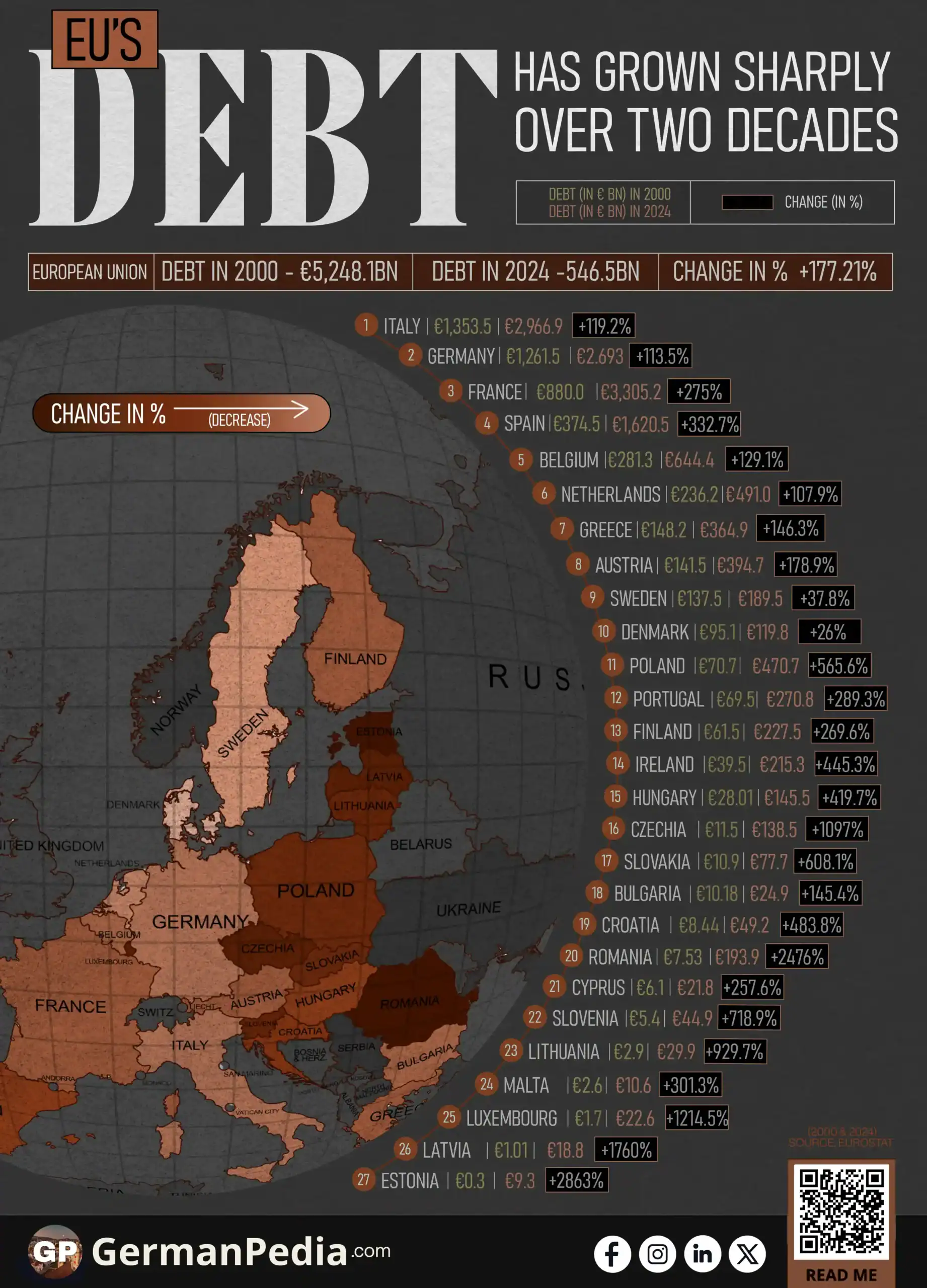
- Government debt across the EU rose sharply between 2000 and 2024. The total debt has increased from about €5.2 trillion to €14.5 trillion.
- Europe borrowed much more over time, but its fiscal hierarchy almost remained the same.
- Europe’s largest economies carry most of the debt in absolute terms. France, Italy, and Germany together account for a dominant share of Europe’s total public debt.
- The fastest debt growth rates occurred mainly in Central and Eastern Europe (e.g., Romania, Estonia). Their debt levels were very low at the start of the 2000s.
- Southern European countries (e.g., Greece, Spain) show sustained debt pressure, shaped by the euro-area crisis and pandemic-era spending.
- Northern European countries (e.g., Denmark, Sweden) accumulated debt more slowly. It reflected stronger starting positions and tighter fiscal management.
Use this Visualization: You may use this image for free with proper attribution to GermanPedia (i.e., by linking back to GermanPedia).
Need help communicating complex ideas visually? We help you turn data into your most persuasive story. Contact us to learn more.
Government Debt of EU Countries
| Country | Debt (in € bn) | Change (in %) | |
|---|---|---|---|
| 2000 | 2024 | ||
| Italy | 1,353.57 | 2,966.92 | +119.20% |
| Germany | 1,261.58 | 2,693.78 | +113.50% |
| France | 880.00 | 3,305.26 | +275.60% |
| Spain | 374.56 | 1,620.57 | +332.70% |
| Belgium | 281.37 | 644.40 | +129.10% |
| Netherlands | 236.23 | 491.06 | +107.90% |
| Greece | 148.22 | 364.97 | +146.30% |
| Austria | 141.54 | 394.79 | +178.90% |
| Sweden | 137.59 | 189.54 | +37.80% |
| Denmark | 95.15 | 119.87 | +26.00% |
| Poland | 70.74 | 470.79 | +565.60% |
| Portugal | 69.59 | 270.88 | +289.30% |
| Finland | 61.56 | 227.55 | +269.60% |
| Ireland | 39.51 | 215.38 | +445.30% |
| Hungary | 28.01 | 145.57 | +419.70% |
| Czechia | 11.57 | 138.51 | +1,097.60% |
| Slovakia | 10.98 | 77.73 | +608.10% |
| Bulgaria | 10.18 | 24.98 | +145.40% |
| Croatia | 8.44 | 49.28 | +483.80% |
| Romania | 7.53 | 193.96 | +2,476.10% |
| Cyprus | 6.10 | 21.82 | +257.60% |
| Slovenia | 5.48 | 44.90 | +718.90% |
| Lithuania | 2.91 | 29.99 | +929.70% |
| Malta | 2.65 | 10.65 | +301.30% |
| Luxembourg | 1.72 | 22.65 | +1,214.50% |
| Latvia | 1.01 | 18.80 | +1,760.30% |
| Estonia | 0.32 | 9.35 | +2,863.00% |
| EU Total | 5,248.11 | 14,546.56 | +177.21% |
Source: Eurostat
“Government debt” is the total amount a country’s national, regional, and local governments owe, measured at face value at year’s end. That means the debt is counted at the amount the government actually owes, not at what it could be sold for. Bond prices can go up or down, but the amount owed stays the same.

Between 2000 and 2024, government debt across the European Union rose drastically. The EU’s total debt increased from about €5.2 trillion to €14.5 trillion, a rise of more than 170%.
This growth reflects a long series of pressures, such as the euro-area crisis, the pandemic, energy shocks, and ageing populations. But while debt increased almost everywhere, the pace and scale differed widely across countries.
Where Europe’s Debt Is Heaviest and Where It Grew Fastest
Europe’s debt story has two sides. The largest economies hold most of the debt, while countries with very low debt in the early 2000s recorded the fastest growth rates.
Europe’s biggest economies account for the bulk of the increase in government debt.
- France saw its debt rise from €880 billion in 2000 to over €3.3 trillion in 2024.
- Italy increased from €1.35 trillion to nearly €3.0 trillion over the same period.
- Germany more than doubled its debt. It reached €2.7 trillion in 2024.
How did Germany’s debt increase over the years? ->
A different picture emerges when looking at growth rates.
The biggest percentage increases in debt occurred mostly in Central and Eastern Europe. Countries such as Romania, Estonia, Latvia, and Czechia recorded debt growth of several hundred or even several thousand percent.
These figures look dramatic, but they reflect very low debt levels at the start of the 2000s. Even after rapid growth, most of these countries still hold far less debt in absolute terms than Western Europe’s largest economies.
Which European countries had the highest GDP? ->
How did Germany’s GDP grow over three decades? ->
High growth rates reflect catch-up, market development, and crisis responses. It is not a shift in where Europe’s debt is concentrated.
Regional Debt Patterns: Pressure in the South, Restraint in the North
Southern Europe shows a pattern of sustained debt pressure.
Spain, Portugal, and Greece all more than doubled their debt over the period. In these cases, debt growth reflects long-running fiscal stress. It is further amplified by the euro debt crisis and later by pandemic-era spending.
Northern Europe followed a different path. Denmark and Sweden recorded increases of less than 40%, while the Netherlands roughly doubled its debt.
This reflects stronger starting positions and tighter fiscal management, even during periods of crisis.
Over the past two decades, Europe’s public debt has risen sharply. However, it has not changed the continent’s fiscal order.
Debt accumulated where economies were already largest, and it grew fastest where starting levels were lowest. Overall, the change was widespread, similar to the trend in Europe’s GDP and population trends. However, the underlying hierarchy remained largely intact. The EU countries with the largest debts in 2000, remain on their side of the rankings across two decades. The same happened for countries with smallest debts.
How did the population in European countries change over time? ->
How has the population in Germany grown since 1997? ->
More topics
- Top 25 Richest People in Germany (2025)
- Germany’s Smoking Rate Has Declined Over Two Decades
- Germany’s Electricity Mix: From Coal to Renewables
- Changes in Harvest of Germany’s Five Key Crops
- Top German Companies by Revenue
- Germany’s Top Car Brands by New Registrations
- Unemployment Across Germany: A Federal State Breakdown
- Where Germany’s Tourists Come From
- Germany’s Largest National Parks, Ranked by Size
- Which Federal States Drive Germany’s Economy?
- Here’s Why Divorces in Germany Are Falling
- Germans Are Marrying Later Than Ever
- How Marriage Rates Have Fallen in Germany: 1990–2023
- How Germany’s Birth Rates Dropped and Deaths Rose
- Leading Causes of Death in Germany