Key Takeaways
- Gold remains an important reserve asset in Europe. It is mainly held for long-term stability and confidence rather than everyday use.
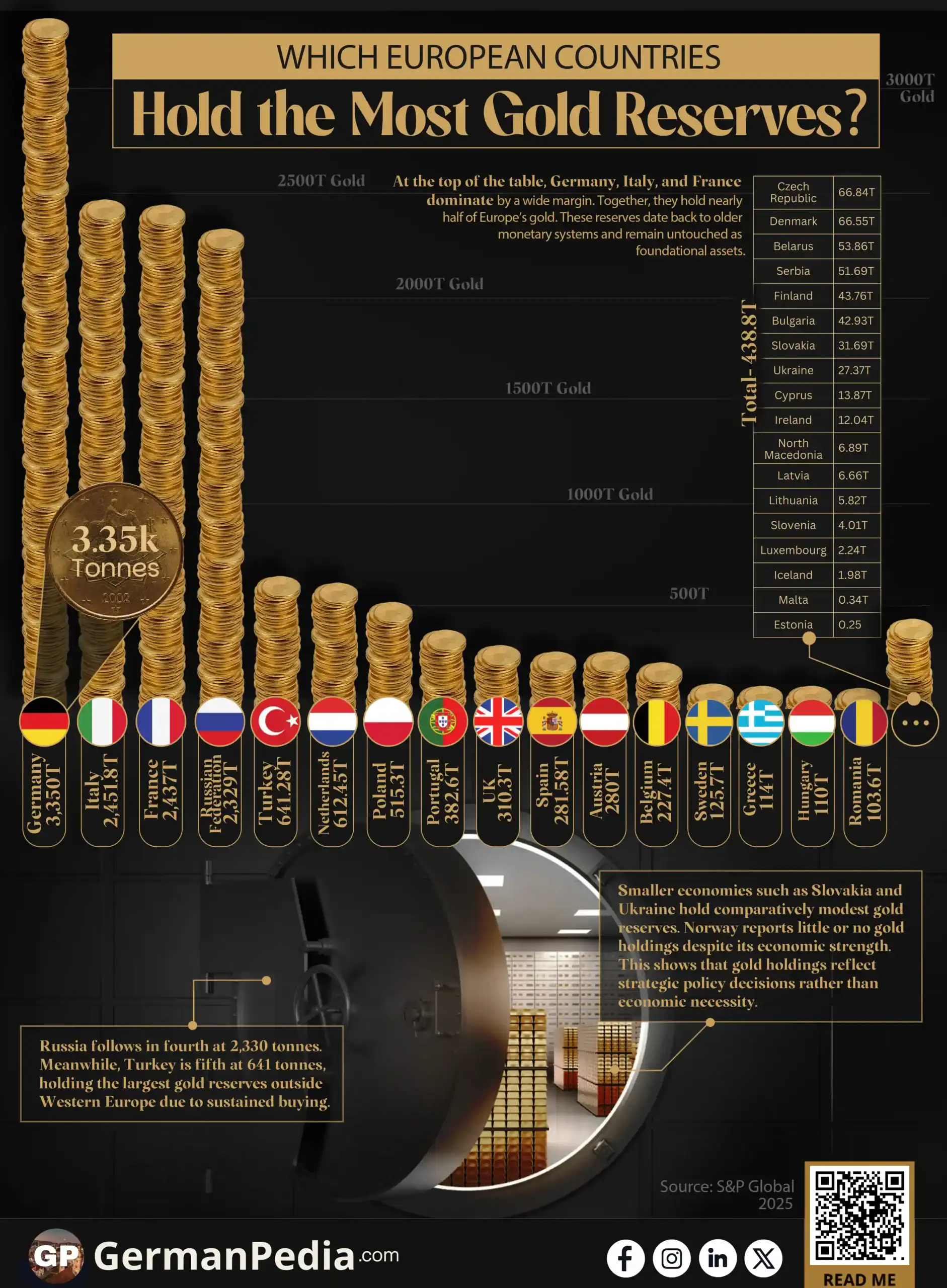
- Most of Europe’s gold is concentrated in a few countries. Germany, Italy, and France each hold over 2,400 tonnes. These gold reserves were built up over decades and are still treated as core reserve assets.
- Russia and Turkey stand out outside Western Europe. Russia ranks fourth, while Turkey’s sustained buying has made it the largest gold holder beyond Western Europe.
- Smaller countries hold much less gold. In places like Slovakia and Ukraine, gold plays a supporting role rather than anchoring reserve strategies.
- Reserve strategies vary by policy choice. Norway holds little to no gold despite its wealth, showing that economic size does not always translate into gold holdings.
Use this Visualization: You may use this image for free with proper attribution to GermanPedia (i.e., by linking back to GermanPedia).
Need help communicating complex ideas visually? We help you turn data into your most persuasive story. Contact us to learn more.
Europe’s Gold Reserves by Country
| Rank | Country | Gold Reserves (tonnes) |
|---|---|---|
| 1 | Germany | 3,350.25 |
| 2 | Italy | 2,451.84 |
| 3 | France | 2,437.00 |
| 4 | Russian Federation | 2,329.63 |
| 5 | Turkey | 641.28 |
| 6 | Netherlands | 612.45 |
| 7 | Poland | 515.34 |
| 8 | Portugal | 382.66 |
| 9 | United Kingdom | 310.29 |
| 10 | Spain | 281.58 |
| 11 | Austria | 279.99 |
| 12 | Belgium | 227.40 |
| 13 | Sweden | 125.72 |
| 14 | Greece | 114.68 |
| 15 | Hungary | 110.01 |
| 16 | Romania | 103.63 |
| 17 | Czech Republic | 66.84 |
| 18 | Denmark | 66.55 |
| 19 | Belarus | 53.86 |
| 20 | Serbia | 51.69 |
| 21 | Finland | 43.76 |
| 22 | Bulgaria | 42.93 |
| 23 | Slovakia | 31.69 |
| 24 | Ukraine | 27.37 |
| 25 | Cyprus | 13.87 |
| 26 | Ireland | 12.04 |
| 27 | North Macedonia | 6.89 |
| 28 | Latvia | 6.66 |
| 29 | Lithuania | 5.82 |
| 30 | Slovenia | 4.01 |
| 31 | Luxembourg | 2.24 |
| 32 | Iceland | 1.98 |
| 33 | Malta | 0.34 |
| 34 | Estonia | 0.25 |
| 35 | Norway | 0.00* |
| 36 | Armenia | 0.00* |
| 37 | Croatia | 0.00* |
| — | Switzerland | AWAITED |
| — | Azerbaijan | AWAITED |
| — | Bosnia and Herzegovina | AWAITED |
| — | Albania | AWAITED |
Source: S&P Global
Gold remains a core reserve asset across Europe, even as portfolios prioritize foreign currencies and financial assets. It serves central banks as a long-term store of value for stability and confidence, rather than daily liquidity.
At the top of the table, Germany, Italy, and France dominate by a wide margin. Together, they hold nearly half of Europe’s gold. These reserves date back to older monetary systems and remain untouched as foundational assets.
Russia follows in fourth at 2,330 tonnes. Meanwhile, Turkey is fifth at 641 tonnes, holding the largest gold reserves outside Western Europe due to sustained buying.
Smaller economies such as Slovakia and Ukraine hold comparatively modest gold reserves. Norway reports little or no gold holdings despite its economic strength. This shows that gold holdings reflect strategic policy decisions rather than economic necessity.
More topics
- Top 25 Richest People in Germany (2025)
- Germany’s Smoking Rate Has Declined Over Two Decades
- Germany’s Electricity Mix: From Coal to Renewables
- Changes in Harvest of Germany’s Five Key Crops
- Top German Companies by Revenue
- Germany’s Top Car Brands by New Registrations
- Unemployment Across Germany: A Federal State Breakdown
- Where Germany’s Tourists Come From
- Germany’s Largest National Parks, Ranked by Size
- Which Federal States Drive Germany’s Economy?
- Here’s Why Divorces in Germany Are Falling
- Germans Are Marrying Later Than Ever
- How Marriage Rates Have Fallen in Germany: 1990–2023
- How Germany’s Birth Rates Dropped and Deaths Rose
- Leading Causes of Death in Germany