
Key Takeaways
- Berlin’s largest employers are concentrated in sectors shaped by demographic demand and everyday consumption.
- Deutsche Bahn is the largest employer in Berlin. It had 27,414 employees in 2024.
- Healthcare and social care organisations represent over 70,000 jobs within the top 20. They are led by Charité (24,332) and Vivantes–Netzwerk für Gesundheit (20,215).
- Retail and logistics companies operate at scale and show largely incremental year-on-year changes. These include Edeka, Rewe Markt GmbH, and Deutsche Post.
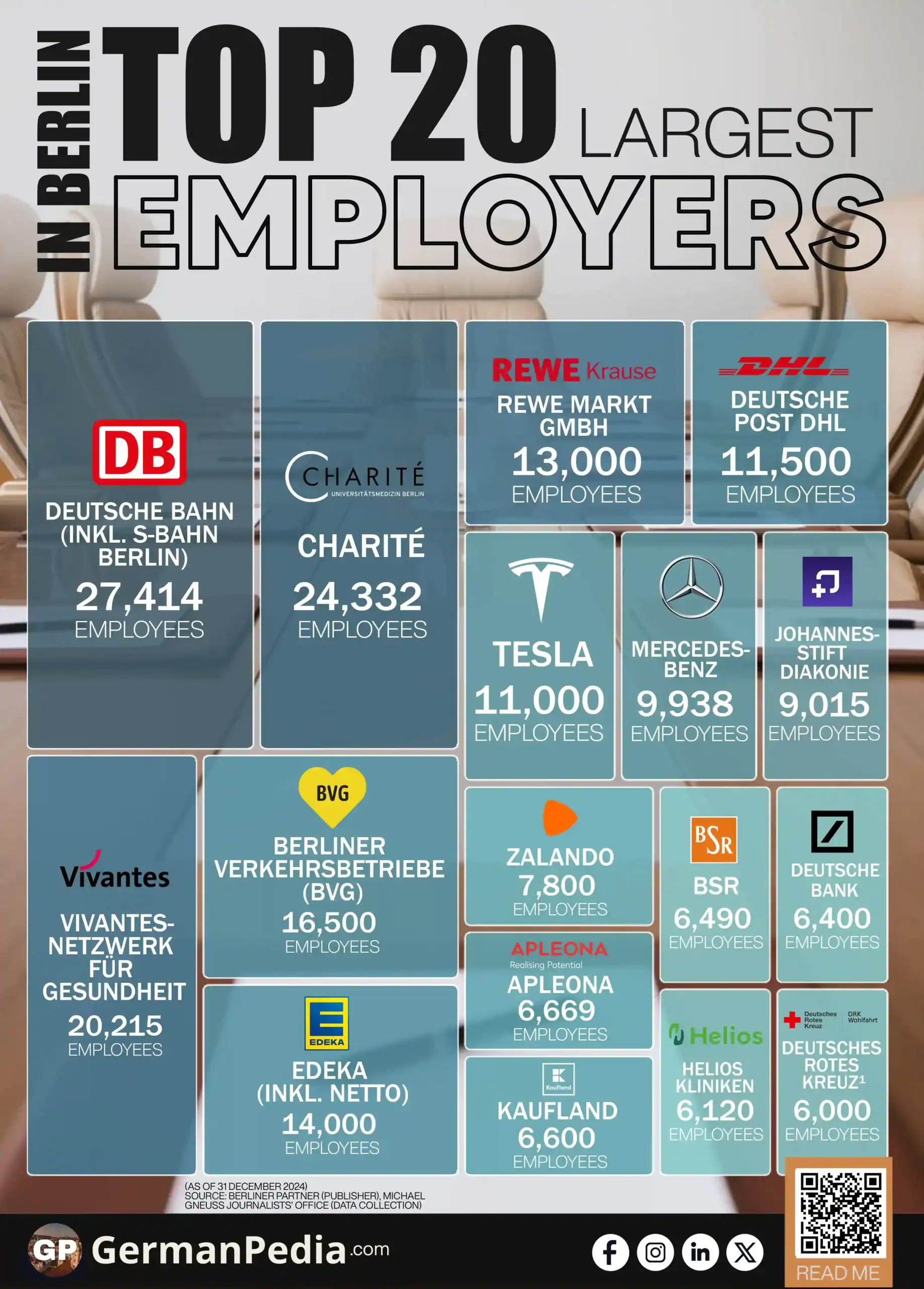
Use this Visualization: You may use this image for free with proper attribution to GermanPedia (i.e., by linking back to GermanPedia).
Need help communicating complex ideas visually? We help you turn data into your most persuasive story. Contact us to learn more.
| Rank | Company | Industry | Employees* | % Change |
|---|---|---|---|---|
| 1 | Deutsche Bahn (inkl. S-Bahn Berlin) | Transport/Logistics | 27,414 | +2.3% |
| 2 | Charité | Health | 24,332 | +3.6% |
| 3 | Vivantes-Netzwerk für Gesundheit | Health | 20,215 | +5.2% |
| 4 | Berliner Verkehrsbetriebe (BVG) | Transport | 16,500 | +2.5% |
| 5 | Edeka (inkl. Netto)¹ | Retail | 14,000 | — |
| 6 | Rewe Markt GmbH | Retail | 13,000 | +4.0% |
| 7 | Deutsche Post DHL¹ | Logistics | 11,500 | 0.0% |
| 8 | Tesla¹ | Automotive | 11,000 | — |
| 9 | Mercedes-Benz | Automotive | 9,938 | -4.2% |
| 10 | Johannesstift Diakonie | Health | 9,015 | +2.8% |
| 11 | Zalando | Digital Economy | 7,800 | +1.3% |
| 12 | Apleona | Building Management | 6,669 | -6.3% |
| 13 | Kaufland | Retail | 6,600 | 0.0% |
| 14 | Berliner Stadtreinigungsbetriebe BSR | Waste Disposal | 6,490 | +1.1% |
| 15 | Deutsche Bank² | Bank | 6,400 | +16.4% |
| 16 | Helios Kliniken | Health | 6,120 | -8.3% |
| 17 | Deutsches Rotes Kreuz¹ | Social welfare | 6,000 | — |
Source: Berliner Partner (publisher), Michael Gneuss Journalists’ Office (data collection)
¹ Editorial estimate based on the reported year-on-year percentage change.
² Deutsche Bank: Berlin employees, including the Deutsche Bank and Postbank brands.
³ Caritasverband für das Erzbistum Berlin: including Caritas Altenhilfe, Caritas Familien- und Jugendhilfe, and Caritas Gesundheit Berlin.

Berlin is often described as Germany’s startup capital.
Unicorn Startups in Germany ->
However, if you work in Berlin, the city’s employment structure looks very different from its global image.
The largest employer is Deutsche Bahn (including S-Bahn Berlin), with 27,414 employees in the region.
It is followed by Charité (24,332) and Vivantes – Netzwerk für Gesundheit (20,215). In fourth place is Berliner Verkehrsbetriebe (BVG), employing 16,500 people.
Together, these four institutions account for nearly 88,500 jobs.
All of them operate essential public systems: national rail, urban transport, and hospital networks. None are high-growth startups. All are structurally embedded in the city’s daily functioning.
This means Berlin’s largest workplaces are long-established institutions with stable staffing needs rather than rapidly scaling firms.
Healthcare as a Structural Employment Pillar
Healthcare and social care are deeply embedded in the ranking.
Beyond Charité and Vivantes, the top 20 include:
- Johannesstift Diakonie – 9,015 employees
- Helios Kliniken – 6,120 employees
- Deutsches Rotes Kreuz – 6,000 employees
- Caritasverband für das Erzbistum Berlin – 5,200 employees
Combined with the two large hospital networks, healthcare and social care account for over 70,000 jobs within the top 20 alone.
This reflects structural forces:
- Berlin hosts one of Europe’s largest university hospital systems.
- It serves as a healthcare hub for eastern Germany.
- Demographic ageing increases long-term demand for care services.
Employment growth in these institutions is generally gradual. The reported increases, mostly between +2% and +5%, suggest steady expansion rather than volatility.
Healthcare is not a marginal sector in Berlin. It is one of its core employment engines.
Retail and Logistics are Employment Anchors
Retail and logistics also play a major role in Berlin’s employment structure.
- Edeka (incl. Netto) – 14,000 employees
- Rewe Markt GmbH – 13,000 employees
- Deutsche Post DHL – 11,500 employees
These sectors operate at scale and are tied to daily consumption patterns. Their employment levels also tend to move incrementally, reflecting steady demand.
Overall, Berlin’s largest employers are concentrated in:
- Public infrastructure
- Healthcare and social services
- Retail
- Logistics
These are sectors shaped by demographic demand, public service provision, and everyday consumption.
Berlin’s economy may be dynamic at the margins. But its employment base is built on institutions that move steadily, hire consistently, and operate for the long term.
More topics
- Germany’s Median Wage by Federal State
- Top 10 Largest Employers in Germany
- Germany’s Average Working Age Is Getting Older
- Germany’s Gender Employment Gap Narrowed Over Six Decades
- Germany’s Gender Pay Gap in Full-Time Work Falls to 9%
- Women Are Increasing in Managerial Roles Across the EU
- Women Hold Less Than One Third of Managerial Roles in Germany
- Employment by Federal State in Germany
- Germans Earn More Than Foreign Workers Across Germany
- Top German Companies by Revenue
- Top Companies in Germany by LinkedIn (2021-2025)
- Unemployment Across Germany: A Federal State Breakdown
- Germany’s Fastest-Growing Jobs by LinkedIn
- Highest Paying Jobs in Germany
- Sick Leaves in Germany Doubled Since 2007