
Key Takeaways
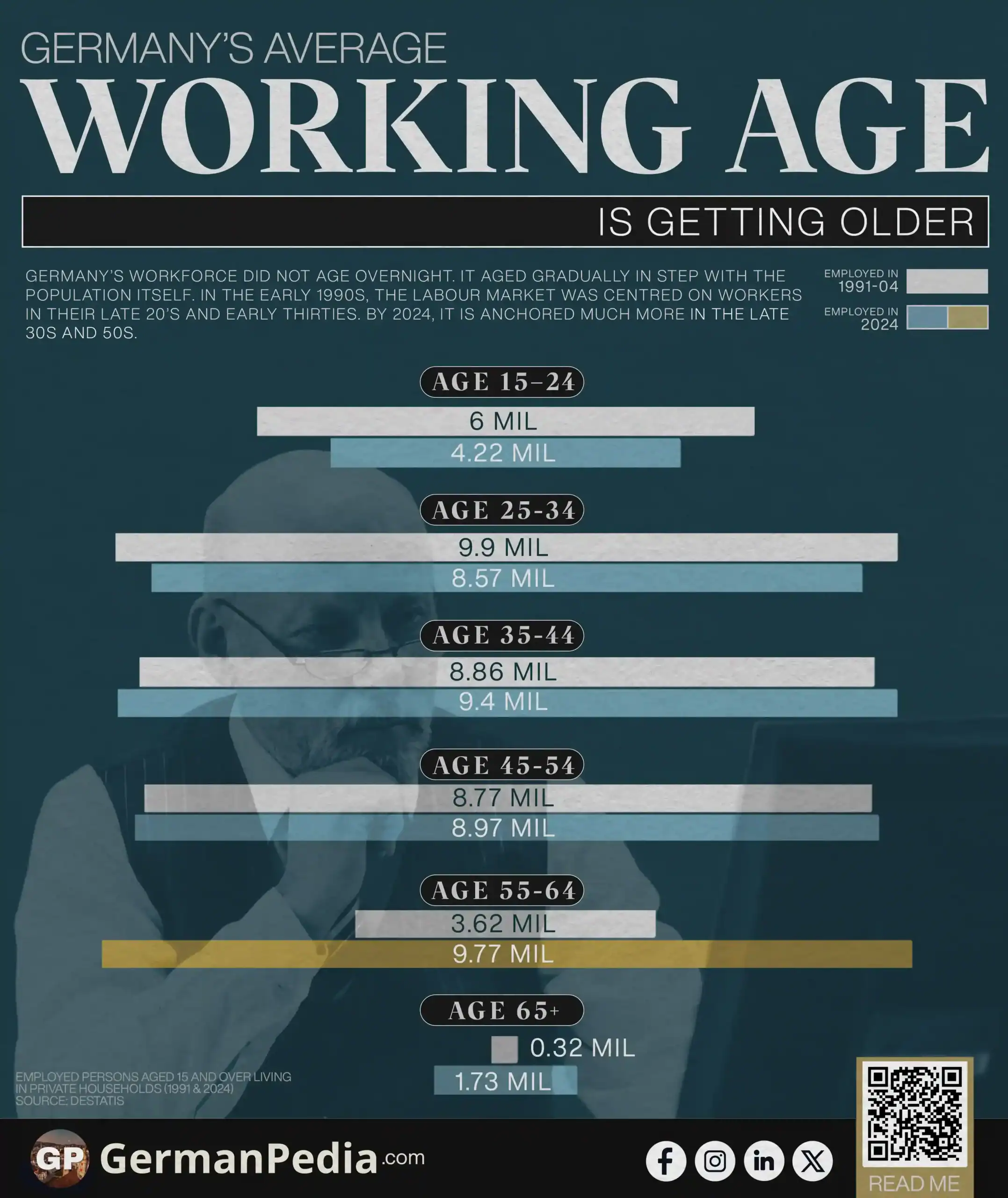
- In 1991, Germany’s largest age group in employment was 25–29-year-olds. It recorded 5.09 million workers.
- Employment among 55–59-year-olds more than doubled from 1991 to 2024. It rose from 2.7 million to 5.5 million. This makes it the largest group in 2024.
- The number of workers aged 60–64 nearly quadrupled over the same period.
- Employees aged 65 and older remain one of the smallest groups, but they showed the highest growth rates. It rose from 320,000 to 1.73 million, which is more than four times higher than in 1991.
- The shift reflects demographic ageing, pension reforms, and longer working lives.
Use this Visualization: You may use this image for free with proper attribution to GermanPedia (i.e., by linking back to GermanPedia).
Need help communicating complex ideas visually? We help you turn data into your most persuasive story. Contact us to learn more.
Employed Persons by Age Group in Germany
| Age Group | Employed (in millions, % out of total) | % Change | |
|---|---|---|---|
| 1991-04 | 2024 | ||
| 15–19 | 1.64 (4.4%) | 1.14 (2.7%) | –30% |
| 20–24 | 4.34 (11.6%) | 3.08 (7.2%) | –29% |
| 25–29 | 5.09 (13.6%) | 4.03 (9.4%) | –21% |
| 30–34 | 4.81 (12.8%) | 4.54 (10.7%) | –6% |
| 35–39 | 4.54 (12.1%) | 4.75 (11.1%) | +5% |
| 40–44 | 4.32 (11.5%) | 4.65 (10.9%) | +8% |
| 45–49 | 4.06 (10.8%) | 4.31 (10.1%) | +6% |
| 50–54 | 4.71 (12.6%) | 4.66 (10.9%) | –1% |
| 55–59 | 2.71 (7.2%) | 5.51 (12.9%) | +103% |
| 60–64 | 0.91 (2.4%) | 4.26 (10.0%) | +368% |
| 65+ | 0.32 (0.9%) | 1.73 (4.0%) | +441% |
| Total | 37.45 | 42.64 | +13.9 |
Source: Destatis

Three decades ago, Germany’s labour market looked younger than it does today. In the early 1990s, most employed people were in their twenties and early thirties. In 1991, workers aged 25–29 formed the single largest group, with 5.09 million people in employment.
Older age groups were much smaller at the time. Only 910,000 people aged 60–64 were employed. Among those 65 and over, just 320,000 were still working.
By 2024, the structure had shifted.
Youth employment declined:
- Employed 15–19-year-olds fell by 30% (1.64 million to 1.14 million)
- The 20–24 group dropped by 29% (4.34 million to 3.08 million)
- The 25–29 group decreased by 21% (5.09 million to 4.03 million)
The most significant change happened at older ages.
Employment among 55–59-year-olds is now the largest of all age groups. It more than doubled, rising from 2.7 million in 1991 to 5.5 million in 2024.
For those aged 60–64, the increase was even more pronounced. Employment rose from under 1 million to more than 4.2 million. That is nearly four times the level recorded in 1991.
Among workers 65 and older, employment climbed from 320,000 to 1.73 million, showing more than a fourfold rise. Despite being the smallest group, it showed the highest growth rates.
This expansion of older workers has reshaped the labour market.
The shift is not random. It reflects long-term structural factors:
Germany’s population is older overall. It reported a median age of about 45.7 years in 2023. The country now has more people in their 50s and 60s than it did three decades ago.
Persistently low fertility means fewer young workers are entering the labour market. Over time, emigration of younger adults has also contributed to a smaller share of young working-age residents.
Policy changes played a role as well. Retirement ages have gradually increased. Early retirement options were reduced. Participation rates among people aged 60–64 have risen steadily. More people remain active later in life, and better health has made longer working lives more feasible.
The result is clear. In the early 1990s, the labour market was centred on workers in their late twenties and early thirties. By 2024, it is anchored much more in the late 30s and 50s.
Younger workers have not disappeared. However, their relative weight has declined, while older age groups now make up a much larger share of total employment.
Germany’s workforce did not age overnight. It aged gradually in step with the population itself.
More topics
- Germany’s Median Wage by Federal State
- Top 10 Largest Employers in Germany
- Top German Companies by Revenue
- Highest Paying Jobs in Germany
- Top Companies in Germany by LinkedIn (2021-2025)
- Unemployment Across Germany: A Federal State Breakdown
- Germany’s Fastest-Growing Jobs by LinkedIn
- Employment Legal Insurance in Germany
- Women Are Increasing in Managerial Roles Across the EU
- Women Hold Less Than One Third of Managerial Roles in Germany
- Employment by Federal State in Germany
- Italy is the Old Man of Europe
- Sick Leaves in Germany Doubled Since 2007
- Germany’s Healthcare Expenditure Vs. Aging Population
- Sexual Violence and Rape Increased in the EU
References
- https://www-genesis.destatis.de/datenbank/online/table/12211-9001
- https://www.destatis.de/EN/Themes/Labour/Labour-Market/Employment/Tables/et-etq-2021.html
- https://www.iza.org/publications/dp/14908/reforms-of-an-early-retirement-pathway-in-germany-and-their-labor-market-effects
- https://www.oecd.org/content/dam/oecd/en/publications/reports/2025/07/oecd-employment-outlook-2025-country-notes_5f33b4c5/germany_2d76c931/7a8d6d9d-en.pdf