
Key Takeaways
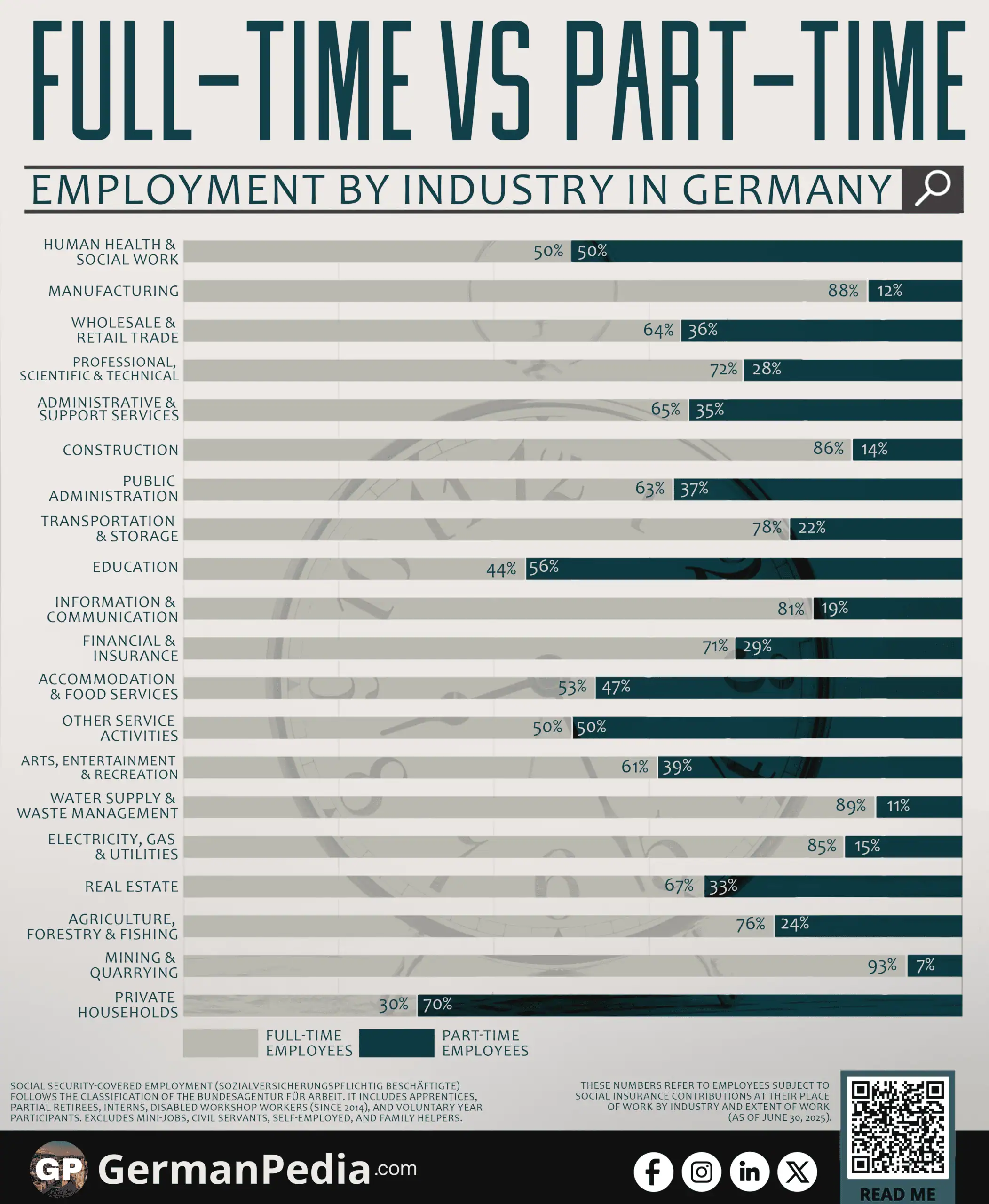
- Industrial sectors remain overwhelmingly full-time. Manufacturing employs about 5.83 million full-time workers compared with 770,000 part-time workers. That means only 12% of workers are part-time. Construction (86%) and utilities (85%) show similar patterns.
- Part-time work is far more common in service industries. In wholesale and retail trade, about 36% of workers are part-time, while administrative services (35%) and public administration (37%) show similarly mixed employment structures.
- Human health and social work is Germany’s largest employment sector. It employs roughly 2.76 million full-time and 2.77 million part-time workers, making it almost evenly split.
- Industrial sectors remain overwhelmingly full-time. Manufacturing, construction, and utilities rely heavily on full-time workers because production processes, technical teams, and site-based work are harder to divide into shorter schedules.
- Service sectors rely more on part-time work. Retail, healthcare, education, and public services employ larger shares of part-time workers due to shift schedules, institutional flexibility, and customer demand patterns.
Use this Visualization: You may use this image for free with proper attribution to GermanPedia (i.e., by linking back to GermanPedia).
Need help communicating complex ideas visually? We help you turn data into your most persuasive story. Contact us to learn more.
Full-Time vs Part-Time Employment* in Germany by Industry
| Industry | Employees (In millions) | |
|---|---|---|
| Full-time | Part-time | |
| Human health & social work | 2.76 (50%) | 2.77 (50%) |
| Manufacturing | 5.83 (88%) | 0.77 (12%) |
| Wholesale & retail trade | 2.91 (64%) | 1.61 (36%) |
| Professional, scientific & technical | 1.88 (72%) | 0.71 (28%) |
| Administrative & support services | 1.42 (65%) | 0.77 (35%) |
| Construction | 1.69 (86%) | 0.27 (14%) |
| Public administration | 1.34 (63%) | 0.79 (37%) |
| Transportation & storage | 1.54 (78%) | 0.44 (22%) |
| Education | 0.66 (44%) | 0.82 (56%) |
| Information & communication | 1.09 (81%) | 0.26 (19%) |
| Financial & insurance | 0.71 (71%) | 0.30 (29%) |
| Accommodation & food services | 0.59 (53%) | 0.52 (47%) |
| Other service activities | 0.43 (50%) | 0.43 (50%) |
| Arts, entertainment & recreation | 0.19 (61%) | 0.12 (39%) |
| Water supply & waste management | 0.25 (89%) | 0.03 (11%) |
| Electricity, gas & utilities | 0.25 (85%) | 0.04 (15%) |
| Real estate | 0.21 (67%) | 0.10 (33%) |
| Agriculture, forestry & fishing | 0.19 (76%) | 0.06 (24%) |
| Mining & quarrying | 0.05 (93%) | 0.00 (7%) |
| Private households | 0.01 (30%) | 0.03 (70%) |
Source: Destatis
*Employment type (full-time or part-time) is determined by the ratio of contracted weekly working hours to the establishment’s standard full-time schedule. Data are recorded by place of work, not place of residence
**Social security-covered employment (sozialversicherungspflichtig Beschäftigte) follows the classification of the Bundesagentur für Arbeit. It includes apprentices, partial retirees, interns, disabled workshop workers (since 2014), and voluntary year participants. Excludes mini-jobs, civil servants, self-employed, and family helpers.

Industrial Germany Works Mostly Full-Time
Germany’s core industrial sectors remain strongly dominated by full-time workers.
Manufacturing is the country’s largest industrial employer. It employs roughly 5.8 million full-time workers, compared with about 770,000 part-time employees. That means only 12% of workers in manufacturing are part-time.
A similar pattern appears across the full-time workforce of production sectors:
- Construction: 1.69 million (86%)
- Waste and water services: 254,000 (89%)
- Utilities: 251,000 (85%)
These industries depend on continuous production processes, technical teams, and site-based work, where dividing roles into shorter schedules is often less practical.
As a result, the traditional structure of full-time employment remains dominant across Germany’s industrial economy.
Part-Time Work Is More Common in the Service Sector
Outside of industrial sectors, part-time work is more common.
In wholesale and retail trade, 2.91 million people work full-time, while 1.61 million work part-time. This means 36% of workers in the sector are part-time.
A similar structure appears in administrative and support services. The sector employs 1.42 million full-time workers and 772,000 part-time workers. 35% of its workforce is under part-time employment. In public administration, around 1.34 million employees work full-time compared with about 785,000 part-time workers. This means that 37% of the workforce works reduced hours.
Human health and social work is Germany’s largest employment sectors. The sector employs roughly 2.76 million full-time workers and 2.77 million part-time workers. This makes it one of the most evenly split sectors in the labour market.
In some service sectors, part-time work is even more prevalent.
In education, part-time workers actually outnumber full-time staff. The sector employs around 822,000 part-time workers compared with 656,000 full-time employees. This means 56% of its workforce is made up of part-timers.
Several practical factors contribute to this pattern.
- Shift-based work is common in sectors such as healthcare, where services must operate around the clock.
- In education (56% part-time) and public administration (37%), reduced hours are more common due to work-life balance policies and regulations such as Germany’s Teilzeit- und Befristungsgesetz.
- Sectors like retail and hospitality often organise work around busy and quiet periods during the day and week, leading to shorter shifts.
Germany’s labour market is often described as highly flexible. In practice, however, this flexibility is concentrated in certain parts of the service economy. Industrial sectors remain largely organised around full-time work, while many service sectors rely much more heavily on part-time employment.
More topics
- Germany’s Median Wage by Federal State
- Top 10 Largest Employers in Germany
- Women Are Increasing in Managerial Roles Across the EU
- Women Hold Less Than One Third of Managerial Roles in Germany
- Employment by Federal State in Germany
- Employer Refuses to Pay Wages: Employees’ Right in Germany
- Germans Earn More Than Foreign Workers Across Germany
- Top German Companies by Revenue
- Top Companies in Germany by LinkedIn (2021-2025)
- Unemployment Across Germany: A Federal State Breakdown
- Germany’s Fastest-Growing Jobs by LinkedIn
- Employment Legal Insurance in Germany
- Highest Paying Jobs in Germany
- Sick Leaves in Germany Doubled Since 2007
- Commuting in Germany: Cars, Climate Goals, and Daily Reality