
Key Takeaways
- Rotterdam ranks first among EU container ports in the Top 100 List of global ports. It recorded 13.8 million TEU in 2024. Its position at the mouth of the Rhine makes it a natural entry point for Europe’s densest cluster of industrial economies.
- Spain is the only EU country with three ports in the Top 100 List. This includes Valencia (38th), Algeciras (44th), and Barcelona (54th).
- Hamburg and Bremen face competition from both the Benelux ports to the west and Gdańsk to the east. Gdańsk is the Baltic Sea’s primary container gateway for Central and Eastern European trade.
- Several EU Mediterranean ports exist to serve global shipping routes rather than local economies. They sit on the main East-West corridor between Asia and Europe. COSCO Shipping’s investment since 2010 has transformed Piraeus into the Eastern Mediterranean’s largest hub.
- The busiest EU container ports sit where major shipping routes and major economies meet. Geography determines position. Investment determines scale.
Use this Visualization: You may use this image for free with proper attribution to GermanPedia (i.e., by linking back to GermanPedia).
Need help communicating complex ideas visually? We help you turn data into your most persuasive story. Contact us to learn more.
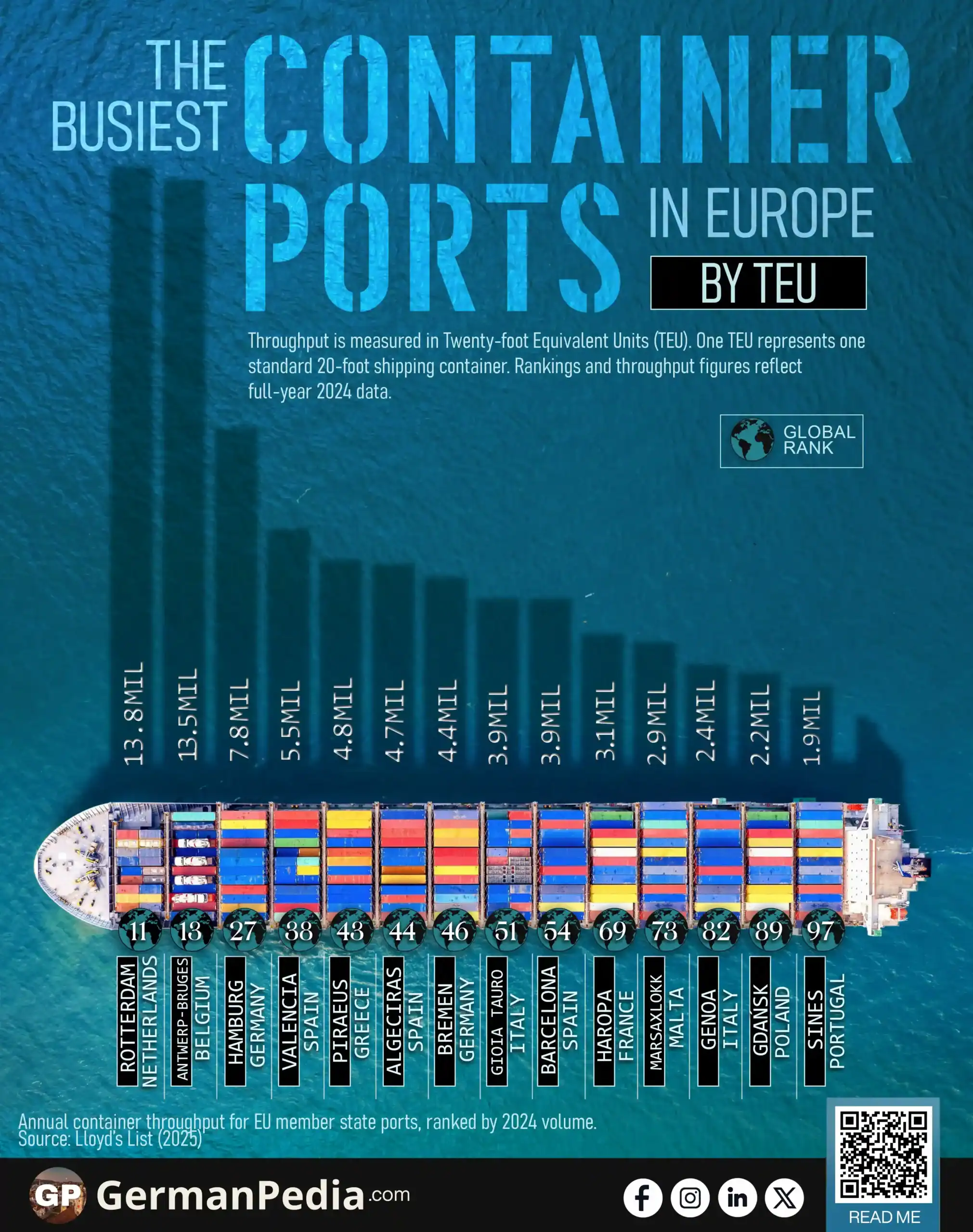
Rotterdam and Antwerp-Bruges are the two busiest container ports in the EU. Together, they handle more containers each year than the next five EU ports on the ranking combined.
Fourteen EU member state ports appear in the global top 100. They span 10 countries across four maritime zones: the North Sea, the Mediterranean, the Atlantic, and the Baltic.
EU’s Busiest Container Ports
| Global Rank | Port / Country | TEU (In millions, 2024) |
|---|---|---|
| 11 | Rotterdam, Netherlands | 13.8 |
| 13 | Antwerp-Bruges, Belgium | 13.5 |
| 27 | Hamburg, Germany | 7.8 |
| 38 | Valencia, Spain | 5.5 |
| 43 | Piraeus, Greece | 4.8 |
| 44 | Algeciras, Spain | 4.7 |
| 46 | Bremen/Bremerhaven, Germany | 4.4 |
| 51 | Gioia Tauro, Italy | 3.9 |
| 54 | Barcelona, Spain | 3.9 |
| 69 | Haropa, France | 3.1 |
| 73 | Marsaxlokk, Malta | 2.9 |
| 82 | Genoa, Italy | 2.4 |
| 89 | Gdańsk, Poland | 2.2 |
| 97 | Sines, Portugal | 1.9 |
Source: Lloyd’s List (2025)
Throughput is measured in Twenty-foot Equivalent Units (TEU). One TEU represents one standard 20-foot shipping container. Rankings and throughput figures reflect full-year 2024 data.

The North Sea Holds the Largest EU Container Port Volume
Rotterdam ranks 11th globally and first in the EU in terms of container port volume. It handled 13.8 million TEU in 2024. Rotterdam sits at the mouth of the Rhine. The Rhine connects it directly to Germany, Switzerland, and Central Europe by river barge. This makes it the natural entry point for Europe’s densest cluster of industrial economies.
Antwerp-Bruges ranks 13th globally and second in the EU, with 13.5 million TEU. The two Benelux ports are the closest competitors in EU container shipping. Antwerp-Bruges merged with the port of Bruges in 2022. The merger expanded the port beyond containers into roll-on/roll-off cargo and liquid bulk. The gap between the two ports has been narrowing.
Hamburg ranks 27th globally and third in the EU, with 7.8 million TEU. Bremen/Bremerhaven ranks 46th. Both German ports serve the same Central European hinterland as Rotterdam and Antwerp-Bruges. They face competition from both sides.
- To the west, Rotterdam and Antwerp-Bruges compete for the same Central European cargo.
- To the east, Gdańsk has grown into the Baltic Sea’s main container terminal. It is now the primary gateway for Central and Eastern European trade.
Spain Has Three of Europe’s Busiest Container Ports
Spain is the only EU country with three ports in the top 100 list of global ports.
- Valencia (38th): 5.5 million TEU
- Algeciras (44th): 4.7 million TEU
- Barcelona (54th): 3.9 million TEU
Valencia and Barcelona are gateway ports. Their cargo moves into and out of the Spanish economy. Spain’s manufacturing and export industries are concentrated along the Mediterranean coast. Both ports serve that corridor directly.
Algeciras is a transshipment hub. It sits at the Strait of Gibraltar, where Atlantic and Mediterranean shipping lanes intersect. Containers from large ocean-going vessels are transferred onto smaller regional ships and continue to their destination. The cargo does not enter Spain. It passes through.
Mediterranean Container Ports on the Asia-Europe Shipping Route
Several EU ports in the Mediterranean exist primarily to serve global shipping routes, not local economies. They sit on the main East-West corridor between Asia and Europe. Containers arrive, transfer between vessels, and move on.
Piraeus in Greece ranks 43rd globally and fifth in the EU, with 4.8 million TEU. COSCO Shipping, China’s state-owned shipping group, has operated its main terminals since 2010. COSCO’s investment transformed Piraeus from a minor regional port into the Eastern Mediterranean’s largest container hub.
Gioia Tauro in Italy ranks 51st, with 3.9 million TEU. It sits at the geographic center of the Mediterranean. Marsaxlokk in Malta ranks 73rd. Both serve as transshipment hubs along the same corridor.
The remaining EU ports function as regional gateways. Each connects its national economy to global shipping routes.
- Haropa, France (69th): 3.1 million TEU
- Genoa, Italy (82nd): 2.4 million TEU
- Sines, Portugal (97th): 1.9 million TEU
The pattern across all 14 ports is consistent. The busiest EU container ports sit where major shipping routes and major economies meet. Rotterdam commands the Rhine. Algeciras commands the Strait of Gibraltar. The Mediterranean hubs sit on the path between Asia and Europe. Geography is the foundation. Investment and trade policy determine how much of that geography each port can use.
More topics
- Countries Driving Germany’s Quarter Trillion Export Surplus
- Germany’s Top Export Partners: Where €1.55 Trillion in Goods Go
- Germany’s Top Import Partners
- EU Relies on Imports for Natural Gas
- US Oil Exports to the EU Are Highly Concentrated
- Government Spending on Education in EU Countries
- EU Rent Price Index by Country Over Time
- The Best EU Countries to Retire In
- Foreign-Born Population in the EU Is Rising
- EU Passports Are Among the Strongest in the World
- Internet Use for Mental Health Information Across the EU
- Which EU Countries Have the Highest Diabetes Prevalence?
- EU Alternatives to Common US Platforms
- Where are Data Centers Concentrated in the EU?
- Which EU Countries Have the Most Soft Power?
References
- https://www.lloydslist.com/one-hundred-container-ports-2025
- https://www.portofrotterdam.com/en/news-and-press-releases/cargo-throughput-port-rotterdam-slightly-decreased-2024
- https://newsroom.portofantwerpbruges.com/annual-figures-for-port-of-antwerp-bruges-show-growth-despite-challenging-times
- https://www.porteconomics.eu/top-15-europen-union-container-ports-in-2024/
- https://www.seatrade-maritime.com/ports-logistics/hamburg-throughput-dropped-2-1-in-2024
- https://greekreporter.com/2025/04/02/greece-piraeus-port-record-revenues-profits-2024/
- https://www.porteconomics.eu/container-throughput-at-rotterdam-and-antwerp-bruges-a-growing-rivalry/