
Key Takeaways
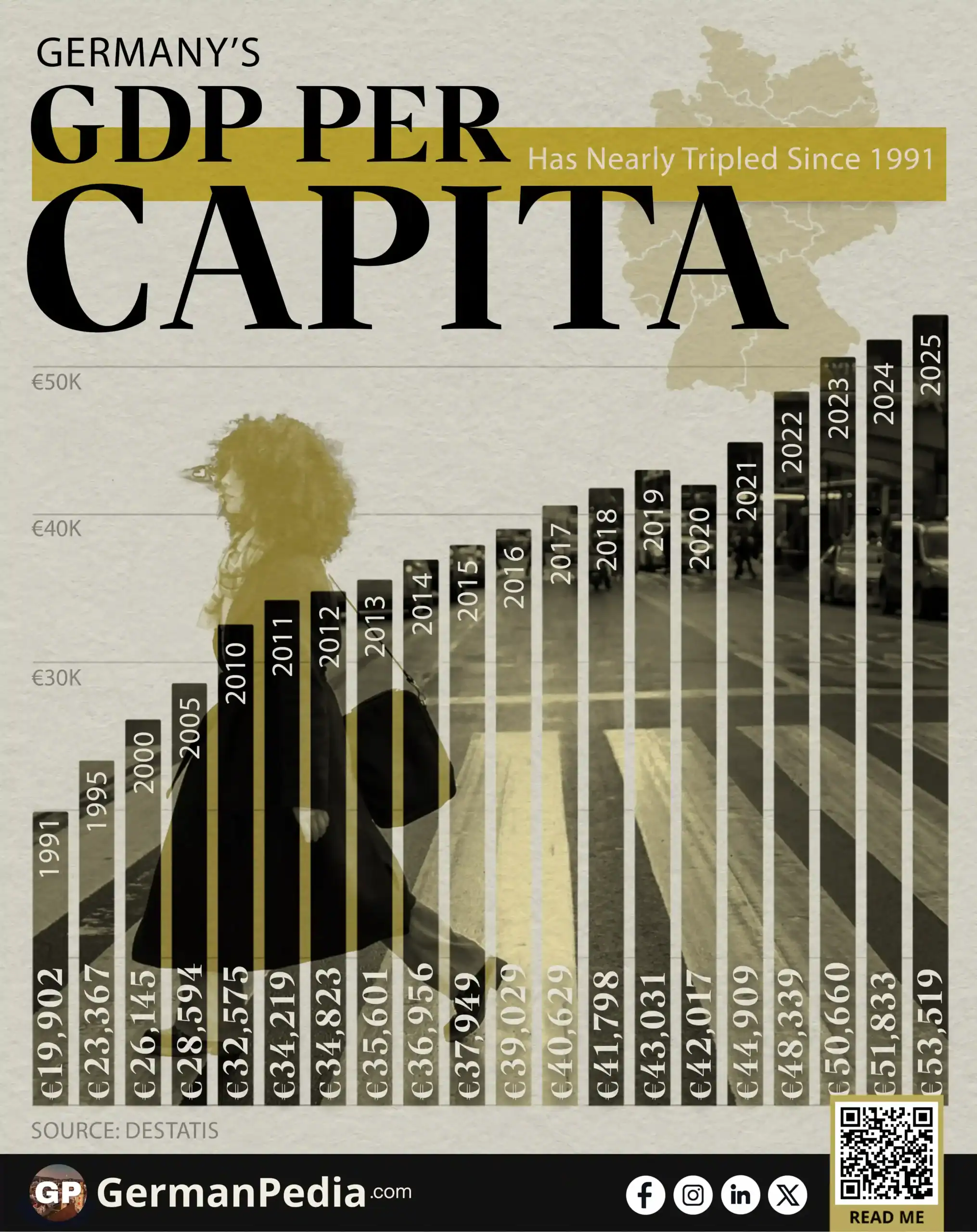
- Germany’s GDP per capita is close to three times higher than in 1991. It rose from €19,902 to €53,519 in 2025. This reflects long-term growth in economic output per person.
- In the 1990s, GDP per capita rose to €25,512. This is driven mainly by reunification-related investment and economic integration.
- Major crises caused only temporary declines, recovering in the years that followed. GDP per capita fell by 3.4% in 2009 during the global financial crisis and by 2.4% in 2020 during the pandemic.
- GDP per capita rose by 7.6% in 2022. It is the fastest growth rate in the series, reflecting post-pandemic reopening and higher prices.
Use this Visualization: You may use this image for free with proper attribution to GermanPedia (i.e., by linking back to GermanPedia).
Need help communicating complex ideas visually? We help you turn data into your most persuasive story. Contact us to learn more.
Nominal GDP per Capita in Germany
| Year | Gross Domestic Product Per Capita | |
|---|---|---|
| In € | YoY change (In %) | |
| 1991 | 19,902 | — |
| 1992 | 21,241 | 6.7 |
| 1993 | 21,710 | 2.2 |
| 1994 | 22,650 | 4.3 |
| 1995 | 23,367 | 3.2 |
| 1996 | 23,673 | 1.3 |
| 1997 | 24,134 | 1.9 |
| 1998 | 24,830 | 2.9 |
| 1999 | 25,512 | 2.7 |
| 2000 | 26,145 | 2.5 |
| 2001 | 26,933 | 3.0 |
| 2002 | 27,254 | 1.2 |
| 2003 | 27,478 | 0.8 |
| 2004 | 28,151 | 2.4 |
| 2005 | 28,594 | 1.6 |
| 2006 | 29,889 | 4.5 |
| 2007 | 31,389 | 5.0 |
| 2008 | 32,060 | 2.1 |
| 2009 | 30,988 | -3.4 |
| 2010 | 32,575 | 5.1 |
| 2011 | 34,219 | 5.0 |
| 2012 | 34,823 | 1.8 |
| 2013 | 35,601 | 2.2 |
| 2014 | 36,956 | 3.8 |
| 2015 | 37,949 | 2.7 |
| 2016 | 39,029 | 2.8 |
| 2017 | 40,629 | 4.1 |
| 2018 | 41,798 | 2.9 |
| 2019 | 43,031 | 2.9 |
| 2020 | 42,017 | -2.4 |
| 2021 | 44,909 | 6.9 |
| 2022 | 48,339 | 7.6 |
| 2023 | 50,660 | 4.8 |
| 2024 | 51,833 | 2.3 |
| 2025 | 53,519 | 3.3 |
Source: Destatis

In Germany, GDP per capita has increased steadily over the past three decades as economic output grew faster than the population over time.
Which Federal States Drive Germany’s Economy? ->
German Population Growth Between 1997 and 2025 ->
Measured in nominal euros, GDP per capita rose from €19,902 in 1991 to €53,519 in 2025. This means that average economic output per person has nearly tripled over this period.
What is Gross Domestic Product (GDP)? ->
This long-term pattern was already visible in the 1990s, when GDP per capita rose from €19,902 to €25,512. It showed an annual growth ranging from around 1% to nearly 7%.
Early gains were shaped mainly by reunification-related investment and the gradual integration of economic systems. It produced steady progress despite uneven year-to-year growth.
Over time, major economic disruptions appeared in the data as temporary declines rather than lasting breaks:
- During the global financial crisis, GDP per capita fell by 3.4% in 2009
- During the pandemic, it declined by 2.4% in 2020
In both cases, output per person recovered as economic activity resumed, returning to its previous path.
The strongest annual increase followed the pandemic. In 2022, GDP per capita rose by 7.6%, the largest year-on-year gain since the 1990s. This jump reflects economic reopening and higher prices rather than a fundamental change in Germany’s economic structure.
Because the series is measured in nominal euros, faster growth in recent years does not necessarily mean that purchasing power increased at the same pace. As a result, GDP per capita can rise even when purchasing power improves more slowly.
Overall, the near tripling of Germany’s GDP per capita since 1991 does not point to sudden takeoffs or dramatic transformations. Instead, it reflects decades of gradual accumulation, interrupted by short-lived shocks that did not alter the economy’s long-term direction.
More topics
- Top 25 Richest People in Germany (2025)
- Germany’s Smoking Rate Has Declined Over Two Decades
- Germany’s Electricity Mix: From Coal to Renewables
- Changes in Harvest of Germany’s Five Key Crops
- Top German Companies by Revenue
- Germany’s Top Car Brands by New Registrations
- Unemployment Across Germany: A Federal State Breakdown
- Where Germany’s Tourists Come From
- Germany’s Largest National Parks, Ranked by Size
- Which Federal States Drive Germany’s Economy?
- Here’s Why Divorces in Germany Are Falling
- Germans Are Marrying Later Than Ever
- How Marriage Rates Have Fallen in Germany: 1990–2023
- How Germany’s Birth Rates Dropped and Deaths Rose
- Leading Causes of Death in Germany