
Key Takeaways
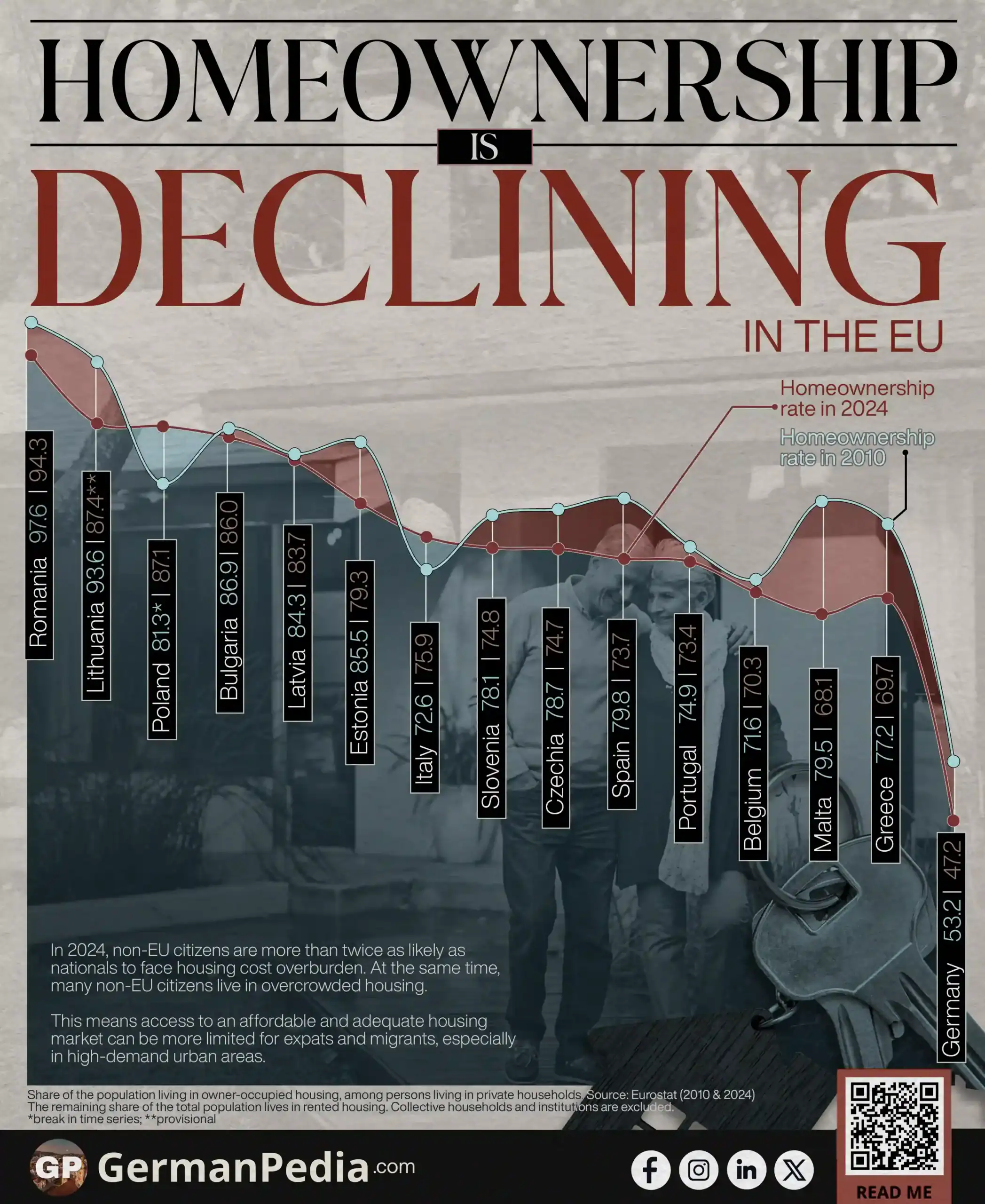
- Homeownership in the EU has declined modestly, from 70.7% in 2010 to 68.4% in 2024, showing a gradual shift away from ownership.
- Many EU countries recorded declines, with the largest drops in Malta (-14.3%), Germany (-11.3%), and Greece (-9.7%),
- The decline is driven by structural factors such as limited housing supply, rising house prices, and higher rents that reduce the ability to save for homeownership.
- Young adults are increasingly delaying homeownership, as saving for a deposit becomes more difficult and more people remain in private rentals longer.
- Some countries still see rising homeownership, such as Poland, where housing is viewed as a stable investment.
- Housing pressures affect non-EU residents more strongly, with higher rates of housing cost overburden and overcrowding compared to EU nationals.
- The European Union is responding through funding and policy support, including efforts to increase housing supply and improve affordability.
Use this Visualization: You may use this image for free with proper attribution to GermanPedia (i.e., by linking back to GermanPedia).
Need help communicating complex ideas visually? We help you turn data into your most persuasive story. Contact us to learn more.
Homeownership in the EU Over Time
| Country | Homeownership rate | % Change | |
| 2010 | 2024 | ||
| Poland | 81.3* | 87.1 | +7.1% |
| Italy | 72.6 | 75.9 | +4.5% |
| Slovakia | 90.0 | 93.1 | +3.4% |
| Croatia | 88.2 | 91.0 | +3.2% |
| Netherlands | 67.2 | 68.8 | +2.4% |
| Hungary | 89.7 | 91.6 | +2.1% |
| Latvia | 84.3 | 83.7 | -0.7% |
| Bulgaria | 86.9 | 86.0 | -1.0% |
| France | 62.0 | 61.2 | -1.3% |
| Belgium | 71.6 | 70.3 | -1.8% |
| Portugal | 74.9 | 73.4 | -2.0% |
| Romania | 97.6 | 94.3 | -3.4% |
| Sweden | 67.3 | 64.8 | -3.7% |
| Slovenia | 78.1 | 74.8 | -4.2% |
| Czechia | 78.7 | 74.7 | -5.1% |
| Cyprus | 73.1 | 69.4 | -5.1% |
| Austria | 57.4 | 54.5 | -5.1% |
| Ireland | 73.3 | 69.3 | -5.5% |
| Lithuania | 93.6 | 87.4** | -6.6% |
| Luxembourg | 68.1 | 63.5 | -6.8% |
| Estonia | 85.5 | 79.3 | -7.3% |
| Spain | 79.8 | 73.7 | -7.6% |
| Finland | 74.3 | 68.1 | -8.3% |
| Denmark | 66.6 | 60.9 | -8.6% |
| Greece | 77.2 | 69.7 | -9.7% |
| Germany | 53.2 | 47.2 | -11.3% |
| Malta | 79.5 | 68.1 | -14.3% |
Source: Eurostat (2010 & 2024)
The remaining share of the total population lives in rented housing. Collective households and institutions are excluded.
*break in time series; **provisional

Across the European Union, the homeownership rate of private households has declined modestly from 70.7% in 2010 to 68.4% in 2024.
This shows that while most people still own the homes they live in, ownership is becoming slightly less common across Europe.
Many EU countries recorded declines in homeownership. The largest drops include:
- Malta (−14.3 points)
- Germany (−11.3 points)
- Greece (−9.7 points)
- Denmark (−8.6 points)
- Finland (−8.3 points)
Several structural factors are driving the decline in homeownership across the EU.
- Limited housing supply. In many EU countries, new housing construction has not kept pace with demand. A share of housing stock in some cities has also shifted toward short-term rentals and tourism-related use. This imbalance has contributed to rising house prices, especially in urban areas where demand is strongest.
- House prices are rising faster than incomes. This also makes it harder for households to save for a deposit and enter the housing market.
- Higher rental costs reduce the ability to save, especially for younger households.
Germany’s House Prices By State ->
As a result, many young adults are delaying homeownership, and people are staying longer in private rentals as buying a home becomes more difficult.
Despite the overall trend, some countries recorded increases in homeownership:
- Poland (+7.1 points)
- Italy (+4.5 points)
- Slovakia (+3.4 points)
- Croatia (+3.2 points)
These countries also face rising costs, but these are often supported by country-specific factors. In Poland, for example, housing is often viewed as a stable investment, alongside rising incomes and purchasing power.
How does increasing house prices affect non-EU residents?
In 2024, non-EU citizens are more than twice as likely as nationals to face housing cost overburden. At the same time, many non-EU citizens live in overcrowded housing.
This means access to an affordable and adequate housing market can be more limited for expats and migrants, especially in high-demand urban areas.
How is the EU responding to declining homeownership?
Housing policy is mainly handled by individual countries, but the European Union has put housing among its priorities since 2024. Since then, it has introduced measures to support it.
These include the European Affordable Housing Plan and related policies to
- increase housing supply
- provide financial support for housing projects
- simplify permitting procedures
- support for high-quality and energy-efficient construction to lower long-term costs and environmental impact
More topics
- Homeownership Rate in the EU
- Germany’s Home Prices Rise 13.8% as Growth Shifts Regions
- Apartment Rents Are Rising Faster Than House Rents in Germany
- Where People Move Within Germany by Federal State
- GDP per Capita vs Actual Consumption per Capita in the EU
- Renting in Germany
- Rental Deposit (Kaution) in Germany
- Rent Increase in Germany [Tenant Rights And Regulations]
- Rental Property Scams in Germany
- Rental Contracts in Germany
- 7 Tips on Finding a Rental Property in Germany
- 12 Mistakes Foreigners Make While Living in Germany
- Unemployment Across Germany: A Federal State Breakdown
- Top German Companies by Revenue
- Which Federal States Drive Germany’s Economy?
References
- https://ec.europa.eu/eurostat/databrowser/view/ILC_LVHO02__custom_21116624/default/table
- https://ec.europa.eu/eurostat/cache/metadata/en/ilc_sieusilc.htm
- https://www.helsinkitimes.fi/world-int/23665-homeownership-declines-across-eu-as-young-adults-find-themselves-locked-out-of-the-market.html
- https://www.pwc.pl/pl/pdf-nf/2022/PwC_Report_What_is_behind_the_boom.pdf?_gl=1*16uql8n*_up*MQ..*_ga*MTc0NzI4MjQ4Ny4xNzc3MjI2MjY0*_ga_DS68YWXQK4*czE3NzcyMjYyNjMkbzEkZzAkdDE3NzcyMjYyNjMkajYwJGwwJGgw*_ga_9SM7B2113F*czE3NzcyMjYyNjMkbzEkZzAkdDE3NzcyMjYyNjMkajYwJGwwJGgw*_ga_QG9LG0VZCB*czE3NzcyMjYyNjUkbzEkZzAkdDE3NzcyMjYyNjUkajYwJGwwJGgw
- https://www.pwc.pl/en/publikacje/whats-behind-the-boom-changes-in-the-polish-housing-market.html
- https://www.europarl.europa.eu/topics/en/article/20241014STO24542/housing-crisis-why-prices-are-rising-and-what-the-eu-is-doing-about-it
- https://www.euronews.com/my-europe/2026/03/26/europes-housing-crisis-who-is-really-paying-the-price
- https://ec.europa.eu/eurostat/databrowser/view/ilc_lvho25/default/table?lang=en
- https://housing.ec.europa.eu/news/commission-takes-action-more-affordable-housing-across-europe-2025-12-16_en
- https://www.eib.org/en/projects/topics/sustainable-cities-regions/urban-development/affordable-and-sustainable-housing