
Key Takeaways
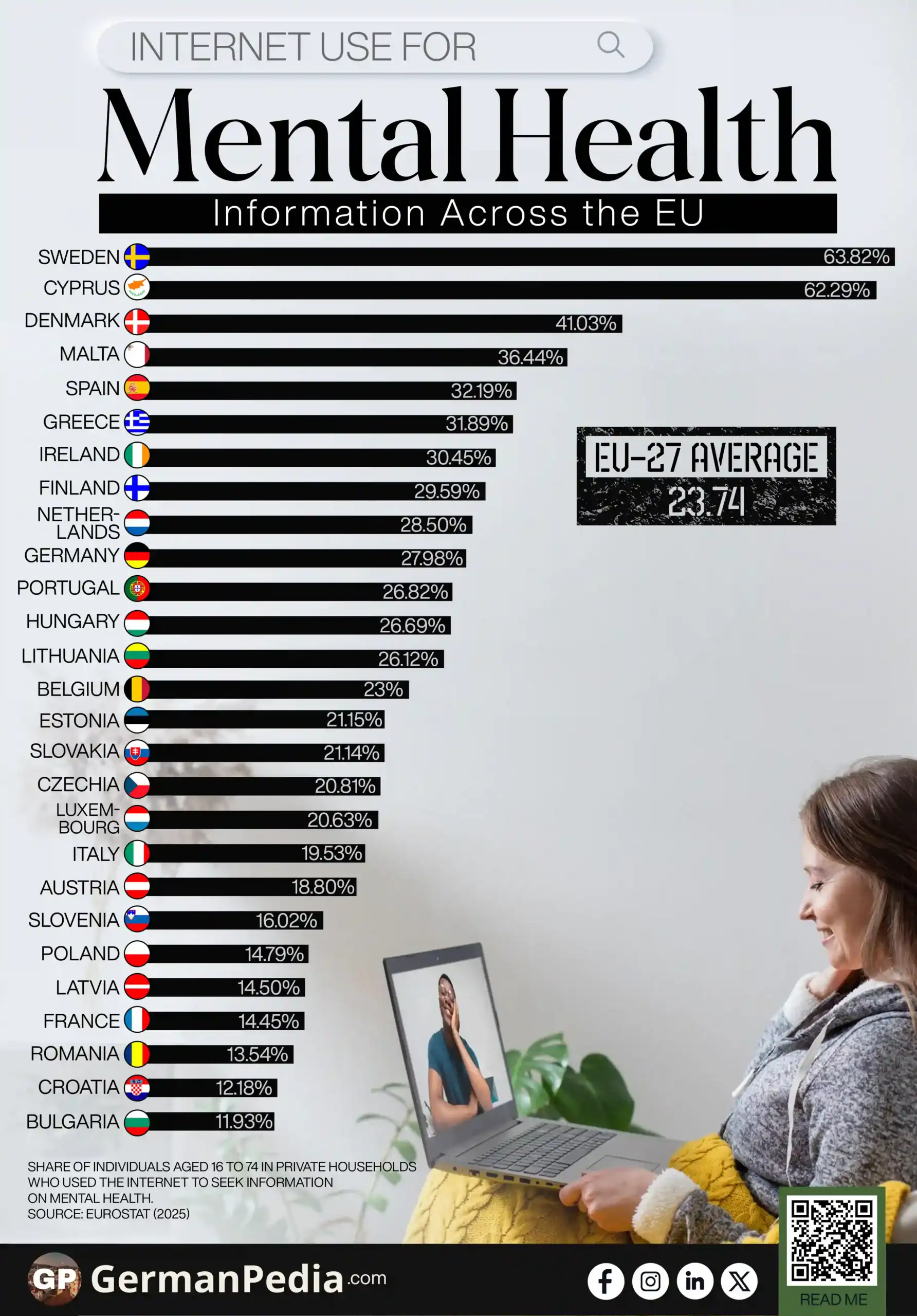
- In 2025, 23.74% individuals aged 16 to 74 in the EU used the internet to seek mental health information.
- Sweden ranks first with 63.82% of its internet users seeking mental health information online. Cyprus ranks second at 62.29%.
- Sweden and Cyprus reach these figures for different reasons. In Cyprus, limited specialist mental health services outside urban centers push people online. In Sweden, high demand and long waiting times drive internet use before formal care is accessed.
- Low internet use for mental health information in parts of Eastern Europe reflects higher residual stigma and lower digital health literacy.
- In countries with strong primary care systems, general practitioners serve as the first point of contact for health information. With this, fewer people tend to route mental health questions through the internet.
Use this Visualization: You may use this image for free with proper attribution to GermanPedia (i.e., by linking back to GermanPedia).
Need help communicating complex ideas visually? We help you turn data into your most persuasive story. Contact us to learn more.
EU’s Social Media Use for Seeking Mental Health Information
| Country | Individuals Seeking Mental Health Information Online (In %) |
|---|---|
| Sweden | 63.82 |
| Cyprus | 62.29 |
| Denmark | 41.03 |
| Malta | 36.44 |
| Spain | 32.19 |
| Greece | 31.89 |
| Ireland | 30.45 |
| Finland | 29.59 |
| Netherlands | 28.50 |
| Germany | 27.98 |
| Portugal | 26.82 |
| Hungary | 26.69 |
| Lithuania | 26.12 |
| Belgium | 23.00 |
| Estonia | 21.15 |
| Slovakia | 21.14 |
| Czechia | 20.81 |
| Luxembourg | 20.63 |
| Italy | 19.53 |
| Austria | 18.80 |
| Slovenia | 16.02 |
| Poland | 14.79 |
| Latvia | 14.50 |
| France | 14.45 |
| Romania | 13.54 |
| Croatia | 12.18 |
| Bulgaria | 11.93 |
| EU-27 average | 23.74 |
Source: Eurostat (2025)

Only 1 in 4 EU individuals aged 16 to 74 used the internet to seek mental health information.
Sweden ranks first with 63.82% of its internet users seeking mental health information online. That is double the EU average. Cyprus ranks second at 62.29%.
Sweden and Cyprus look very different. Sweden is a high-income Northern European country with a well-funded public health system. Scandinavian and Nordic countries tend to have relatively lower stigma around mental health, especially among younger cohorts. In Sweden, mental health education is embedded in school curricula. This supports open discussion and early help‑seeking
Meanwhile, Cyprus is a small island in the Eastern Mediterranean with limited specialist mental health infrastructure outside its main cities. There is also a high mental‑health stigma in the general population.
Despite these differences, they share two conditions that explain their high internet use for mental health information.
First, social media penetration among young people in both countries is among the highest in the EU. When social media platforms are already embedded in daily life, they become a natural channel for mental health information-seeking.
Second, both countries have a gap in formal care access. These gaps push people toward social media as a substitute.
In Cyprus, the problem is geographic. Specialist mental health services are concentrated in urban centres. For young people and adolescents outside those areas, the internet can function as a first-line source of information and peer support.
In Sweden, the problem is capacity. Mental health services exist and are relatively well-funded. The issue is demand outpacing supply. Long waiting times push people toward online self-screening and peer communities before they can access formal care.
Why Do Most EU Adults Not Use the Internet for Mental Health Information?
Two patterns account for most of the variation below the EU average in internet use for mental health information.
The first is mental health stigma and digital literacy. In countries where asking for help is still seen as a weakness, people either do not search or do not report having done so. This pattern is common in parts of Eastern Europe, including Bulgaria (11.93%), Romania (13.54%), and Croatia (12.18%).
The second is the healthcare gatekeeping effect. In countries where the default response to a health concern is to call a general practitioner, fewer people tend to route their mental health questions through the internet. France (14.45%) and Italy (19.53%), for example, both have strong primary care systems, which may explain their low internet use for mental health information.
Across the EU, low internet use for mental health information can reflect high stigma or poor digital literacy. However, high use is not always a success story either. Sometimes it reflects a functional gap where specialists are hard to reach, or appointments are hard to get.
More topics
- The Best EU Countries to Retire In
- Happiness vs Income in the EU
- Most Visited AI Websites in Germany
- EU Alternatives to Common US Platforms
- Environmental Impact of AI Websites in Germany
- Where are Data Centers Concentrated in the EU?
- Top 20 Most Visited Websites in Germany
- How Do Germans Perceive Other Countries as Allies and Threats?
- Which EU Countries Have the Most Soft Power?
- EU Passports Are Among the Strongest in the World
- Which EU Countries Have the Highest Obesity Rates?
- EU House Price Index Rises Over 60% Since 2010
- 49% of Young Adults Live With Their Parents in the EU
- Top 13 Most Valuable Brands in the EU
- EU Unicorn Startups: Which Countries Lead and Why
References
- https://ec.europa.eu/eurostat/databrowser/view/ISOC_CI_AC_I__custom_21391757/default/table?page=time:2025
- https://publications.jrc.ec.europa.eu/repository/handle/JRC141047
- https://www.hbsc.org/policy-impact/tackling-mental-ill-health-in-sweden/
- https://pmc.ncbi.nlm.nih.gov/articles/PMC8749346/
- https://publications.jrc.ec.europa.eu/repository/handle/JRC141047
- https://pmc.ncbi.nlm.nih.gov/articles/PMC13089435/
- https://pmc.ncbi.nlm.nih.gov/articles/PMC10486137/