
Key Takeaways
- Germany’s public debt reached €2.69 trillion in 2024.
- Debt growth has been event-driven. It recorded sharp increases during reunification, financial crises, and consecutive economic shocks.
- The 1990s reunification marked the first major surge, as Germany absorbed long-term integration costs.
- The 2008 financial crisis and eurozone debt crisis pushed public debt higher as the government stepped in to support banks and the economy.
- Between 2013 and 2019, borrowing was tightly constrained under the debt brake, leading to stabilization.
- Since 2020, the pandemic and energy-related spending have driven the fastest debt increase since reunification.
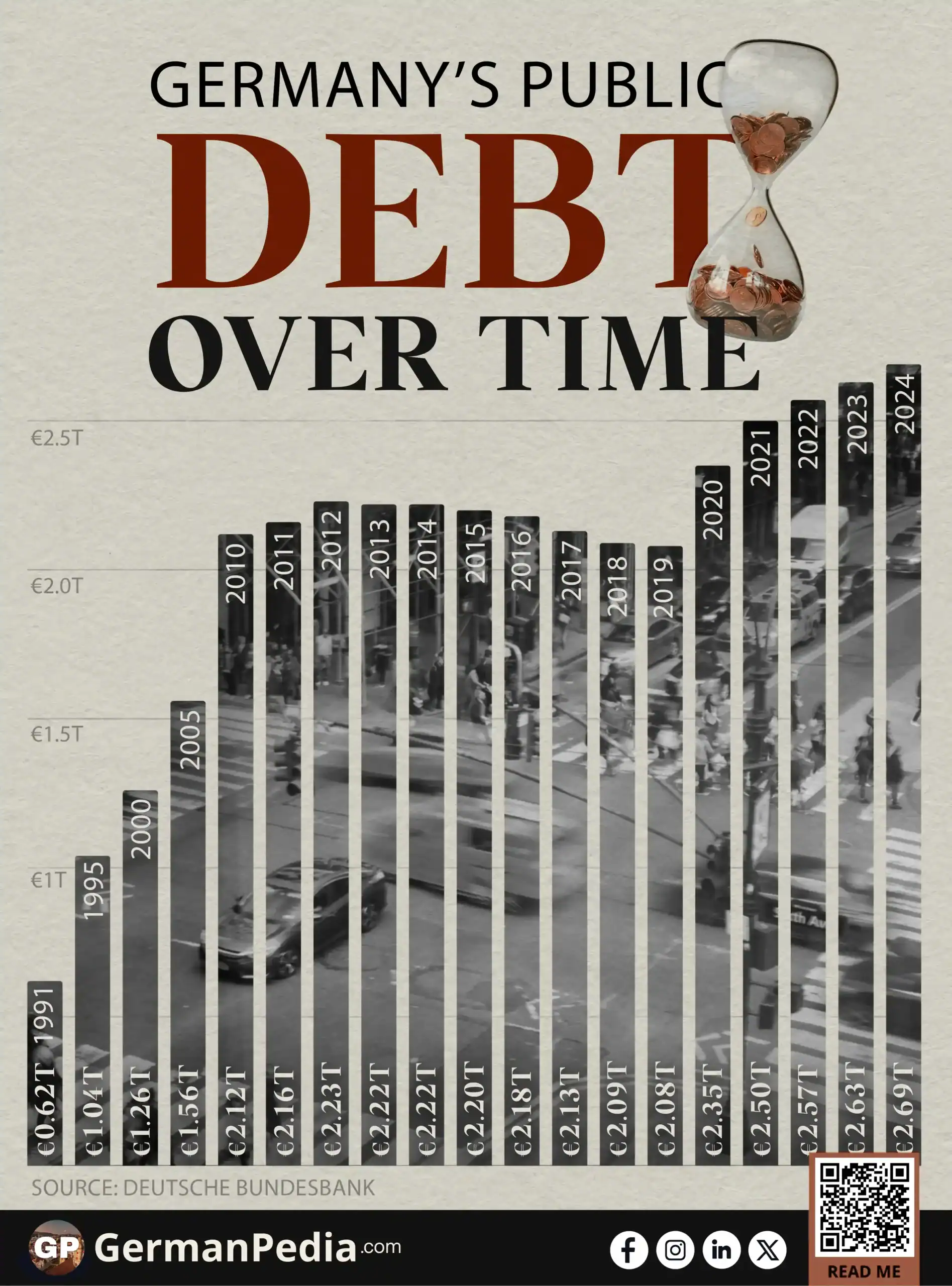
Use this Visualization: You may use this image for free with proper attribution to GermanPedia (i.e., by linking back to GermanPedia).
Need help communicating complex ideas visually? We help you turn data into your most persuasive story. Contact us to learn more.
Public Debt in Germany Per Year
| Year | Debt (In € Trillion) |
|---|---|
| 1991 | 0.62 |
| 1992 | 0.71 |
| 1993 | 0.79 |
| 1994 | 0.87 |
| 1995 | 1.04 |
| 1996 | 1.11 |
| 1997 | 1.16 |
| 1998 | 1.20 |
| 1999 | 1.25 |
| 2000 | 1.26 |
| 2001 | 1.27 |
| 2002 | 1.33 |
| 2003 | 1.42 |
| 2004 | 1.49 |
| 2005 | 1.56 |
| 2006 | 1.61 |
| 2007 | 1.62 |
| 2008 | 1.69 |
| 2009 | 1.80 |
| 2010 | 2.12 |
| 2011 | 2.16 |
| 2012 | 2.23 |
| 2013 | 2.22 |
| 2014 | 2.22 |
| 2015 | 2.20 |
| 2016 | 2.18 |
| 2017 | 2.13 |
| 2018 | 2.09 |
| 2019 | 2.08 |
| 2020 | 2.35 |
| 2021 | 2.50 |
| 2022 | 2.57 |
| 2023 | 2.63 |
| 2024 | 2.69 |
Source: Deutsche Bundesbank
Germany’s Public Debt from 1991 to 2024
As of 2024, Germany’s public debt stands at €2.69 trillion. This represents the total outstanding liabilities of the general government, including federal, state, and local levels.
Germany’s debt has not risen evenly over time. Instead, increases largely coincide with major economic and political shocks, followed by periods of stabilization or slower growth.
German Reunification (1990s)
German reunification was the 1990 integration of East and West Germany into one federal state. It required large public spending on infrastructure rebuilding, pension and social security alignment, industrial restructuring, and long-term regional transfers.
Public debt nearly doubled during this decade.
Global Financial and Eurozone Crises (2008–2012)
The 2008 global financial crisis originated in the U.S. housing and banking system. It quickly spread through international financial markets, including Germany’s.
It prompted the German government to provide financial support to banks to limit the economic impact. This included financial guarantees and emergency funding. The subsequent eurozone debt crisis required additional government spending and financial measures to maintain stability.
Public borrowing increased sharply during this period.
Fiscal Consolidation Period (2013–2019)
Between 2013 and 2019, Germany reduced public borrowing under the debt brake. It was a constitutional rule that strictly limits new government borrowing in normal economic conditions.
New borrowing was constrained, spending growth was restrained, and budget surpluses were used to limit further debt accumulation.
Public debt stabilized and declined slightly toward the end of the decade.
Pandemic and Energy Shocks (2020–2024)
The COVID-19 pandemic triggered the most abrupt increase in public debt since reunification. Emergency borrowing financed short-term work schemes, business support, healthcare spending, and economic relief programs during lockdowns.
Soon after, the energy crisis following Russia’s invasion of Ukraine added further pressure through gas price caps, household subsidies, and industrial support. While repayments of earlier emergency loans slowed the pace of growth, public debt still rose to €2.69 trillion by 2024.
More topics
- Top 25 Richest People in Germany (2025)
- Germany’s Smoking Rate Has Declined Over Two Decades
- Germany’s Electricity Mix: From Coal to Renewables
- Changes in Harvest of Germany’s Five Key Crops
- Top German Companies by Revenue
- Germany’s Top Car Brands by New Registrations
- Unemployment Across Germany: A Federal State Breakdown
- Where Germany’s Tourists Come From
- Germany’s Largest National Parks, Ranked by Size
- Which Federal States Drive Germany’s Economy?
- Here’s Why Divorces in Germany Are Falling
- Germans Are Marrying Later Than Ever
- How Marriage Rates Have Fallen in Germany: 1990–2023
- How Germany’s Birth Rates Dropped and Deaths Rose
- Leading Causes of Death in Germany