
Key Takeaways
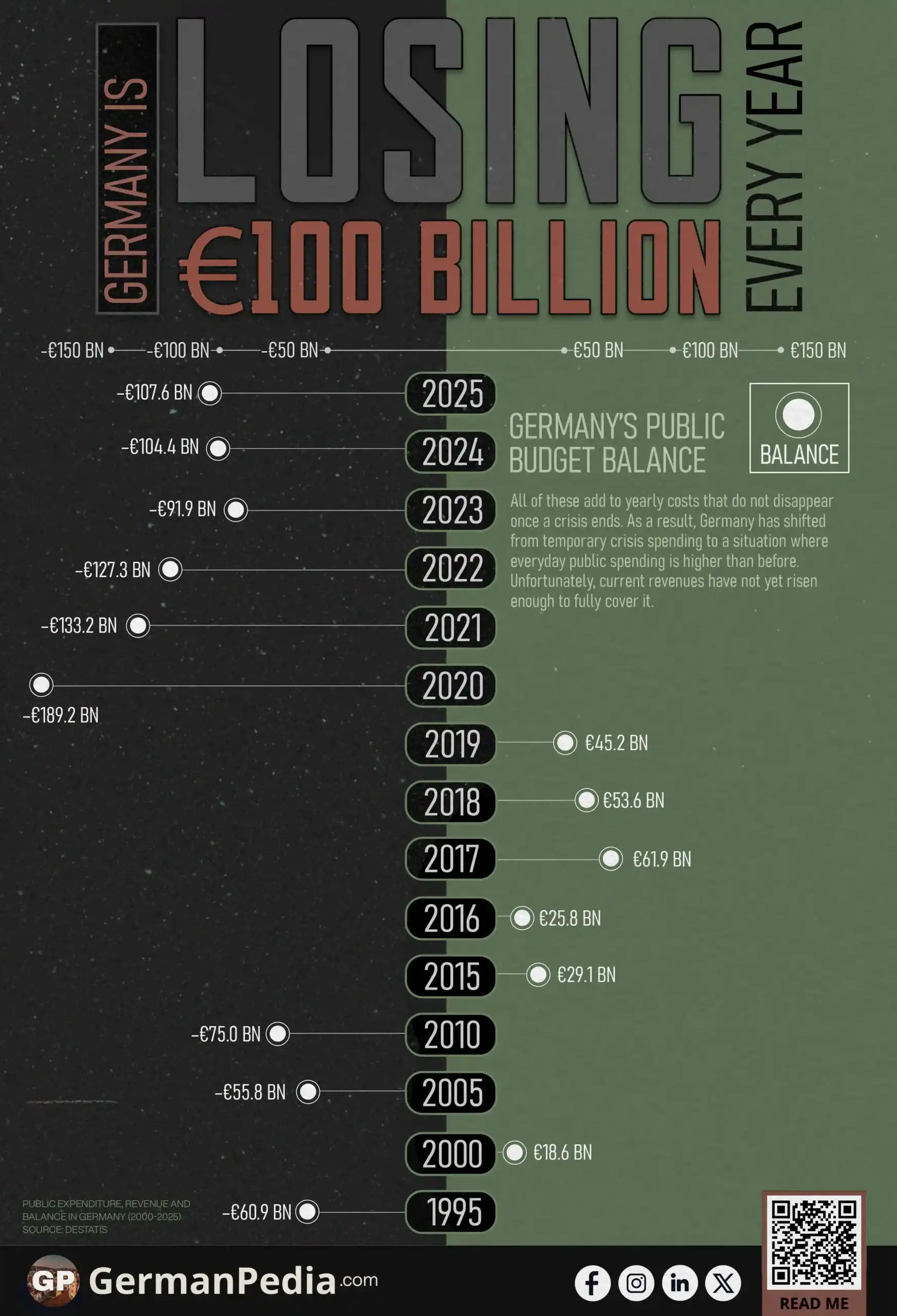
- In the early 2000s, Germany usually spent more than it collected. Slow growth, high unemployment, and reunification costs limited tax income while keeping public spending high.
- From 2015 to 2019, revenues exceeded spending. Strong employment and rising wages helped close the gap and produced several years of surpluses.
- The pandemic caused a sharp break. Emergency support in 2020 and 2021 led to the largest spending gaps in the series, with the peak recorded in 2020 at €189.2 bn.
- Since 2022, spending has remained higher than income. Rather than crisis measures, ongoing costs now drive the gap. These include expenses for defence, energy support, social benefits, and an ageing population.
Use this Visualization: You may use this image for free with proper attribution to GermanPedia (i.e., by linking back to GermanPedia).
Need help communicating complex ideas visually? We help you turn data into your most persuasive story. Contact us to learn more.
Germany’s Public Budget Balance
Source: Destatis
Expenditure is the total amount the government spent in the year. The balance is revenue minus its expenditure. A negative balance means the government spent more than it collected. A positive balance means it collected more than it spent.
*Revised data method with broader coverage. Figures are not fully comparable with earlier years.

In the early 2000s, Germany consistently spent more than it collected. Public spending exceeded revenue in most years. There were only a few gaps, such as €56 bn in 2005 and €75 bn in 2010. These imbalances reflected weak economic growth, high unemployment at the time, and the long-term fiscal after-effects of reunification.
Spending continued to rise gradually, but tax and contribution income did not keep pace. As a result, Germany rarely closed the gap between what the state spent and what it took in during this period.
How Germany’s Debt-to-GDP Ratio Changed Since 2000s ->
Between 2015 and 2019, this pattern reversed. For several years, public income was higher than public spending. The gap peaked in 2017, when revenues exceeded spending by €61.9 bn. This shift was driven by changes, including:
- record employment and rising wages
- strong tax and social contribution income
- slower growth in public spending
By 2019, public finances appeared broadly stable. Germany recorded a €45.2 bn surplus. Meanwhile, public debt relative to economic output was falling.
That stability ended abruptly in 2020. As pandemic support measures expanded and economic activity declined, public spending jumped to €1.68 trillion while revenues fell. The result was the largest gap in the series, at €189.2 bn.
In 2021, emergency support remained in place. Revenues recovered, but not enough to match spending. It left a gap of €133.2 bn. Together, these two years mark a clear break from earlier patterns.
Since 2022, the gap in financial balance has narrowed but has not closed. Public spending has continued to grow faster than revenue:
- €127.3 bn in 2022
- €91.9 bn in 2023
- €104.4 bn in 2024
By the third quarter of 2025, spending already exceeded income by €107.6 bn. This indicated continued pressure even before full-year figures are available.
Unlike during the pandemic, today’s gap is no longer driven by one-off emergency measures. Instead, the government is now spending more on a lasting basis, including:
- higher defence spending
- ongoing energy support
- rising social benefits
- an ageing population
Germany’s 2026 Budget Highlights ->
Germany’s Healthcare Expenditure Vs. Aging Population ->
All of these add to yearly costs that do not disappear once a crisis ends. As a result, Germany has shifted from temporary crisis spending to a situation where everyday public spending is higher than before. Unfortunately, current revenues have not yet risen enough to fully cover it.
More topics
- Top 25 Richest People in Germany (2025)
- Germany’s Smoking Rate Has Declined Over Two Decades
- Germany’s Electricity Mix: From Coal to Renewables
- Changes in Harvest of Germany’s Five Key Crops
- Top German Companies by Revenue
- Germany’s Top Car Brands by New Registrations
- Unemployment Across Germany: A Federal State Breakdown
- Where Germany’s Tourists Come From
- Germany’s Largest National Parks, Ranked by Size
- Which Federal States Drive Germany’s Economy?
- Here’s Why Divorces in Germany Are Falling
- Germans Are Marrying Later Than Ever
- How Marriage Rates Have Fallen in Germany: 1990–2023
- How Germany’s Birth Rates Dropped and Deaths Rose
- Leading Causes of Death in Germany