
Key Takeaways
- Growth in student numbers of higher education institutions is increasingly driven by international enrolment.
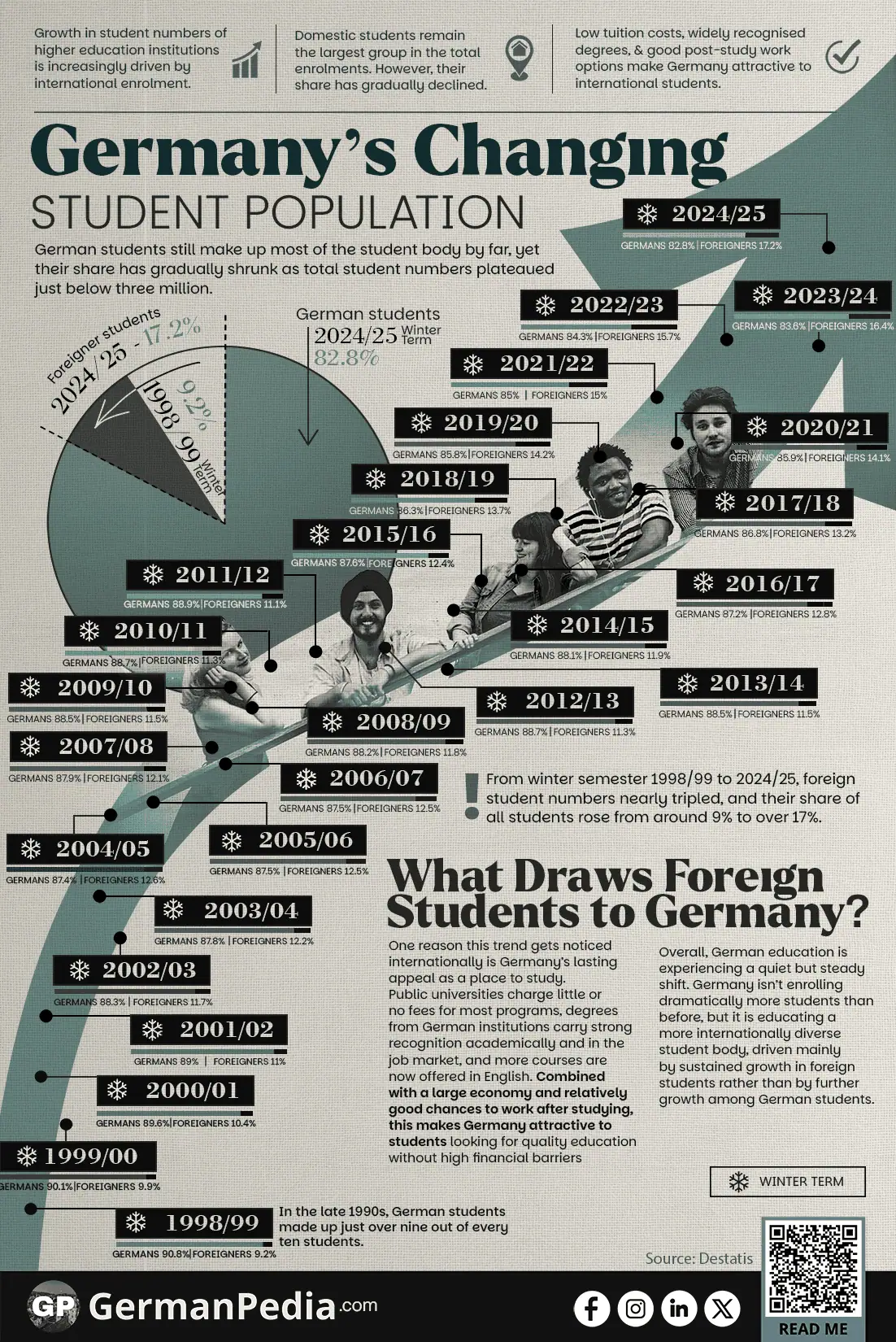
- Germany’s student population is becoming more international by composition, not by scale. Foreign students account for 9.2% of total enrolment in winter term (WT) 1998/99. It increased to 17.2% in WT 2024/25.
- Domestic students remain the largest group in the total enrolments. However, their share gradually declined as total student numbers plateaued just below three million in recent years.
- Low tuition costs, widely recognised degrees, more English-taught programmes, and good post-study work options make Germany attractive to international students.
Use this Visualization: You may use this image for free with proper attribution to GermanPedia (i.e., by linking back to GermanPedia).
Over more than two decades, total enrolment at higher education institutions (HEI) has grown and then largely stabilised, hovering just below three million students in recent years. What has changed more noticeably is who makes up that total.
Student Enrolment Composition in German Universities
| Winter Term | Number of students (% out of total students) | Total | |
|---|---|---|---|
| Germans | Foreigners | ||
| 1998/99 | 1,634,657 (90.8%) | 165,994 (9.2%) | 1,800,651 |
| 1999/00 | 1,595,424 (90.1%) | 175,065 (9.9%) | 1,770,489 |
| 2000/01 | 1,611,836 (89.6%) | 187,027 (10.4%) | 1,798,863 |
| 2001/02 | 1,662,090 (89.0%) | 206,241 (11.0%) | 1,868,331 |
| 2002/03 | 1,711,785 (88.3%) | 227,026 (11.7%) | 1,938,811 |
| 2003/04 | 1,773,329 (87.8%) | 246,136 (12.2%) | 2,019,465 |
| 2004/05 | 1,716,774 (87.4%) | 246,334 (12.6%) | 1,963,108 |
| 2005/06 | 1,737,408 (87.5%) | 248,357 (12.5%) | 1,985,765 |
| 2006/07 | 1,732,674 (87.5%) | 246,369 (12.5%) | 1,979,043 |
| 2007/08 | 1,707,799 (87.9%) | 233,606 (12.1%) | 1,941,405 |
| 2008/09 | 1,786,164 (88.2%) | 239,143 (11.8%) | 2,025,307 |
| 2009/10 | 1,876,403 (88.5%) | 244,775 (11.5%) | 2,121,178 |
| 2010/11 | 1,965,262 (88.7%) | 252,032 (11.3%) | 2,217,294 |
| 2011/12 | 2,115,682 (88.9%) | 265,292 (11.1%) | 2,380,974 |
| 2012/13 | 2,217,208 (88.7%) | 282,201 (11.3%) | 2,499,409 |
| 2013/14 | 2,315,531 (88.5%) | 301,350 (11.5%) | 2,616,881 |
| 2014/15 | 2,377,341 (88.1%) | 321,569 (11.9%) | 2,698,910 |
| 2015/16 | 2,417,494 (87.6%) | 340,305 (12.4%) | 2,757,799 |
| 2016/17 | 2,448,115 (87.2%) | 358,895 (12.8%) | 2,807,010 |
| 2017/18 | 2,470,395 (86.8%) | 374,583 (13.2%) | 2,844,978 |
| 2018/19 | 2,473,557 (86.3%) | 394,665 (13.7%) | 2,868,222 |
| 2019/20 | 2,479,448 (85.8%) | 411,601 (14.2%) | 2,891,049 |
| 2020/21 | 2,527,708 (85.9%) | 416,437 (14.1%) | 2,944,145 |
| 2021/22 | 2,501,351 (85.0%) | 440,564 (15.0%) | 2,941,915 |
| 2022/23 | 2,462,053 (84.3%) | 458,210 (15.7%) | 2,920,263 |
| 2023/24 | 2,398,826 (83.6%) | 469,485 (16.4%) | 2,868,311 |
| 2024/25 | 2,372,035 (82.8%) | 492,087 (17.2%) | 2,864,122 |
Source: Destatis

Germany’s student population has not transformed overnight.
In the late 1990s, German students made up just over nine out of every ten students. Since then, their actual numbers generally rose through the 2000s and 2010s, before reaching a peak and dipping slightly in the most recent years.
This isn’t a sudden drop, but rather a levelling off. German students still make up most of the student body by far, yet their share has gradually shrunk as total student numbers plateaued just below three million.
At the same time, foreign student numbers have followed a different path.
From winter semester 1998/99 to 2024/25, foreign student numbers nearly tripled. Their share of all students rose from around 9% to over 17%.
This increase happened steadily over the years, with no single jump that would suggest a short-term shock. Instead, it points to a long-term pattern: while German student numbers have reached a plateau, foreign student numbers keep growing.
The result isn’t explosive growth in total student numbers, but a rebalancing of who studies in Germany. In recent years, foreign students have increasingly helped maintain overall student numbers at a time when German student numbers are no longer rising. Germany’s higher education system is therefore becoming more international by composition rather than by scale.
What Draws Foreign Students to Germany?
One reason this trend gets noticed internationally is Germany’s lasting appeal as a place to study.
Public universities in Germany charge little or no fees for most programs, degrees from German institutions carry strong recognition academically and in the job market, and more courses are now offered in English. Combined with a large economy and relatively good chances to work after studying, this makes Germany attractive to students looking for quality education without high financial barriers.
Overall, German education is experiencing a quiet but steady shift. Germany isn’t enrolling dramatically more students than before, but it is educating a more internationally diverse student body, driven mainly by sustained growth in foreign students rather than by further growth among German students.
More topics
- Highest Paying Jobs in Germany
- Popular Study Destinations for German Students
- Educational Attainment in European Countries
- Grocery Prices in Germany Have Increased Since 2000
- Germany’s Smoking Rate Has Declined Over Two Decades
- Germany’s Electricity Mix: From Coal to Renewables
- Changes in Harvest of Germany’s Five Key Crops
- Top German Companies by Revenue
- Germany’s Top Car Brands by New Registrations
- Unemployment Across Germany: A Federal State Breakdown
- Where Germany’s Tourists Come From
- Germany’s Largest National Parks, Ranked by Size
- Which Federal States Drive Germany’s Economy?
- How Marriage Rates Have Fallen in Germany: 1990–2023
- Leading Causes of Death in Germany