
Key Takeaways
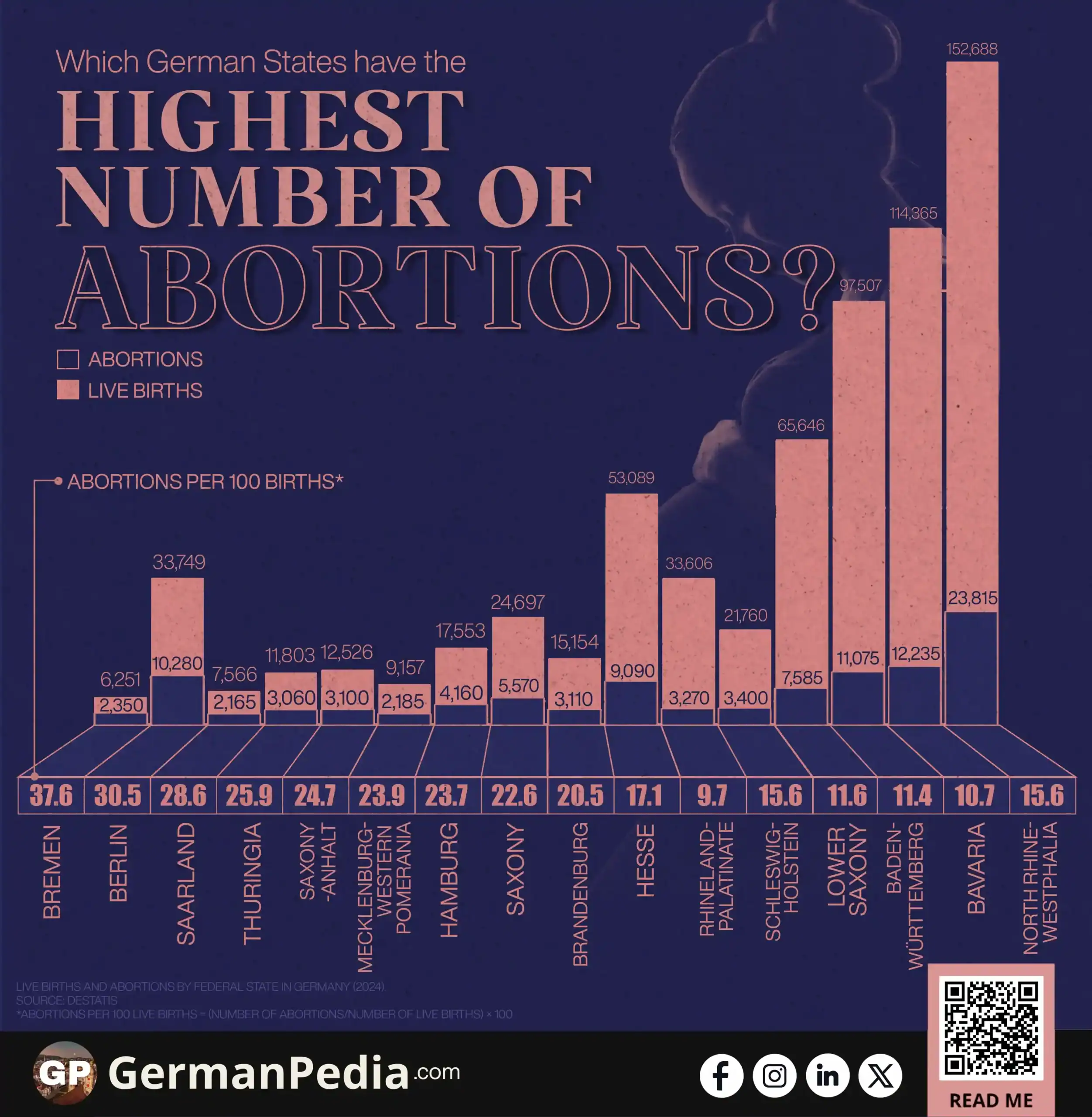
- Germany recorded 106,450 abortions and 676,117 live births in 2024. This equals 15.7 abortions per 100 live births nationwide.
- Abortion ratios vary widely across states. They range from 9.7 per 100 births in Rhineland-Palatinate to 37.6 in Bremen.
- City-states record the highest ratios. Bremen (37.6 abortions per 100 births), Berlin (30.5), and Hamburg (23.7) stand well above the national average.
- Eastern Germany also shows higher abortion ratios than many Western states. Historical policies and healthcare access patterns continue to influence regional differences.
- Southern and southwestern states show the lowest ratios. Baden-Württemberg (11.4), Bavaria (10.7), and Rhineland-Palatinate (9.7) record some of the lowest levels in the country.
Use this Visualization: You may use this image for free with proper attribution to GermanPedia (i.e., by linking back to GermanPedia).
Need help communicating complex ideas visually? We help you turn data into your most persuasive story. Contact us to learn more.
Abortion in Germany is illegal under the criminal code but permitted under specific conditions. A pregnancy may be terminated within the first 12 weeks after conception if the woman receives mandatory counselling and observes a three-day waiting period before the procedure. Abortions are also permitted for medical reasons or in cases of rape, where counselling is not required.
In 2024, Germany recorded 676,117 live births and 106,450 abortions, equivalent to about 15.7 abortions per 100 live births.
Abortions and Live Births by German Federal State
| Federal State | Live Births | Abortions | Abortions per 100 Births* |
|---|---|---|---|
| Bremen | 6,251 | 2,350 | 37.6 |
| Berlin | 33,749 | 10,280 | 30.5 |
| Saarland | 7,566 | 2,165 | 28.6 |
| Thuringia | 11,803 | 3,060 | 25.9 |
| Saxony-Anhalt | 12,526 | 3,100 | 24.7 |
| Mecklenburg-Western Pomerania | 9,157 | 2,185 | 23.9 |
| Hamburg | 17,553 | 4,160 | 23.7 |
| Saxony | 24,697 | 5,570 | 22.6 |
| Brandenburg | 15,154 | 3,110 | 20.5 |
| Hesse | 53,089 | 9,090 | 17.1 |
| North Rhine-Westphalia | 152,688 | 23,815 | 15.6 |
| Schleswig-Holstein | 21,760 | 3,400 | 15.6 |
| Lower Saxony | 65,646 | 7,585 | 11.6 |
| Baden-Württemberg | 97,507 | 11,075 | 11.4 |
| Bavaria | 114,365 | 12,235 | 10.7 |
| Rhineland-Palatinate | 33,606 | 3,270 | 9.7 |
Source: Destatis
*Abortions per 100 live births = (Number of abortions/Number of live births) × 100

City-States Record Highest Abortion Ratios
Germany’s three city-states have some of the highest abortion ratios in the country.
Bremen shows the highest level at 37.6 abortions per 100 live births, followed by Berlin (30.5) and Hamburg (23.7).
Urban demographics help explain this pattern. Large cities tend to have:
- younger populations
- more single-person households
- larger student populations
- lower fertility rates
Why Did Birth Rates Drop in Germany? ->
Urban areas also offer greater access to reproductive healthcare services, including clinics that provide pregnancy termination.
This combination often increases the number of abortions relative to births, even when overall fertility remains relatively low.
East–West Pattern on Abortion Rates
Beyond city-states, the data also shows a noticeable East–West pattern.
Several eastern states rank among the highest abortion ratios in Germany:
- Thuringia – 25.9 abortions per 100 births
- Saxony-Anhalt – 24.7
- Mecklenburg-Western Pomerania – 23.9
- Saxony – 22.6
- Brandenburg – 20.5
Meanwhile, the lowest abortion ratios appear mainly in southern and southwestern Germany, including:
- Rhineland-Palatinate – 9.7 abortions per 100 births
- Bavaria – 10.7
- Baden-Württemberg – 11.4
- Lower Saxony – 11.6
This regional contrast largely reflects two long-term structural factors.
First, history and social attitudes. Before reunification, the former East Germany (GDR) had more liberal abortion laws and strongly encouraged women to join the workforce. This helped make abortion more socially accepted and supported a larger network of providers.
After reunification in 1990, Germany adopted a single legal framework that was largely based on West German law, which was more restrictive. Although attitudes have become more similar over time, eastern states generally remain more accepting of abortion.
Second, differences in healthcare access. Abortion services remain more geographically accessible in parts of eastern and northern Germany than in some western regions, where fewer providers are available. As a result, some people travel to another state to obtain abortion services.
Hospital Capacity Across Germany ->
Together, these factors help explain why eastern states still record higher abortion-to-birth ratios on average, even decades after reunification.
These regional differences illustrate how abortion statistics are shaped not only by individual decisions but also by demographic structure, healthcare access, and long-term institutional history.
More topics
- How Germany’s Birth Rates Dropped and Deaths Rose
- Hospital Capacity Across Germany: A State-by-State Comparison
- Germany’s Median Wage by Federal State
- Life Expectancy in European Countries
- Germans Are Marrying Later Than Ever
- German Population Growth Between 1997 and 2025
- How Marriage Rates Have Fallen in Germany: 1990–2023
- Unemployment Across Germany: A Federal State Breakdown
- Germany’s Smoking Rate Has Declined Over Two Decades
- Why Men Face Higher Cancer Risk in Germany
- Germany’s Average Working Age Is Getting Older
- Top 20 Most Visited Websites in Germany
- Full-time vs Part-time Employment by Industry
- Germany’s Gender Pay Gap in Full-Time Work Falls to 9%
- Germany Athletes with Longest Olympic Careers
References
- https://www-genesis.destatis.de/datenbank/online/statistic/23311/table/23311-0005
- https://www-genesis.destatis.de/datenbank/online/table/12612-0100
- https://pmc.ncbi.nlm.nih.gov/articles/PMC11281759/
- https://www.ssoar.info/ssoar/bitstream/handle/document/74433/ssoar-gebfra-2020-1-hanschmidt_et_al-The_Change_in_Attitudes_Towards.pdf;jsessionid=5AF479429B5A30656A4C59C2D2A45D98?sequence=1
- https://newlinesmag.com/essays/germanys-abortion-debate-is-still-shaped-by-its-east-west-divide/