
Key Takeaways
- In 2024, fully electric cars made up 13.5% of new cars sold in the EU. Hybrid cars made up a bigger share: 26.5% were petrol-hybrids and 3.6% were diesel-hybrids.
- Denmark (51%), Malta (37.7%), Sweden (35%), and the Netherlands (35%) have the highest share of electric cars. This is thanks to tax breaks, easy access to charging stations, and government policies that favor EVs.
- In bigger countries like Germany and France, electric car adoption is slower, even with strong government support. This is mostly because of their size, the challenge of building enough charging stations, and the wide range of driving needs (city driving vs. long road trips).
- Across the EU, hybrid cars are more popular than fully electric ones right now. This shows the shift to cleaner cars is happening, just not through electric cars alone yet.
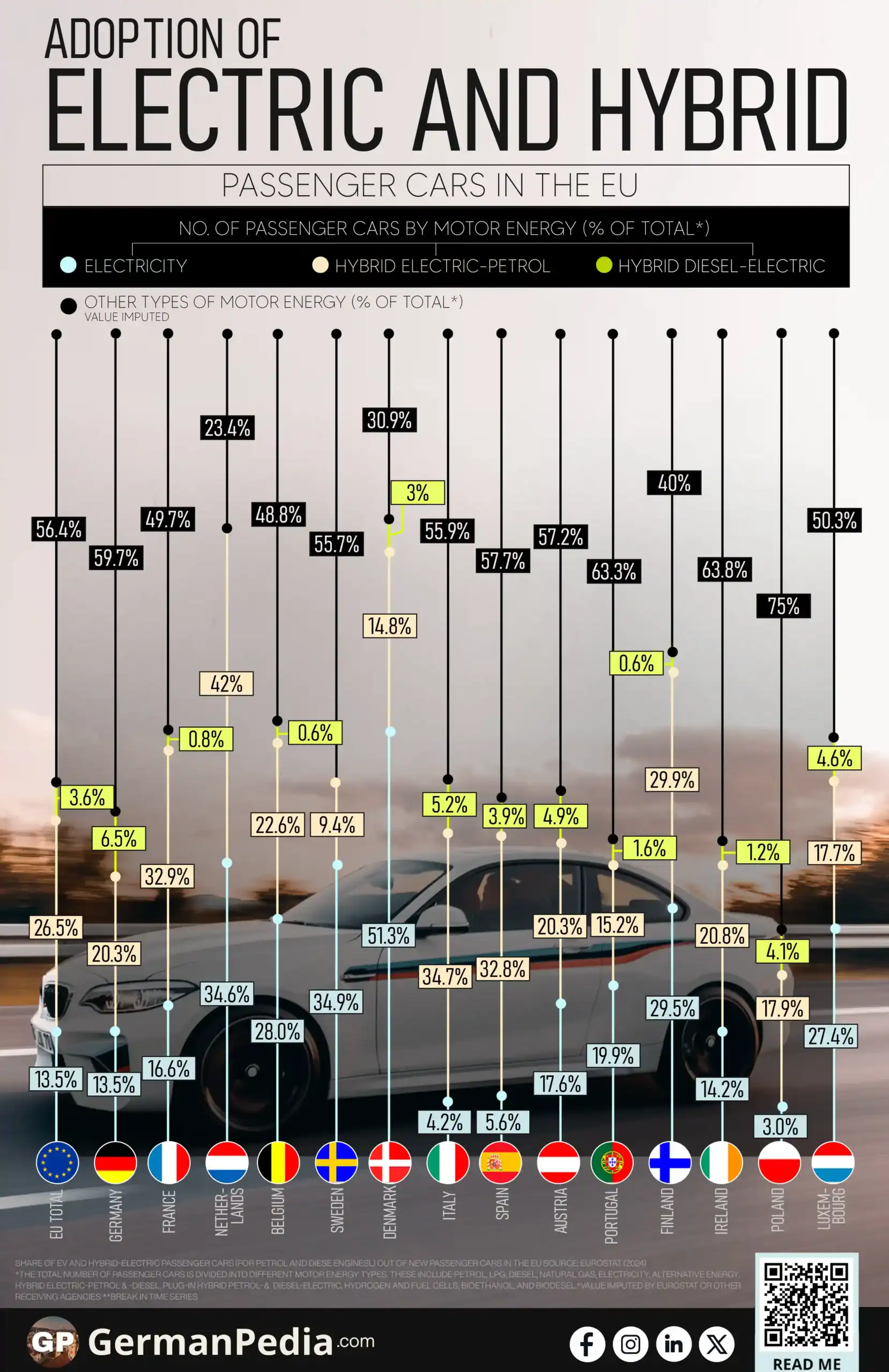
Use this Visualization: You may use this image for free with proper attribution to GermanPedia (i.e., by linking back to GermanPedia).
Need help communicating complex ideas visually? We help you turn data into your most persuasive story. Contact us to learn more.
Across the European Union, the transition toward lower-emission transport is shaped by both market demand and binding EU policy, especially the revised CO2 standards for new cars and vans.
One key rule is Regulation (EU) 2023/851. It says that starting in 2035, every new car and van sold in the EU must produce zero emissions, meaning no exhaust pollution at all.
In 2024, electricity-powered passenger cars accounted for 13.5% of all new passenger cars in the EU. Hybrid electric-powered ones, particularly those with diesel engines, made up a significantly larger share.
This shows that the EU is clearly moving toward cleaner cars, but different countries are getting there in different ways.
Electric and Hybrid-Electric Passenger Cars in the EU
| Country | Total | No. of Passenger Cars by Motor Energy (% of Total*) | ||
|---|---|---|---|---|
| Electricity | Hybrid Electric-Petrol | Hybrid Diesel-Electric | ||
| EU Total | 10,759,959 | 1,455,122 (13.5%) | 2,849,919 (26.5%) | 392,379 (3.6%) |
| Germany | 2,817,331 | 380,609 (13.5%) | 571,488 (20.3%) | 183,998 (6.5%) |
| France | 1,781,580 | 295,053 (16.6%) | 585,851 (32.9%) | 13,871 (0.8%) |
| Netherlands | 381,529 | 132,167 (34.6%) | 160,173 (42.0%) | 0 (0%) |
| Belgium | 456,303* | 127,915*(28.0%) | 103,003**(22.6%) | 2,703** (0.6%) |
| Sweden | 270,744 | 94,546 (34.9%) | 25,414 (9.4%) | 0 (0%) |
| Denmark | 173,461 | 89,058 (51.3%) | 25,631* (14.8%) | 5,150* (3.0%) |
| Italy | 1,592,098 | 66,606 (4.2%) | 553,291* (34.7%) | 82,315* (5.2%) |
| Spain | 1,067,172 | 59,383 (5.6%) | 350,144 (32.8%) | 42,115 (3.9%) |
| Austria | 253,789 | 44,622 (17.6%) | 51,611 (20.3%) | 12,479 (4.9%) |
| Portugal | 210,411 | 41,772 (19.9%) | 31,965 (15.2%) | 3,336 (1.6%) |
| Finland | 74,075 | 21,870 (29.5%) | 22,114 (29.9%) | 411 (0.6%) |
| Ireland | 125,138 | 17,780 (14.2%) | 26,025 (20.8%) | 1,496 (1.2%) |
| Poland | 554,248 | 16,564* (3.0%) | 98,947 (17.9%) | 22,651 (4.1%) |
| Luxembourg | 46,635 | 12,777 (27.4%) | 8,264 (17.7%) | 2,152 (4.6%) |
| Czechia | 217,520 | 10,854 (5.0%) | 2,624* (1.2%) | 229* (0.1%) |
| Romania | 151,105 | 9,795 (6.5%) | 47,943* (31.7%) | 3,725* (2.5%) |
| Greece | 136,984 | 8,708 (6.4%) | 56,254* (41.1%) | 1,561* (1.1%) |
| Hungary | 121,674 | 8,569 (7.0%) | 50,963* (41.9%) | 5,070* (4.2%) |
| Slovenia | 52,533 | 3,154 (6.0%) | 12,479* (23.8%) | 0* (0%) |
| Malta | 7,683 | 2,893 (37.7%) | 1,458 (19.0%) | 70 (0.9%) |
| Slovakia | 91,544 | 2,227* (2.4%) | 23,761* (26.0%) | 4,445* (4.9%) |
| Lithuania | 27,857 | 1,877 (6.7%) | 11,514 (41.3%) | 1,605 (5.8%) |
| Bulgaria | 42,799 | 1,665* (3.9%) | 1,005* (2.3%) | 0* (0%) |
| Estonia | 25,744 | 1,323 (5.1%) | 10,369 (40.3%) | 1,345 (5.2%) |
| Latvia | 17,135 | 1,260 (7.4%) | 6,393 (37.3%) | 1,202 (7.0%) |
| Cyprus | 15,061 | 1,193 (7.9%) | 5,987 (39.8%) | 450 (3.0%) |
| Croatia | 47,806 | 882 (1.8%) | 5,248 (11.0%) | 0* (0%) |
Source: Eurostat (2024)
The total number of passenger cars is divided into different motor energy types. These include petrol, LPG, diesel, natural gas, electricity, alternative energy, hybrid electric-petrol & -diesel, plug-in hybrid petrol- & diesel-electric, hydrogen and fuel cells, bioethanol, and biodesel.
*value imputed by Eurostat or other receiving agencies
**break in time series

In some countries, electric passenger cars now make up a large share of new passenger cars.
- Denmark: 51%
- Malta: 37.7%
- Sweden: 35%
- Netherlands: 35%
These countries share a few things in common that help EVs (electric vehicles) catch on.
The biggest factor is government policy and taxes. In Denmark and the Netherlands, taxes make petrol and diesel cars much more expensive to buy or own, while electric cars get lower taxes and fees. This makes electric cars a better deal financially.
Charging stations matter too. These countries have more charging stations, and more people can charge their cars at home, which makes owning an EV easier day-to-day.
Despite Malta’s small market size (7,683 new passenger cars), its 37.7% share of electricity-powered cars places it among the EU’s leading adopters. This is mainly backed by strong purchase incentives, alongside charging access and policy support.
Across countries of very different sizes, the adoption of electric passenger cars tends to accelerate when cost, infrastructure, and policy incentives align, reducing both the financial and practical barriers to switching.
In bigger countries like Germany and France, the switch to electric is happening more slowly:
- Germany: 13.5% electric
- France: 16.6% electric
Meanwhile, hybrid cars make up a much bigger chunk of new car sales in both countries:
- France: 32.9% hybrid electric-petrol
- Germany: 20.3% hybrid electric-petrol
Both Germany and France support the shift to electric cars through national and EU policies, and both keep expanding their charging networks. But they also have two of the largest and most varied car markets in the EU.
Germany Reintroduced Subsidy on Electric Cars ->
Automotive Brands Lead Germany’s Companies with Biggest Revenue ->
Size makes a real difference. Bigger countries need many more charging stations, and drivers have very different needs, from short city trips to long highway drives. That makes it harder to roll out electric cars evenly everywhere.
So even though Germany and France sell the most electric cars in total numbers, electric cars still make up a smaller percentage of their overall car sales compared to smaller countries.
In both countries, hybrid cars still outsell fully electric ones. This shows that drivers are moving toward cleaner cars, without needing to switch all the way to electric yet.
Farther south and east in the EU, a similar pattern shows up.
In Italy and Spain, electric passenger cars make up a relatively small share of new passenger cars in the EU:
- Italy: 4.2%
- Spain: 5.6%
At the same time, hybrid electric-petrol passenger cars account for a much larger share:
- Italy: 34.7%
- Spain: 32.8%
Across the EU, the shift to cleaner cars is clearly happening, but not the same way everywhere.
In some countries, adoption is moving quickly toward fully electric passenger cars. In others, hybrid-electric ones make up a larger share of new passenger cars, indicating a more gradual change in the new-car market.
Rather than one single switch from petrol or diesel straight to electric, the real picture is a mix: different types of cleaner cars are cutting emissions at different speeds, depending on the country.
More topics
- Germany’s Top 8 Most Valuable Brands
- Germany’s Top Car Brands by New Registrations
- Top German Companies by Revenue
- Top 20 Largest Employers in Berlin
- Bilateral Support to Ukraine Reached €342 Billion
- Heavy Armour Support to Ukraine is Led by a Few Countries
- Germany’s Public Workforce: How Functions Shape Work
- Fuel Price Changes in Germany Amid US-Iran Tensions
- Petrol Prices Are Rising Across the EU
- Most Surveilled Major Cities in the EU
- Environmental Impact of AI Websites in Germany
- Ukraine War Casualties Reach 1.8 Million After Four Years
- Environmental Impact of AI Websites in Germany
- Where are Billionaires Concentrated in the EU?
- EU Unicorn Startups: Which Countries Lead and Why
References
- https://ec.europa.eu/eurostat/databrowser/view/road_eqr_carpda__custom_20997507/default/table?page=time:2024
- https://theicct.org/publication/ev-transition-check-sep25/
- https://climate.ec.europa.eu/eu-action/transport-decarbonisation/road-transport/cars-and-vans_en
- https://theicct.org/publication/europes-ev-market-leaders-denmark-sweden-and-finland-aug25/
- https://alternative-fuels-observatory.ec.europa.eu/transport-mode/road/malta/incentives-legislations
- https://meetinc.com.mt/news/malta-ranks-second-in-eu-for-electric-car-uptake-in-2024-despite-eu-wide-drop/
- https://globalnation.inquirer.net/307190/hybrid-cars-now-the-top-choice-for-consumers-in-europe-in-2025