
Key Takeaways
- Germany’s national share of children under 3 in Kita or childcare stands at 37.8%. State rates range from 31.3% in Bremen to 60.5% in Mecklenburg-Vorpommern.
- Eastern German states average 54.9% for children under 3 in Kita or childcare. Western states average 34.5%.
- All five highest-ranked states for under-3 Kita and childcare are in the east. All five lowest-ranked are in the west.
- The under-3 divide traces to childcare policy before reunification. By 1988, 80% of East German children under 3 attended a state nursery, compared to 3% in West Germany.
- About 300,000 children under 3 in western Germany had no Kita place in 2025 despite their families wanting one. Western states never built enough facilities or staff to meet that demand.
- For children aged 3 to 6, the east-west gap nearly disappears. All 16 states report a share between 86.6% and 100.8%. The national average is 95%.
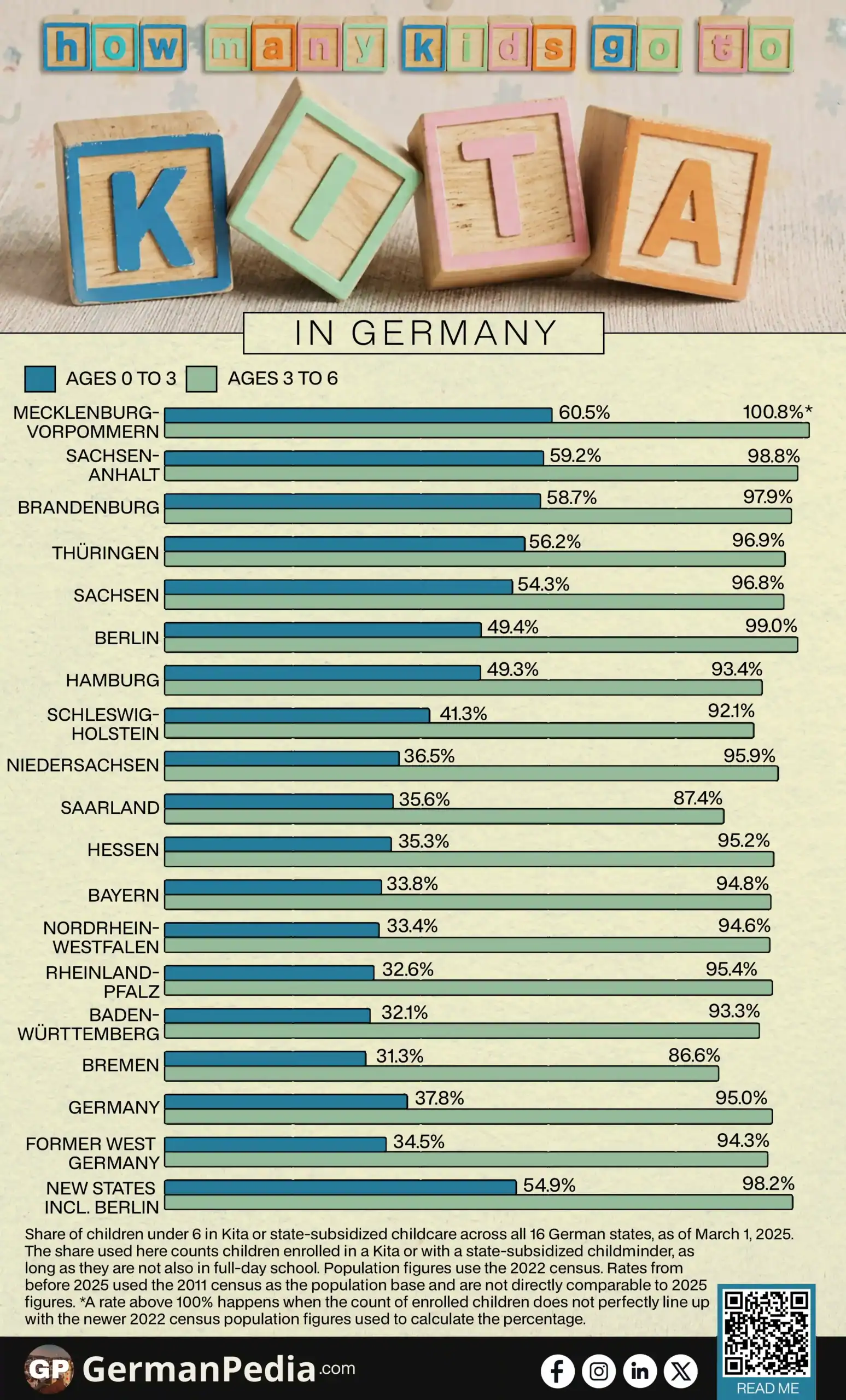
Use this Visualization: You may use this image for free with proper attribution to GermanPedia (i.e., by linking back to GermanPedia).
Need help communicating complex ideas visually? We help you turn data into your most persuasive story. Contact us to learn more.
Share of Children in Kita or Childcare, by Age and State
| Federal State | % of Kids in Kita or Childcare (per age group) | |
|---|---|---|
| Ages 0 to 3 | Ages 3 to 6 | |
| Mecklenburg-Vorpommern | 60.5 | 100.8* |
| Sachsen-Anhalt | 59.2 | 98.8 |
| Brandenburg | 58.7 | 97.9 |
| Thüringen | 56.2 | 96.9 |
| Sachsen | 54.3 | 96.8 |
| Berlin | 49.4 | 99.0 |
| Hamburg | 49.3 | 93.4 |
| Schleswig-Holstein | 41.3 | 92.1 |
| Niedersachsen | 36.5 | 95.9 |
| Saarland | 35.6 | 87.4 |
| Hessen | 35.3 | 95.2 |
| Bayern | 33.8 | 94.8 |
| Nordrhein-Westfalen | 33.4 | 94.6 |
| Rheinland-Pfalz | 32.6 | 95.4 |
| Baden-Württemberg | 32.1 | 93.3 |
| Bremen | 31.3 | 86.6 |
| Germany | 37.8 | 95.0 |
| Former West Germany | 34.5 | 94.3 |
| New states incl. Berlin | 54.9 | 98.2 |
Source: Destatis
The share used here counts children enrolled in a Kita or with a state-subsidized childminder, as long as they are not also in full-day school. Population figures use the 2022 census. Rates from before 2025 used the 2011 census as the population base and are not directly comparable to 2025 figures.
*A rate above 100% happens when the count of enrolled children does not perfectly line up with the newer 2022 census population figures used to calculate the percentage.

Kitas are Germany’s publicly funded daycare centres for children from birth to age 6. They provide early childhood care and education before children enter primary school.
Is Your Child Ready For School In Germany? ->
Germany’s national share of children under 3 in Kita or childcare is 37.8% as of March 2025. That figure conceals a wide divide.
Bremen has 31.3% of its children under 3 in Kita or childcare. Mecklenburg-Vorpommern enrolls 60.5% of its under-3s. Both states operate under the same federal law that guarantees every child over age one a Kita place. The difference traces to a policy split that began decades before reunification and has never fully closed.
The former eastern states average 54.9% for under-3 Kita and childcare. That includes Berlin. The former western states average 34.5%.
The five highest-ranked states are all eastern:
- Mecklenburg-Vorpommern: 60.5%
- Sachsen-Anhalt: 59.2%
- Brandenburg: 58.7%
- Thüringen: 56.2%
- Sachsen: 54.3%
The five lowest-ranked states are all western:
- Bremen: 31.3%
- Baden-Württemberg: 32.1%
- Rheinland-Pfalz: 32.6%
- Nordrhein-Westfalen: 33.4%
- Bayern: 33.8%
The regional divide in Kita and childcare enrollment traces to a policy split formalised in 1949. This was when East and West Germany became separate states. East Germany, then known as the GDR, promoted full-time employment for mothers.
It built a network of publicly funded nurseries for children under 3. These nurseries are known as Krippen. By 1988, 80% of East German children in that age group attended one. In West Germany that year, the rate was 3%.
West Germany took the opposite approach. It extended parental leave to three years. The policy encouraged mothers to remain at home with young children rather than return to work.
Reunification in 1990 brought both systems under a single legal framework. It did not close the infrastructure gap. Eastern states had the facilities, the staff, and the cultural norm of placing children in care from early infancy. Western states did not.
The gap is visible in the numbers today. As of 2025, around 300,000 children under 3 in western Germany are without a Kita place despite their families wanting one. The shortfall exists because western states never built enough facilities or trained enough staff to meet demand.
The east-west gap in Kita and childcare enrollment nearly disappears for children aged 3 to 6. All 16 German states report a share between 86.6% and 100.8%. The national average is 95%.
Bremen ranks lowest at 86.6%. Saarland ranks second-lowest at 87.4%. Both are western states. Even those figures sit far above what western states provide for the under-3 group.
The structural inequality in German childcare is age-specific. Once children turn 3, the east-west divide effectively disappears.
More topics
- Household Debt Rose in Most EU Countries Over Time
- GDP per Capita vs Actual Consumption per Capita in the EU
- Which EU Country Has the Highest Trade-to-GDP Ratio?
- GDP of European Countries
- Which EU Countries Attract the Most Foreign Investment?
- Gender Pay Gap Across EU Countries
- Which EU Country Has the Highest Cost of Living?
- EU Household Expenditure on Food and Non-Alcoholic Beverages
- EU Rent Price Index by Country Over Time
- Grocery Prices in Germany [2000 – 2025]
- Which EU Countries Had the Highest Inflation Rates?
- Minimum Wages Rose Fastest in Eastern Europe
- Which EU Countries Have the Highest Unemployment?
- The Best EU Countries to Retire In
- Most Prosperous EU Countries by Prosperity Index
References
- https://www.destatis.de/DE/Themen/Gesellschaft-Umwelt/Soziales/Kindertagesbetreuung/Tabellen/betreuungsquote.html
- https://www.lieselotte-ahnert.de/files/32/eastwestgermancomp.pdf
- https://blogs.lse.ac.uk/businessreview/2018/04/19/the-tale-of-two-germanies-highlights-how-childcare-provision-benefits-women/
- https://www.iwkoeln.de/en/studies/wido-geis-thoene-an-examination-of-the-development-of-the-number-of-childcare-places-available-and-the-demand-for-them.html